Learning to Let Go of Things You Cannot Control
Written by
on
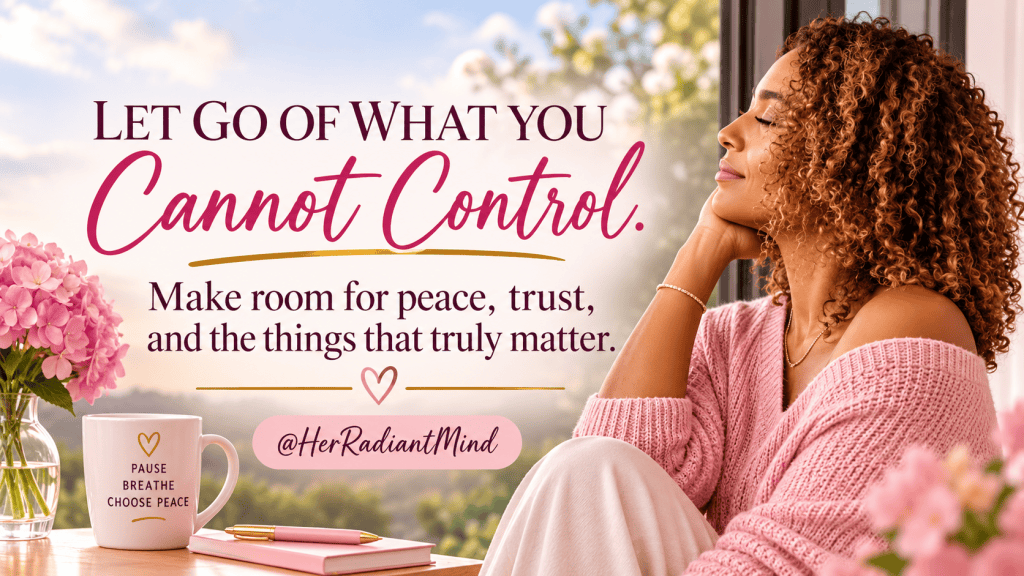
Have you ever felt exhausted from thinking about something you have absolutely no control over?
Perhaps you’ve replayed a conversation in your mind, wondering whether you should have said something differently. Maybe you’re waiting for someone to make a decision, worrying about how a situation will unfold, or trying to anticipate every possible outcome so nothing catches you off guard.
You tell yourself to stop worrying, but your mind keeps going.
You think about what could happen, what might go wrong, and what you would do if things don’t turn out the way you hoped.
And somewhere beneath all those thoughts is a desire for one thing: certainty.
You want to know that everything will be okay. You want reassurance that the people you care about will make the right decisions. You want your plans to work out and your efforts to lead somewhere meaningful.
But life doesn’t always offer that kind of certainty.
As November unfolds and another year approaches its end, you may find yourself reflecting on unfinished plans, unexpected changes, and situations that still haven’t worked themselves out.
Perhaps you’ve spent too much time worrying about what you cannot change and not enough time enjoying the moments that are already here.
If that sounds familiar, here’s a gentle reminder:
You don’t have to control everything to find peace within yourself.
Sometimes, the most empowering thing you can do is recognize what is within your control, release what isn’t, and learn to trust yourself through whatever comes next.
Because letting go isn’t about caring less. It’s about learning to stop exhausting yourself trying to manage what was never yours to control.
Why Letting Go Can Feel So Difficult
Letting go sounds simple until you’re emotionally invested in the outcome.
When you care deeply about something or someone, uncertainty can feel uncomfortable. You want to protect what matters to you, avoid disappointment, and make sure things turn out as expected.
So you start trying to anticipate every possibility.
You replay conversations, analyze people’s behaviour, plan for every scenario, and search for reassurance that everything will work out.
Sometimes, you convince yourself that if you think about a situation long enough, you’ll eventually find the answer.
But here’s the problem: Not everything in life can be figured out through more thinking.
Research on uncertainty and psychological well-being suggests that difficulty tolerating uncertainty can contribute to worry and emotional distress.[1][2]
This helps explain why situations outside our control can occupy so much mental space.
When we don’t know what will happen, our minds may try to fill in the gaps with possibilities, assumptions, and worst-case scenarios.
We begin preparing for things that haven’t happened and worrying about outcomes that may never occur.
Before we realize it, we’re emotionally exhausted from living through situations that exist primarily in our imagination.
And while planning and preparation can be helpful, constantly trying to predict the future can leave very little room to experience the present.
Letting go begins when you recognize that uncertainty is part of life and that you don’t have to solve every unknown before allowing yourself to feel okay.
The Difference Between Caring and Trying to Control Everything
One of the biggest misconceptions about letting go is that it means becoming indifferent.
It doesn’t.
You can care deeply about your family without controlling every decision they make.
You can work toward your goals without demanding that everything happen according to your timeline.
You can love someone without taking responsibility for their emotions.
You can prepare for the future without allowing fear of the unknown to consume your present.
The difference lies in understanding what belongs to you and what doesn’t.
For example:
You can control:
- How you respond to challenging situations.
- The boundaries you establish.
- The effort you put into your goals.
- The decisions you make.
- How you care for your emotional well-being.
- Whether you seek support when you need it.
You cannot fully control:
- Other people’s opinions or reactions.
- Whether someone understands your perspective.
- How quickly opportunities come your way.
- Other people’s decisions and behaviour.
- Unexpected changes or circumstances.
- Every outcome, regardless of how carefully you plan.
Sometimes, we become so focused on trying to influence things outside our control that we overlook the choices available to us.
You cannot make someone appreciate your efforts, but you can decide how much of yourself you’re willing to give.
You cannot guarantee that an opportunity will work out, but you can prepare, show up, and remain open to other possibilities.
You cannot control every challenge that comes your way, but you can choose how you respond and where you seek support.
Your power isn’t in controlling every outcome. It’s in learning how to respond without losing yourself in the process.
The Hidden Cost of Trying to Control Everything
Constantly trying to manage what happens around you can become emotionally exhausting.
You may find yourself:
- Overthinking conversations long after they’ve ended.
- Feeling responsible for keeping everyone happy.
- Struggling to relax when something remains unresolved.
- Constantly checking for updates or reassurance.
- Feeling disappointed when things don’t go according to plan.
- Finding it difficult to enjoy the present because you’re worried about the future.
Sometimes, the need to control everything comes from a genuine desire to prevent disappointment or protect yourself from uncertainty.
But the more energy you spend trying to manage things outside your influence, the less energy you have available for your own well-being.
Think about how much mental space you could reclaim if you stopped trying to figure out what everyone else was thinking.
Imagine how much lighter your days might feel if you allowed yourself to leave some questions unanswered.
What if you didn’t need to know exactly how everything would unfold before you could enjoy today?
Letting go creates room for something important: the ability to participate in your life without constantly fighting what you cannot change.
A Gentle Story About Learning to Let Go
Imagine a woman named Leila.
Leila has been waiting to hear back about a job opportunity she genuinely wants.
She prepared for the interview, researched the organization, and did her best to communicate her experience and qualifications.
After the interview, she sent a thank-you message and waited.
Initially, she felt hopeful.
But as the days passed without an update, her thoughts began taking over.
She kept checking her email, replaying the interview, and wondering whether she had answered certain questions correctly.
She started imagining what it would mean if she didn’t get the position.
Would she ever find the right opportunity? Had she said something that ruined her chances? Should she have followed up again?
Before long, she was spending more time worrying about the outcome than focusing on her everyday life.
One evening, Leila decided to pause and ask herself two questions:
What am I trying to control?
And:
What can I actually do right now?
She realized she couldn’t control the hiring manager’s decision, the company’s timeline, or the other candidates.
But she could control how she spent her time while waiting.
She could continue exploring other opportunities, give herself permission to rest, and stop treating an unanswered email as a reflection of her worth.
She still wanted the job. She still felt uncertain.
But she began reminding herself:
I’ve done my part. I don’t have to force the outcome.
That small shift helped her redirect her attention toward the parts of her life that were still within her control.
Leila’s experience reminds us that letting go doesn’t always mean no longer wanting something.
Sometimes, it simply means learning to want something without allowing the uncertainty surrounding it to consume you.
6 Gentle Ways to Let Go of What You Cannot Control
Letting go is a practice. It requires patience, self-awareness, and a willingness to respond differently when uncertainty begins taking up too much mental space.
Here are six gentle ways to begin.
1. Identify What Is Actually Within Your Control
When something is weighing heavily on your mind, take a moment to separate what you can influence from what you cannot.
This simple exercise can help you recognize where your energy is best spent.
For example, if you’re worried about an upcoming conversation, you cannot control how the other person will respond.
But you can control how you prepare, what you communicate, and the boundaries you maintain.
If you’re worried about your future, you cannot predict every opportunity or challenge.
But you can take small steps toward the life you want to create.
Ask yourself:
- What part of this situation can I influence?
- What action is available to me right now?
- What am I trying to manage that isn’t mine to manage?
You may discover that there is something meaningful you can do, even if you cannot control the final outcome.
The goal isn’t to become passive. It’s to direct your energy toward actions that actually make a difference.
2. Stop Replaying What You Cannot Change
Have you ever replayed a conversation so many times that you began questioning things you hadn’t even considered before?
Perhaps you wish you had spoken up, explained yourself differently, or responded with more confidence.
Reflecting on an experience can help you learn, but repeatedly revisiting the same moment can become emotionally draining.
Instead of asking yourself what you should have done differently over and over, try asking:
What can I learn from this experience, and what would I like to do differently next time?
Once you’ve identified the lesson, gently bring your attention back to the present.
Remind yourself:
I cannot change that moment, but I can choose how I move forward.
You deserve to experience today without continually reliving yesterday.
3. Give Yourself Permission to Sit With Uncertainty
Sometimes, the hardest part of letting go is accepting that you don’t know what will happen next.
You want an answer. You want reassurance. You want to know that the decision you’re making will lead to the outcome you’re hoping for.
But not every situation comes with immediate clarity.
And that’s okay.
You can be uncertain and still take care of yourself.
You can feel nervous and still move forward.
You can wait for an answer without putting your entire life on hold.
When uncertainty feels overwhelming, try reminding yourself:
I don’t have all the answers right now, but I can trust myself to respond to whatever comes.
This doesn’t guarantee that everything will work out perfectly.
It reminds you that you don’t need to predict every outcome to have confidence in your ability to navigate life.
Learning to tolerate uncertainty is an important part of building emotional resilience.[2][3]
4. Stop Taking Responsibility for Everyone Else’s Emotions
This one can be particularly difficult for women who have spent years being the dependable one.
Perhaps you’re accustomed to keeping the peace, anticipating everyone’s needs, and making sure the people around you are comfortable.
You may find yourself adjusting your decisions to avoid disappointing someone, explaining yourself repeatedly, or feeling guilty whenever someone is unhappy with you.
But here’s something worth remembering:
You can care about someone’s feelings without making yourself responsible for managing them.
You are allowed to establish boundaries.
You are allowed to disagree.
You are allowed to make decisions that support your well-being, even when someone else doesn’t understand them.
You cannot control how another person interprets your choices.
You can, however, communicate honestly, act with respect, and remain grounded in your values.
You don’t have to abandon yourself to keep everyone else comfortable.
5. Bring Your Attention Back to the Present
When your mind is constantly focused on what might happen tomorrow, it becomes difficult to appreciate what is happening today.
You may be physically present but mentally somewhere else, worrying about a conversation, a financial decision, a relationship, or an uncertain future.
Mindfulness can help you gently reconnect with the present moment.
You don’t need an elaborate routine.
Try this simple practice:
- Pause whatever you’re doing.
- Take three slow, comfortable breaths.
- Relax your shoulders.
- Notice your feet resting on the floor.
- Identify three things you can see around you.
- Ask yourself, “What needs my attention right now?”
You might discover that the situation you’re worrying about doesn’t require an immediate response.
Perhaps what you need in that moment is a little rest, a glass of water, a walk outside, or simply a few minutes without your phone.
The present moment may not contain all the answers, but it is the only place where you can take meaningful action.
6. Release the Need for Everything to Happen on Your Timeline
Sometimes, what makes letting go difficult isn’t just the uncertainty. It’s the disappointment of realizing that life isn’t unfolding according to the schedule you imagined.
You thought you would have achieved certain goals by now.
You expected a relationship to progress differently.
You imagined your career, finances, or personal circumstances would look a particular way.
And when things take longer than expected, frustration can turn into self-doubt.
But life doesn’t always follow our preferred timeline.
Some opportunities take longer to develop. Some goals require a change in direction. Some seasons involve more waiting, learning, and rebuilding than we anticipated.
Instead of treating every delay as a personal failure, consider what this season might be asking of you.
Perhaps you need more preparation.
Perhaps your priorities have changed.
Perhaps you need to release an expectation that no longer reflects what you genuinely want.
You can remain committed to your dreams without demanding that everything happen immediately.
Your timeline doesn’t have to be perfect for your life to be meaningful.
What to Do When You Find Yourself Overthinking Again
Letting go doesn’t mean you’ll never worry again.
There will be moments when old patterns return, uncertainty feels uncomfortable, or you find yourself trying to control a situation all over again.
Rather than criticizing yourself, recognize what’s happening and gently redirect your attention.
Try this simple three-step reset:
Pause: Notice when your thoughts begin going in circles.
Separate: Ask yourself what is within your control and what isn’t.
Redirect: Choose one small action that supports your well-being in the present moment.
For example, if you’re repeatedly checking your phone while waiting for an important message, consider putting it away for an hour and doing something meaningful with your time.
If you’re replaying a difficult conversation, write down what you learned and what you would like to communicate differently next time.
If you’re worrying about something that hasn’t happened, bring your attention back to what you actually know rather than what you’re imagining.
You don’t have to fight every thought.
Sometimes, you simply need to recognize that a thought doesn’t require your continued attention.
A Gentler Way to End the Year
As November moves toward December, you may feel tempted to evaluate everything that happened this year.
You might focus on the goals you didn’t accomplish, the plans that changed, and the situations that remain unresolved.
But what if you approached the end of this year differently?
What if, instead of trying to tie every loose end together, you gave yourself permission to release some of the pressure?
You don’t have to resolve every disagreement.
You don’t have to understand every disappointment.
You don’t have to know exactly what next year will bring.
And you certainly don’t have to carry every unanswered question into January.
Perhaps this season is an opportunity to reflect on what deserves your attention and what you’ve been holding on to unnecessarily.
You can take responsibility for your choices without trying to control everyone else’s.
You can make plans while remaining open to change.
You can hope for beautiful things without demanding that life unfold exactly as you imagined.
Most importantly, you can begin prioritizing your peace without feeling guilty about it.
A Moment of Reflection 🌸
Before the year comes to a close, take a few quiet moments to reflect on these questions:
- What situation, relationship, or outcome have I been trying too hard to control?
- What part of this situation is genuinely within my influence?
- What am I afraid might happen if I loosen my grip?
- Where in my life do I need to establish healthier boundaries?
- What would choosing peace look like for me right now?
You might find it helpful to write down your answers in a journal.
Don’t rush through them. Allow yourself to be honest about what you’re feeling and what you need.
Sometimes, the clarity we are searching for begins when we stop trying to force an answer.
You Can Care Deeply and Still Let Go
Perhaps one of the most important lessons in personal growth is learning that you can care deeply about something without carrying the responsibility for every possible outcome.
You can love people without controlling their decisions.
You can work toward meaningful goals without becoming consumed by the timeline.
You can prepare for the future without sacrificing the peace available to you today.
And you can acknowledge that some things are outside your control without feeling powerless.
Letting go isn’t about giving up on life.
It’s about recognizing where your energy belongs and learning to use it more intentionally.
As you move into a new season, remember that you don’t need to have every detail figured out to feel hopeful about what’s ahead.
You don’t need to anticipate every challenge to trust yourself.
And you don’t need to carry the weight of everything and everyone around you to prove how much you care.
Sometimes, the most meaningful act of self-care is allowing yourself to put down what was never yours to carry.
Take a breath.
Release what you cannot change.
Focus on what you can.
And give yourself permission to experience a little more peace along the way.
You cannot control every chapter of your life, but you can choose how you show up for yourself as the story unfolds.
And that is a powerful place to begin.
Emotional resilience isn’t about having everything figured out or remaining strong through every difficult moment.
It’s about learning to trust yourself, honour your needs, establish healthy boundaries, and navigate life’s uncertainties without losing connection with who you are.
You deserve a life where peace isn’t something you constantly postpone until everything falls into place.
Give yourself permission to slow down, release unnecessary pressure, and reconnect with the strength that already exists within you.
You don’t have to control everything to create a life that feels more peaceful, meaningful, and fulfilling.
If you’ve been nodding along, it’s time to take the next step. The Radiant Reset is my 12-week coaching program designed to help women just like you reclaim energy, confidence, and resilience.
Thank you for spending this time with me.
Remember—healing is not linear, and growth doesn’t have to be loud to be powerful.
Keep choosing yourself, one gentle moment at a time.💖
Until next time, stay radiant and take tender care of your beautiful mind and body.
With love,
— Christabel, HerRadiantMind
Stay Radiant-Subscribe!
Discover more from herradiantmind
Subscribe to get the latest posts sent to your email.
Comments
Response
-
This really speaks to me. I’m learning that not everything is within my control, and that’s okay. Sometimes, peace comes from doing my best, letting go of the worries, and trusting that everything will work itself out in the end. Thank you for this beautiful and timely reminder. 💖🌺
LikeLike


Leave a Comment