Tag: mindset shift

  • Inner Rebranding: Letting Go of Outdated Versions of Yourself

    Inner Rebranding: Letting Go of Outdated Versions of Yourself

    There comes a quiet moment in life when you pause and think,

    “Wait… who am I even trying to be anymore?”

    Not in a dramatic, movie-scene kind of way.

    More like a random Tuesday washing dishes, scrolling your phone, or catching your reflection after a long day.

    You feel it in your chest.

    A subtle tug.

    The version of you that once fit so comfortably now feels misaligned.

    Like wearing shoes you used to love, but now they just hurt.

    That is inner rebranding.

    It’s the courageous act of letting go of outdated versions of yourself so you can grow into the woman you are becoming.

    Not the one you were told to be.

    Not the one who survived by being “easy,” “strong,” “perfect,” or “small.”

    But the one who is real now.

    And yes—it can feel uncomfortable. Even scary.

    Because changing your life externally is one thing…

    Changing your internal identity is something else entirely.

    What Inner Rebranding Really Means

    Inner rebranding isn’t about becoming fake, polished, or perfect.

    It’s not a personality makeover for appearances.

    It’s deeper than that.

    It’s about updating:

    • the way you see yourself
    • the way you speak to yourself
    • the way you move through the world

    It’s noticing when an old version of you is still in control…

    even though she was built for a life you no longer live.

    Maybe she was:

    • the people-pleaser who kept everyone happy
    • the overworker who believed rest had to be earned
    • the quiet one who learned speaking up was “too much”
    • the achiever who tied worth to performance

    That version of you wasn’t wrong.

    She helped you survive.

    But survival is not the same as living.

    Inner rebranding is choosing to stop dragging old coping mechanisms into a new season—and making space for a version of you that feels softer, safer, stronger, and more honest.

    Why Outdated Versions Stick Around

    Ever wondered,

    “Why do I keep doing this even though I know better?”

    You’re not alone.

    Your brain is wired for familiarity—even when familiarity isn’t healthy.

    Through a process called neuroplasticity, your brain builds pathways based on repetition. The more you think or behave a certain way, the more automatic it becomes.

    So if you spent years:

    • staying quiet
    • fixing everyone’s problems
    • chasing perfection

    Your brain learned:

    “This is how we stay safe.”

    That’s why growth feels uncomfortable.

    You’re not just changing behavior—

    you’re asking your brain to let go of an old map.

    And the brain? It doesn’t give those up easily.

    4 Signs You’re Ready for a New Version of You

    You don’t need a life crisis to begin.

    Often, the signs are quiet.

    1. Your old role feels heavy

    What once felt normal now feels exhausting.

    2. You’re outgrowing your own life

    Your habits, routines, or even relationships no longer feel aligned.

    3. You feel guilty for changing

    Like evolving means disappointing others.

    4. You’re craving something deeper

    Not more noise—more truth, peace, and alignment.

    That craving?

    It’s your inner self whispering:

    “We’re ready.”

    The Grief No One Talks About

    Letting go of who you used to be can feel… emotional.

    Sometimes even like a quiet kind of grief.

    Because you’re not just releasing habits.

    You’re releasing an identity.

    A version of you that:

    • kept you safe
    • helped you feel accepted
    • protected you in ways you needed

    So yes—you may grieve:

    • the comfort of being liked
    • the safety of predictability
    • the identity built around being needed

    This doesn’t mean you’re going backward.

    It means you’re being honest.

    And honesty is part of healing.

    How Identity Gets Stuck

    Here’s the truth:

    You are not your:

    • overthinking
    • perfectionism
    • fear of rejection
    • people-pleasing

    Those are patterns, not your identity.

    But when patterns repeat long enough, they feel like who you are.

    That’s when we say things like:

    “That’s just how I am.”

    But often, what we really mean is:

    “That’s how I learned to survive.”

    Inner rebranding asks a powerful question:

    What if this isn’t who I am…

    but who I had to be?

    The Science of Change

    Your brain is always learning.

    Every time you:

    • choose a new response
    • interrupt an old pattern
    • speak to yourself differently

    You create a new neural pathway.

    But here’s the key:

    change happens through repetition, not pressure.

    Not one big moment—

    but small, consistent shifts:

    • pausing before saying yes
    • resting without guilt
    • speaking kindly to yourself
    • choosing honesty over comfort

    Research also shows that self-compassion reduces stress and increases emotional resilience.

    So no—being hard on yourself won’t speed up growth.

    It actually slows it down.

    What You May Need to Let Go Of

    Sometimes it’s not people you need to release—

    it’s the version of you that keeps showing up.

    Maybe it’s:

    • The overgiver — always pouring from an empty cup
    • The perfectionist — afraid to get it wrong
    • The silent one — afraid to take up space
    • The “strong” one — who never rests
    • The chameleon — who adapts to everyone else

    If this resonates, pause.

    That discomfort?

    It’s awareness.

    And awareness is the first step toward change.

    How to Begin Inner Rebranding

    You don’t need to reinvent your life overnight.

    Start small. Start gently.

    1. Name the old version

    Be honest:

    “I’m letting go of the part of me that thinks love must be earned.”

    2. Notice your triggers

    When do you shrink? Overgive? Overthink?

    Those moments are clues.

    3. Choose one new response

    Try:

    • “Let me think about it” instead of yes
    • pausing instead of apologizing
    • self-compassion instead of criticism

    4. Let your body catch up

    Growth isn’t just mental—it’s physical.

    New ways of being can feel unfamiliar.

    That doesn’t mean they’re wrong.

    It means you’re learning.

    Inner Rebranding in Real Life

    Picture this:

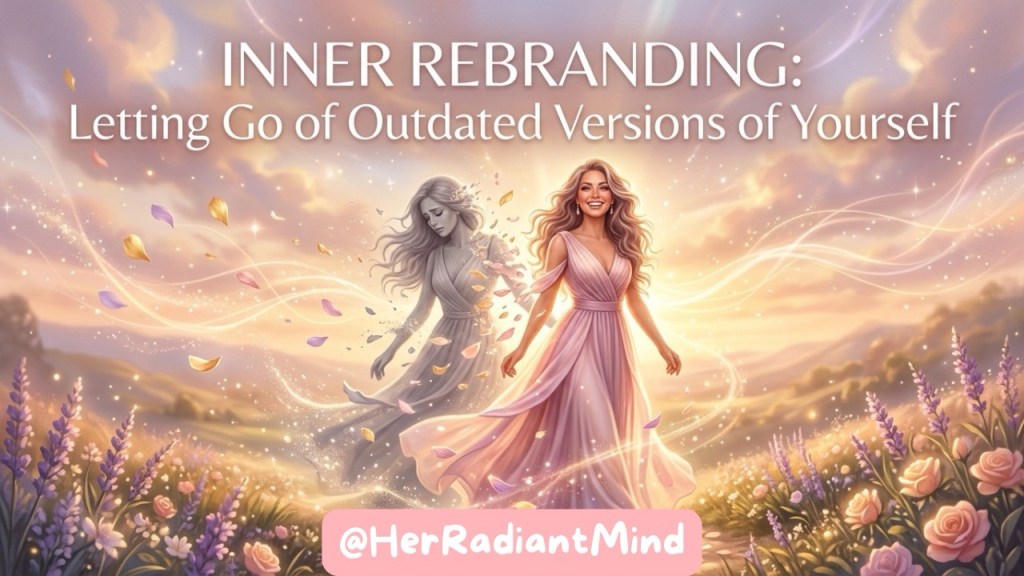
    Two versions of you walk into the same room.

    The old version scans for approval.

    She wonders who’s judging her.

    The new version?

    She enters grounded. Present. Honest.

    She doesn’t perform.

    Same room.

    Different energy.

    That’s inner rebranding.

    The Role of Self-Trust

    To evolve, you need to trust yourself.

    And self-trust is built through small promises:

    • “I won’t ignore my needs.”
    • “I’ll rest before I burn out.”
    • “I’ll speak truth with kindness.”

    Every time you follow through, you reinforce:

    “I’ve got me.”

    What Happens When You Don’t Let Go

    Holding onto an outdated identity can feel… heavy.

    You might feel:

    • stuck
    • resentful
    • emotionally drained
    • disconnected

    Like something is missing.

    Because something is:

    you.

    What You Gain When You Release

    When you let go, you make space for:

    • peace
    • clarity
    • boundaries
    • deeper relationships
    • emotional freedom

    You gain permission to be:

    • evolving
    • imperfect
    • real

    And that’s where true freedom lives.

    A Gentle Truth to Hold Onto

    You don’t have to hate who you used to be to outgrow her.

    She helped you survive.

    But she doesn’t get to lead your future.

    You can honor her…

    and still release her.

    That’s not betrayal.

    That’s growth.

    Final Thoughts

    Inner rebranding isn’t about becoming someone new.

    It’s about coming home to who you’ve been all along—

    beneath the expectations, the pressure, and the noise.

    It’s about gently releasing what no longer fits…

    and stepping into what does.

    You are allowed to:

    • change
    • evolve
    • outgrow old versions of yourself

    And if you’re standing in that in-between space right now…

    this is your sign.

    You don’t have to navigate it alone.

    Ready to Begin Your Inner Rebrand?

    At HerRadiantMind, I help women release old patterns, rebuild self-trust, and step into a more grounded, confident, and radiant version of themselves.

    If this spoke to your heart, consider this your invitation to take the next step.

    Your next chapter isn’t waiting for you to be perfect.

    It’s waiting for you to be real.

    Thank you for spending this time with me.

    Remember—healing is not linear, and growth doesn’t have to be loud to be powerful.

    Keep choosing yourself, one gentle moment at a time.💖

    Until next time, stay radiant and take tender care of your beautiful mind and body.

    With love,

    — Christabel, HerRadiantMind
  • How to Build Self-Trust and Stop Second-Guessing Yourself

    How to Build Self-Trust and Stop Second-Guessing Yourself

    Picture this: you’re standing at the edge of a diving board. Your heart is pounding. The water below looks calm, even inviting — but that small voice in your head starts whispering:

    What if you belly flop? What if everyone laughs?

    So you hesitate.

    You overthink.

    And sometimes… you climb back down without ever jumping.

    Sound familiar?

    That moment — the pause between your intuition and your fear — is where second-guessing quietly steals pieces of your life. Opportunities, confidence, and even joy can slip away while you wait for perfect certainty.

    But here’s the truth:

    Self-trust is not something you’re born with.

    It’s something you build.

    And once you begin strengthening it, decisions that once felt terrifying start to feel natural — even empowering.

    Let’s talk about how.

    Why Self-Trust Can Feel So Hard

    Many of us weren’t taught how to trust ourselves.

    Instead, we learned to look outside ourselves for answers — approval from parents, validation from partners, reassurance from bosses, or the opinions of strangers online.

    Over time, this can weaken our inner compass.

    So when you finally try to make a decision for yourself, doubt creeps in:

    What if I’m wrong?

    What if I regret this?

    What if other people disapprove?

    This cycle of second-guessing can keep you stuck in what psychologists often call analysis paralysis — when overthinking prevents forward movement.

    Your brain is trying to protect you from risk or embarrassment, but in doing so, it can block growth.

    And growth always requires a little uncertainty.

    The Truth About Self-Trust

    Self-trust doesn’t mean you’ll never make mistakes.

    It means you trust yourself to handle whatever happens next.

    That shift is powerful.

    Instead of needing guarantees before you act, you begin to believe:

    I’ll figure it out.

    When you think about it, you’ve already done this many times in your life.

    You’ve navigated challenges.

    You’ve survived hard seasons.

    You’ve learned from mistakes.

    Self-trust simply reconnects you with the strength you already carry.

    3 Powerful Ways to Start Building Self-Trust

    Building self-trust doesn’t happen overnight. It grows through small, consistent choices that prove to yourself: I can rely on me.

    Here are three ways to begin.

    1. Notice When Doubt Appears

    The first step is awareness.

    Pay attention to moments when you start second-guessing yourself.

    Maybe it happens when you want to speak up in a meeting.

    Or when you consider setting a boundary.

    Or when you feel called to try something new.

    Instead of immediately believing the doubt, pause and observe it.

    Ask yourself:

    Is this fear… or intuition?

    Fear usually sounds urgent, critical, and catastrophic.

    Intuition is quieter. It often feels calm, grounded, and clear.

    Learning to recognize the difference is one of the most powerful self-trust skills you can develop.

    2. Keep Small Promises to Yourself

    Self-trust grows through follow-through.

    Each time you make a small promise and keep it, you strengthen the relationship you have with yourself.

    That promise doesn’t have to be big.

    It might be:

    • Taking a short walk

    • Drinking more water

    • Journaling for five minutes

    • Speaking kindly to yourself after a mistake

    Small commitments create momentum.

    And momentum builds confidence.

    3. Change the Way You Speak to Yourself

    Many people speak to themselves in ways they would never speak to a friend.

    If you constantly tell yourself:

    I’m bad at this.

    I always mess things up.

    I’m not ready.

    Your brain begins to believe it.

    Instead, try shifting your inner dialogue.

    From:

    “I’m terrible at making decisions.”

    To:

    “I’m learning how to trust my decisions.”

    This simple shift turns criticism into growth.

    And growth builds self-trust.

    What Self-Trust Looks Like in Real Life

    When self-trust grows, your life begins to change in subtle but powerful ways.

    You start:

    • Setting boundaries without guilt

    • Making decisions faster

    • Speaking up for your needs

    • Trying things you once avoided

    • Letting go of constant validation from others

    You still care about people’s opinions — but they no longer control your choices.

    Your inner voice becomes the one you rely on most.

    When Self-Trust Feels Difficult

    Some people struggle with self-trust because their trust has been broken in the past — by relationships, workplaces, or experiences where their voice was dismissed.

    If that’s you, be gentle with yourself.

    Rebuilding trust — even with yourself — takes time.

    But every moment you choose to listen to your inner voice instead of ignoring it, you rebuild that foundation.

    Little by little.

    Decision by decision.

    The Freedom That Comes From Trusting Yourself

    Imagine making decisions without endlessly replaying every possibility.

    Imagine saying yes when something feels aligned… and no when something doesn’t.

    Imagine feeling grounded in your own voice.

    That’s what self-trust offers.

    It doesn’t eliminate fear.

    But it gives you the courage to move forward anyway.

    A Gentle Invitation

    If this resonated with you, take a moment today and ask yourself:

    Where in my life am I ready to trust myself more?

    Maybe it’s a boundary you need to set.

    A dream you’ve been delaying.

    Or simply choosing to believe in your own voice again.

    Whatever it is, remember this:

    Self-trust grows every time you choose yourself.

    And every step you take toward it is a step toward a more confident, radiant life.

    Thank you for spending this time with me.

    Remember—healing is not linear, and growth doesn’t have to be loud to be powerful.

    Keep choosing yourself, one gentle moment at a time.💖

    Until next time, stay radiant and take tender care of your beautiful mind and body.

    With love,

    — Christabel, HerRadiantMind
  • How to Stop People Pleasing and Step into Your Power

    How to Stop People Pleasing and Step into Your Power

    Have you ever caught yourself holding back in a conversation, shrinking just a little so someone else could feel comfortable? Maybe you said yes when you really meant no—or stayed silent just to keep the peace?

    If so, you’re not alone.

    So many women have been taught that being “nice” means being small. That being agreeable is safer than being honest.

    But what happens when you wake up one day and realize you don’t recognize the version of you who’s always shrinking just to fit in?

    Let’s talk about that.

    The Hidden Cost of People-Pleasing

    People-pleasing sounds innocent enough. After all, who doesn’t want to be kind and helpful?

    But when your need to be liked outweighs your need to be real… that’s when the harm begins.

    You:

    • Say yes to things that drain you
    • Struggle to set boundaries
    • Put everyone else’s needs ahead of your own
    • Constantly worry about what others think
    • Feel emotionally exhausted, resentful, or invisible

    It’s not just a bad habit. It’s a survival strategy.

    One you probably learned early in life to avoid conflict, earn love, or feel safe.

    But here’s the truth:

    You weren’t born to be liked by everyone. You were born to be yourself.

    Why We Start Shrinking

    Let’s pause and go deeper for a second.

    If you grew up in an environment where love was conditional—on being “good,” quiet, obedient, helpful—then it makes perfect sense that you learned to shape-shift.

    To avoid rocking the boat.

    To not take up too much space.

    To silence your needs so you wouldn’t be “too much.”

    This becomes your unconscious belief system:

    “If I stay small, I stay safe.”

    But staying small eventually becomes a cage.

    You lose touch with your own voice. You question your worth. And worst of all—you start to believe that your power is a threat instead of a gift.

    The Turning Point: Recognizing the Pattern

    Maybe that’s where you are now.

    Maybe you’re tired of saying “I’m fine” when you’re actually falling apart.

    Maybe you’re done twisting yourself into a version that’s easier for others to accept.

    Maybe you’re finally ready to stop shrinking and start rising.

    Here’s how to start.

    5 Ways to Step Out of People-Pleasing and Into Your Power

    1. Get Honest with Yourself

    Ask yourself:

    • Where am I holding back to be accepted?
    • What do I truly want—but rarely express?

    Awareness is the first key to freedom. You can’t change what you don’t acknowledge.

    2. Validate Your Own Feelings

    You don’t need someone else’s permission to feel what you feel.

    You don’t have to justify your no.

    You don’t need to explain your boundaries to be respected.

    Give yourself the emotional validation you’ve been seeking from others.

    3. Start Setting Small Boundaries

    Boundaries don’t have to be loud. Sometimes they sound like:

    • “Let me get back to you on that.”
    • “I’m not available today.”
    • “That doesn’t feel right for me.”

    You don’t need a perfect script. You just need practice. And every time you honor your truth, you build inner trust.

    4. Get Comfortable Being Uncomfortable

    Saying no might feel scary. People might be surprised. They might not like it.

    But your peace matters more than their comfort.

    Stepping into your power will feel unfamiliar at first—that’s okay. You’re not doing it wrong. You’re just doing it differently.

    5. Reconnect with Your Authentic Self

    Remember her? The version of you who used to dream big, speak freely, and take up space?

    She’s still there—beneath the layers of conditioning, expectations, and guilt.

    It’s time to come home to her.

    Start by doing one small thing each day that feels true to you. Dance to your favorite song. Wear what makes you feel powerful. Speak up when your heart nudges you to.

    You’re Allowed to Take Up Space

    You don’t need to be agreeable to be lovable.

    You don’t need to shrink to be safe.

    You don’t need to be perfect to be worthy.

    You are already enough. You are already powerful. You just need to remember.

    From Shrinking to Shining

    It’s not easy undoing years of people-pleasing. It takes courage. It takes compassion. And most of all—it takes choosing yourself, even when it feels unfamiliar.

    But let me tell you this:

    Every time you use your voice, set a boundary, or honor your truth…

    You are not just healing yourself.

    You are lighting the way for someone else to do the same.

    So here’s your reminder:

    You don’t need to fit in when you were born to stand out.

    Let’s Connect

    Have you ever struggled with people-pleasing? What’s one boundary you’re learning to set?

    Drop a comment below or share your story—it might be the reminder someone else needs today.

    Let’s Connect

    Have you ever struggled with people-pleasing? What’s one boundary you’re learning to set?

    Drop a comment below or share your story—it might be the reminder someone else needs today.

    If this resonated, bookmark this post and send it to a friend who’s learning to take up space too.

    Next Step: Watch This

    👉 Watch the video version of this blog: From People-Pleasing to Power: How to Stop Shrinking to Fit In

    Ready to keep reclaiming your power?

    Connect with me on instagram https://www.instagram.com/herradiantmind?igsh=MXQwa25vODd2Nnp0NA%3D%3D&utm_source=qr

    Until next time, breathe deep.

    Honor your truth.

    And remember—you are not too much. You are just enough.

    With love & light

    Christabel E.

    Founder, HerRadiantMind

    Stay Radiant—Join the List