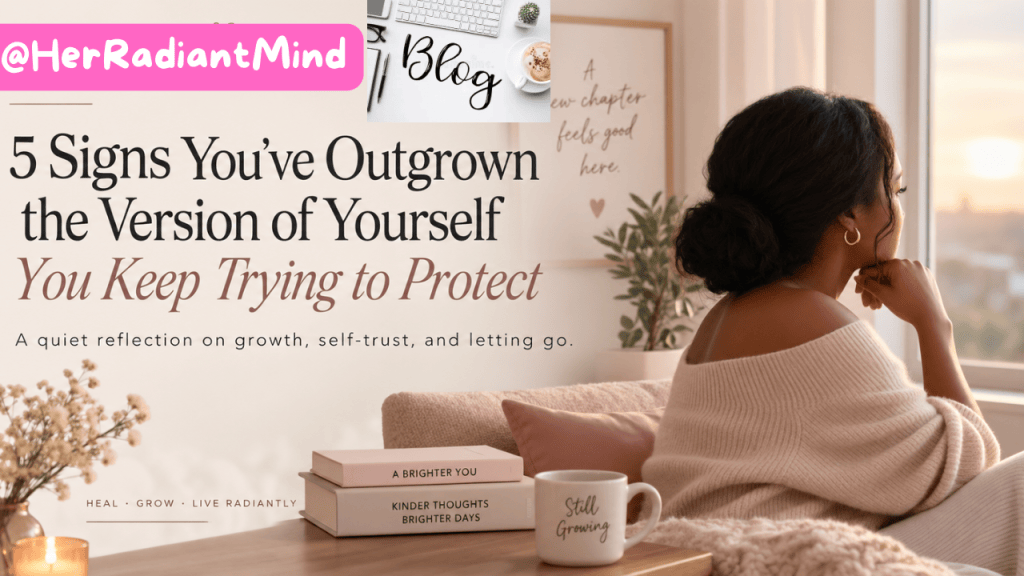
5 Signs You’ve Outgrown the Version of Yourself You Once Needed
Written by
on
There’s a moment that happens quietly.
Maybe you’re washing the dishes after a long day. Driving home from work. Lying in bed scrolling your phone when you suddenly realize something has changed.
You said no without explaining yourself.
You chose rest without feeling guilty.
You walked away from an argument instead of trying to prove your point.
You noticed an old trigger—and instead of spiraling, you paused.
And suddenly you wonder:
When did I become someone who does that?
That moment matters.
Because sometimes growth doesn’t arrive with a dramatic breakthrough. Sometimes it arrives quietly, almost unnoticed, as you realize that the things you once did to protect yourself no longer fit the woman you’re becoming.
You may still be carrying the habits, beliefs, and coping strategies of an older version of yourself.
But you’re not her anymore.
And that’s where things can get complicated.
Because outgrowing yourself isn’t always exciting. Sometimes it feels like grief.
You’re becoming someone new while learning how to release the version of you who got you here.
If you’ve been feeling unsettled lately—like your old coping mechanisms don’t fit quite right, or you’re craving something different without knowing exactly what—perhaps you’re not falling apart.
Perhaps you’re growing.
Here are five quiet signs that you may have outgrown the version of yourself you’ve been trying so hard to protect.
1. You Explain Yourself Less
Remember when every “no” needed a full explanation?
You couldn’t decline an invitation without an excuse.
You couldn’t change your mind without defending your decision.
You couldn’t set a boundary without worrying about whether the other person understood it.
Maybe that’s beginning to change.
Now, you’re able to say:
“That doesn’t work for me.”
And leave it there.
No three-paragraph explanation.
No apology.
No frantic attempt to make sure everyone is comfortable with your decision.
And strangely enough, it might not feel empowering at first.
It might feel wrong.
That’s because over-explaining can become a deeply ingrained way of seeking safety and approval. If you’ve spent years believing that keeping people happy protects you from conflict, rejection, or disappointment, suddenly choosing yourself can feel uncomfortable.
But discomfort doesn’t necessarily mean you’re doing something wrong.
Sometimes it means you’re doing something new.
A gentle reminder:
You don’t have to make your boundaries easier for other people to accept.
You are allowed to make decisions simply because they are right for you.
2. Your Old Triggers Don’t Hit the Same Way
Think about something that used to completely derail you.
Maybe it was criticism.
Someone’s silence.
Being left out.
A change in someone’s tone.
Feeling misunderstood.
A difficult conversation.
There may have been a time when one small interaction could consume your entire day.
You’d replay the conversation.
Analyze every word.
Wonder what you did wrong.
Maybe even abandon your own needs just to restore the peace.
But now?
The trigger happens, and you notice it.
You may still feel something—but you don’t automatically become the old version of yourself.
You pause.
You breathe.
You think.
You respond differently.
That’s growth.
It doesn’t mean you never get triggered again. It means the trigger no longer automatically gets to decide what happens next.
Your body may remember the old pattern, but you’re learning that you have choices now.
And that’s a powerful shift.
3. You Feel Restless in Places That Used to Feel Like Home
This one can be particularly confusing.
Nothing is necessarily wrong.
The friendship isn’t toxic.
The job isn’t terrible.
The routine is familiar.
The environment is comfortable.
And yet…
Something feels different.
You feel restless.
Unfulfilled.
Disconnected.
You find yourself craving deeper conversations, different experiences, more meaningful work, or simply more space to be yourself.
A client once described this beautifully.
I’ll call her Maya.
Maya came to coaching feeling guilty because she couldn’t understand why she no longer felt connected to a group of friends she’d known for years.
“They’re good people,” she told me. “Nothing happened. I just don’t feel like I belong there anymore.”
At first, she wondered if something was wrong with her.
But as we explored what had changed, she realized that she had changed.
She had spent years building her identity around being agreeable, dependable, and available. Her friendships had naturally formed around that version of her.
But she was beginning to want something different.
She wanted conversations about purpose.
Growth.
Creativity.
Boundaries.
The future.
She didn’t necessarily need to walk away from everyone.
She needed to stop forcing herself to remain the same person simply because other people were familiar with her old identity.
That realization changed everything.
Sometimes restlessness isn’t a sign that you need to run.
Sometimes it’s an invitation to pay attention.
You may not have outgrown the people around you.
You may simply be discovering that you need different things now.
4. Your Definition of Safety Has Changed
For many of us, safety once meant:
- Keeping the peace
- Staying agreeable
- Avoiding difficult conversations
- Not making anyone uncomfortable
- Being needed
- Staying small
- Keeping our feelings to ourselves
But growth can completely redefine safety.
Suddenly, safety begins to look like:
Being honest.
Having boundaries.
Taking up space.
Saying what you actually think.
Walking away when something doesn’t feel right.
Choosing yourself without needing permission.
You begin to realize that being liked isn’t the same as being safe.
Keeping everyone happy isn’t the same as being at peace.
And avoiding conflict isn’t the same as having healthy relationships.
You may even notice yourself choosing temporary discomfort over long-term self-abandonment.
You’d rather have the difficult conversation than silently resent someone.
You’d rather disappoint someone than disappoint yourself.
You’d rather be misunderstood than continue pretending to be someone you’re not.
That’s not recklessness.
That’s self-trust.
5. You Grieve the Woman You Used to Be
This is the part nobody talks about enough.
Sometimes you can be deeply grateful for who you’re becoming and still feel tenderness toward who you used to be.
Because that version of you wasn’t stupid.
She wasn’t weak.
She wasn’t “too much.”
She wasn’t incapable.
She was adapting.
Maybe she learned to over-apologize because it helped keep the peace.
Maybe she became a people-pleaser because being agreeable felt safer.
Maybe she stopped expressing her needs because no one seemed to listen.
Maybe she became fiercely independent because depending on others had disappointed her.
Maybe she learned to stay busy because slowing down gave her too much space to feel.
Those patterns may no longer serve you.
But they probably served a purpose once.
And instead of judging that woman, you can thank her.
She got you here.
You don’t have to hate your old self to love your new one.
You can look back and say:
“I understand why you became this way.”
“You were doing the best you could with what you knew.”
“You don’t have to carry this anymore.”
That’s not regression.
That’s compassion.
So, What Do You Do When You Realize You’ve Outgrown Yourself?
You don’t have to reinvent your entire life overnight.
You don’t need to become a completely different person.
And you certainly don’t need to turn personal growth into another project where you’re constantly trying to “fix” yourself.
Start smaller.
The next time you notice yourself slipping into an old protective pattern, pause.
Ask yourself:
“Is this protecting me now—or is it protecting who I used to be?”
Maybe you’re over-explaining.
Maybe you’re shrinking.
Maybe you’re saying yes when you mean no.
Maybe you’re staying somewhere because it’s familiar rather than because it’s fulfilling.
Maybe you’re avoiding a conversation because the old version of you learned that silence was safer.
Pause.
Notice.
Choose.
You don’t have to get it right every time.
Growth isn’t about never returning to old patterns.
It’s about recognizing them sooner and giving yourself permission to choose differently.
You Are Allowed to Become Someone New
There is a version of you that worked incredibly hard to get you here.
Honor her.
Thank her.
Love her.
But you don’t have to keep living from the survival strategies she needed.
You can become softer without becoming weaker.
You can become more assertive without becoming unkind.
You can become independent without shutting everyone out.
You can choose yourself without becoming selfish.
And you can outgrow an old version of yourself without being ashamed that she existed.
Maybe the restlessness you’re feeling isn’t telling you that something is wrong.
Maybe it’s telling you that something is ready to change.
Maybe you’re not lost.
Maybe you’re simply standing at the edge of a new chapter, realizing that the woman who once needed so much protection is finally learning that she can protect herself differently now.
And perhaps the most beautiful part is this:
You don’t have to become someone else.
You simply have to give yourself permission to become more fully you.
✨ A Radiant Reminder
You are allowed to outgrow the version of yourself that once kept you safe.
You are allowed to change your mind.
You are allowed to want more.
You are allowed to need less approval.
You are allowed to take up space.
You are allowed to choose peace.
And you are allowed to become a woman your old self couldn’t yet imagine.
She got you here. Now you get to take it from here.
Reflection Prompt
Take a quiet moment and ask yourself:
What am I still doing to protect a version of me that I have already outgrown?
Then ask:
What would change if I trusted the woman I’m becoming?
You don’t need to have all the answers.
Just start listening.
If This Resonated With You
Save this post for the days when growth feels more like grief than celebration. Share this with someone who needs this reminder!
And if you’re in a season of rebuilding your confidence, reconnecting with yourself, or learning to trust your own voice again, remember:
You don’t have to do it all alone.
At HerRadiantMind, we’re creating a space for women to slow down, reconnect with themselves, build resilience, and create lives that feel aligned—not just successful from the outside.
Your next chapter doesn’t require a new you.
It requires a more honest relationship with the woman you already are.
Discover more from herradiantmind
Subscribe to get the latest posts sent to your email.
Comments
Response
-
This really speaks to the beauty of personal growth. Outgrowing an old version of yourself doesn’t mean rejecting who you once were, it means appreciating how far that version carried you while making room for who you are becoming. Such a thoughtful and empowering message coach. 🌺🤍
LikeLike

 herradiantmind
Leave a Comment