Why You Don’t Have to Be Okay All the Time: Breaking Free from Toxic Positivity and Embracing Emotional Wellness
Written by
on
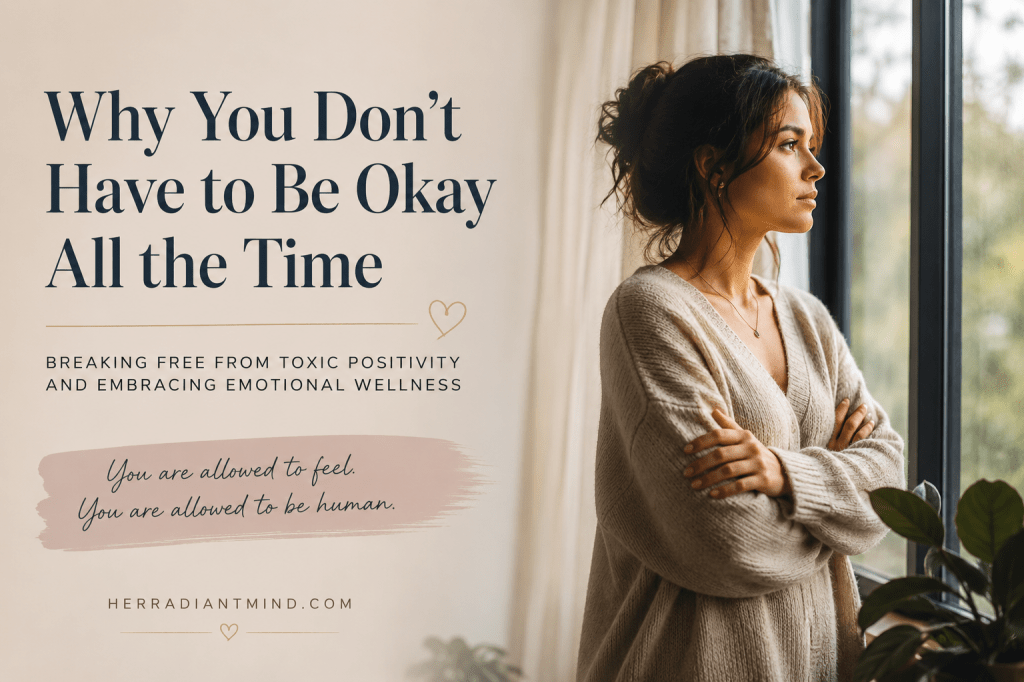
Have you ever noticed how quickly the words “I’m fine” leave your mouth?
Someone asks how you’re doing.
You smile.
You say the expected words.
And the conversation moves on.
Meanwhile, beneath that smile, you’re carrying stress, disappointment, overwhelm, grief, burnout, or simply the weight of being human.
Many women have become experts at appearing okay.
We show up.
We keep going.
We take care of everyone else.
We meet deadlines, manage responsibilities, and push through exhaustion.
From the outside, it may look like strength.
But inside, we’re often running on empty.
The truth is, many of us were never taught how to acknowledge difficult emotions. We were taught how to hide them.
We learned that being positive was admirable.
That being resilient meant never breaking down.
That asking for help was a sign of weakness.
That if we were grateful enough, motivated enough, or optimistic enough, difficult emotions would simply disappear.
But emotions don’t disappear because they’re ignored.
They wait.
And over time, the effort it takes to constantly appear okay can become emotionally exhausting.
What if real emotional wellness isn’t about always feeling positive?
What if true strength is allowing yourself to be honest about what you’re feeling?
Not because you’re weak.
But because you’re human.
Why High-Achieving Women Struggle to Admit They’re Not Okay
For many women, emotional suppression doesn’t begin as a conscious choice. It develops slowly through conditioning and environment.
You may have been:
- Praised for being “the strong one”
- Rewarded for staying calm and composed
- Encouraged to “stay positive” no matter what
- Taught that other people’s needs come first
- Made to feel that emotional expression is “too much”
Over time, these experiences shape a belief system:
“If I stay strong, I will be valued. If I struggle, I will burden others.”
This creates a cycle where emotional honesty feels unsafe or inconvenient.
So instead, you push through.
You normalize exhaustion.
You downplay your stress.
You convince yourself that you’ll rest later—once everything is done.
But “later” rarely comes.
And your emotional needs stay quietly unmet.
The Myth of Always Being Okay
We live in a culture that often confuses positivity with emotional health.
Messages like:
- “Good vibes only”
- “Just think positive”
- “It could be worse”
- “Stay strong”
may sound encouraging, but they can unintentionally invalidate real emotional experiences.
This is where toxic positivity begins.
Toxic positivity is the pressure to maintain a positive mindset even when you’re hurting, overwhelmed, or struggling emotionally.
The problem is not positivity itself.
The problem is when positivity is used to avoid emotional truth.
Because emotions are not obstacles to happiness.
They are part of being alive.
What Happens When You Suppress Your Emotions
Emotions don’t disappear when they are ignored.
They move inward.
Psychologically and physiologically, emotional suppression can increase stress in the body and disrupt emotional regulation.
You might notice this showing up as:
- Feeling emotionally drained for no clear reason
- Becoming easily irritated or overwhelmed
- Numbness or disconnection from yourself
- Difficulty relaxing, even during rest
- Overthinking or mental fatigue
This isn’t a personal flaw.
It’s your nervous system communicating with you.
Emotions are not random—they are signals.
- Sadness often signals a need for rest or support
- Anger often signals a boundary has been crossed
- Anxiety often signals perceived lack of safety or control
- Overwhelm often signals too much demand, too little space
When these signals are ignored, the body continues to speak—just in louder ways.
The Quiet Harm of Toxic Positivity
Toxic positivity rarely shows up in obvious ways.
It often sounds like care.
But underneath, it can feel like dismissal.
Phrases like:
- “Everything happens for a reason”
- “Just be grateful”
- “Don’t think about it too much”
- “Stay positive”
can unintentionally communicate:
“Your current emotions are not acceptable.”
And when that message is internalized, it often becomes self-talk:
- “I shouldn’t feel like this.”
- “Other people are handling things better.”
- “I need to get it together.”
- “Why am I not stronger?”
This internal pressure can become heavier than the emotion itself.
Because now you’re not only carrying what you feel—
you’re also judging yourself for feeling it.
A Simple Real-Life Moment
Imagine this:
You’ve had a long, demanding day.
You sit in your car before going inside.
The engine is off.
The silence is loud.
You feel tired—not just physically, but emotionally.
And your mind immediately starts:
- “It wasn’t even that bad.”
- “Other people have it worse.”
- “I need to stop overreacting.”
So you inhale, reset your face, and go inside.
Functioning.
Smiling.
Continuing.
Now imagine a small shift instead.
You pause.
And you allow one honest sentence:
“This day felt heavy.”
No fixing. No judgment. No explanation.
Just truth.
And in that moment, something inside softens.
Not because anything changed externally—
but because you stopped abandoning yourself internally.
Emotional Validation: What It Really Means
Emotional validation is the practice of acknowledging your feelings without immediately trying to change them.
It sounds like:
- “This is hard right now.”
- “It makes sense I feel this way.”
- “I’m allowed to feel this.”
- “I don’t need to rush past this feeling.”
Validation is not about staying stuck.
It’s about staying connected.
Research in emotional regulation shows that when emotions are acknowledged, they tend to move through more effectively. When they are suppressed, they often linger longer and intensify.
Validation tells your nervous system:
“You are safe to feel this.”
And safety is what allows regulation to happen.
The Connection Between Burnout and Emotional Suppression
Burnout is often seen as purely physical exhaustion.
But emotionally, it runs deeper.
Many people experiencing burnout have spent long periods ignoring their internal signals in order to meet external demands.
This creates:
- Emotional fatigue
- Reduced stress tolerance
- Loss of motivation
- Detachment from joy or meaning
- A sense of emotional “flatness”
Burnout is not simply about doing too much.
It is often about feeling too much—and having nowhere safe to put it.
Gentle Ways to Support Your Emotional Wellness
You don’t need a complete life overhaul to begin healing your relationship with your emotions.
Small, consistent practices matter most.
1. Name what you feel
Even one word helps:
“tired,” “sad,” “overwhelmed,” “irritated”
2. Lower the emotional pressure
Not every feeling needs to be fixed today.
3. Speak to yourself with compassion
Ask:
“What would I say to someone I love right now?”
4. Create small moments of regulation
- A quiet walk
- Deep breathing
- A pause without stimulation
- A warm drink in silence
5. Let emotions exist without urgency
You don’t have to rush your healing.
How Self-Compassion Changes Everything
Self-compassion is not about avoiding responsibility or ignoring growth.
It is about shifting from self-criticism to self-understanding.
Instead of:
- “I shouldn’t feel this way”
You begin to say:
- “This is what I’m feeling right now, and it makes sense.”
This shift changes how you relate to yourself internally.
And over time, it changes how you move through life externally.
Because when you are no longer fighting your emotions, you have more energy to understand them.
Letting Go of the “Always Positive” Identity
If you’ve been the strong, positive, or reliable one for a long time, this shift can feel unfamiliar.
You may worry:
“If I stop being positive, will everything fall apart?”
But emotional honesty does not take away your strength.
It refines it.
True positivity is not forced.
It returns naturally when it is not being used to cover emotional pain.
You are not becoming a negative person.
You are becoming an honest one.
Mental Health Is Not Meant to Look Perfect
There is no perfect emotional state.
Mental health is not a constant feeling of happiness or calm.
It includes:
- Emotional highs and lows
- Moments of uncertainty
- Days of rest
- Times of overwhelm
- Periods of healing and rebuilding
And still—within all of that—continuing to show up for yourself in small, meaningful ways.
That is what emotional resilience actually looks like.
Not perfection.
Presence.
A Grounding Reminder to Carry With You
If today feels heavy, you don’t need to fix it immediately.
You don’t need to justify it.
You don’t need to compare it.
You don’t need to turn it into a lesson.
You can simply say:
“This is where I am right now.”
And let that be enough.
Because sometimes, the most powerful form of healing is not changing how you feel—
but finally allowing yourself to feel it without abandonment.
And in that space, something quietly shifts:
You come back to yourself.
If you’ve been nodding along, it’s time to take the next step. The Radiant Reset is my 12-week coaching program designed to help women just like you reclaim energy, confidence, and resilience.
Thank you for spending this time with me.
Remember—healing is not linear, and growth doesn’t have to be loud to be powerful.
Keep choosing yourself, one gentle moment at a time.💖
Until next time, stay radiant and take tender care of your beautiful mind and body.
With love,
— Christabel, HerRadiantMind
Discover more from herradiantmind
Subscribe to get the latest posts sent to your email.
Comments
Responses
-
-
That really means a lot, thank you. I think we don’t talk enough about how important it is to be honest with ourselves, not just “positive.” I’m so glad this resonated with you, and I appreciate you taking the time to share that💖
LikeLike
-


 herradiantmind
Leave a Comment