How to Create a Life That Feels Peaceful, Not Just Productive
Written by
on
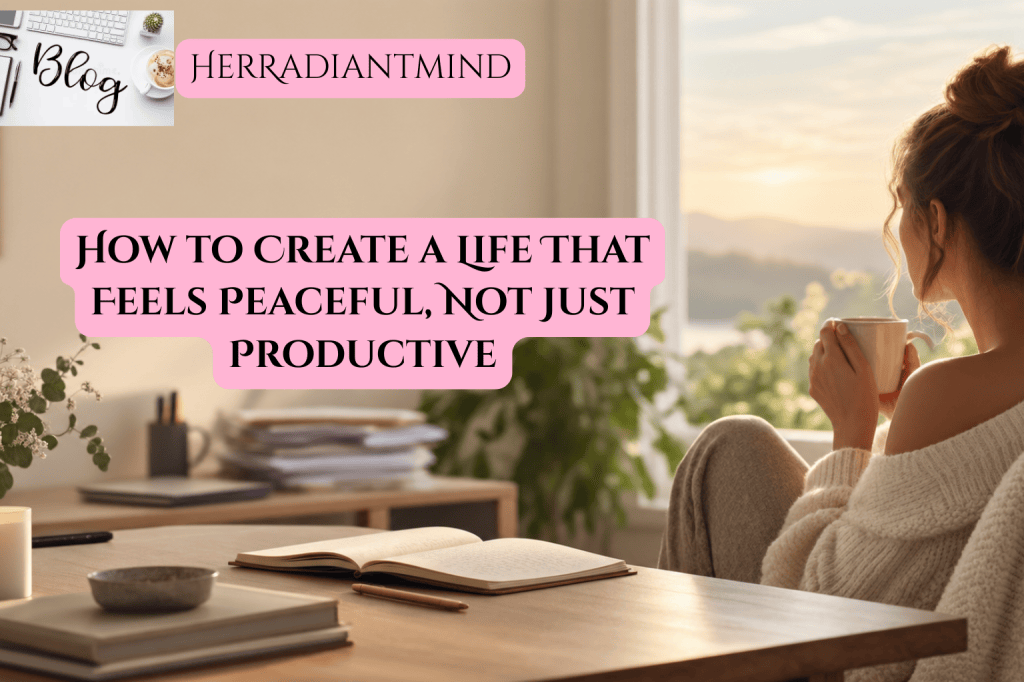
There is a kind of tired that sleep alone doesn’t fix.
It is the tired that comes from constantly doing, answering, fixing, planning, remembering, achieving, and holding everything together.
You get things done.
You show up.
You take care of people.
You meet the deadlines.
You keep the appointments.
You respond to the messages.
And somehow, despite everything you’ve accomplished, you still feel like you’re falling behind.
Maybe you sit down at the end of the day and realize you barely experienced it.
Maybe you feel guilty when you rest because there is always something else that could be done.
Maybe even the things that are supposed to nourish you—your morning coffee, your workout, your journal, your quiet evening—have slowly become another item on your to-do list.
And underneath all that doing is a quiet question:
“When do I actually get to live?”
If that question resonates with you, please hear this:
You are not failing at life because you are tired.
You may simply be living at a pace that asks you to produce more than it asks you to be present.
A peaceful life is not a perfect life.
It isn’t a life without responsibilities, difficult seasons, ambitious goals, or unexpected challenges.
It is a life where you stop abandoning yourself in the name of keeping up.
And creating that life may be simpler—and gentler—than you think.
What Does a Peaceful Life Actually Look Like?
When we think about a peaceful life, we may picture a quiet home, a slow morning, a beautiful cup of coffee, a perfectly organized schedule, or a relaxing vacation.
Those things can certainly feel peaceful.
But peace isn’t something you can permanently create by arranging your circumstances perfectly.
Because even in a beautiful environment, you can still feel overwhelmed.
You can have a clean house and a cluttered mind.
You can have a successful career and an exhausted heart.
You can have a full calendar and still feel strangely empty.
A peaceful life is less about having less to do and more about having a healthier relationship with what you do.
It can look like:
- Knowing when enough is enough.
- Saying no without feeling cruel.
- Resting before you’re completely depleted.
- Making decisions based on your values rather than other people’s expectations.
- Leaving space in your day for things that aren’t productive.
- Letting some things be good enough.
- Giving yourself permission to change.
- Feeling present enough to actually enjoy the life you’re working so hard to build.
Peace is not the absence of responsibility.
It is the presence of self-respect within your responsibilities.
Why Productivity Doesn’t Always Make You Feel Fulfilled
Productivity is not the enemy.
There is nothing wrong with accomplishing things, setting goals, working hard, or being responsible.
The problem begins when productivity becomes connected to your worth.
When you unconsciously believe:
I am valuable when I’m useful.
I can rest when everything is finished.
I should be doing more.
I shouldn’t waste time.
Everyone else needs me.
If I slow down, I’ll fall behind.
Then slowing down can feel uncomfortable—even when you desperately need it.
You may find yourself filling every quiet moment.
Checking your phone before you’ve even gotten out of bed.
Answering emails while eating.
Making lists while watching television.
Feeling guilty when you have nothing scheduled.
Turning hobbies into goals.
Turning self-care into another performance.
You may be productive all day and still go to bed feeling like you didn’t do enough.
That’s the trap.
A productive day is not automatically a meaningful day.
You can accomplish everything on your list and still be disconnected from yourself.
So perhaps the question isn’t only:
“What did I accomplish today?”
Try asking:
“How did I feel while I was living today?”
That question can open a very different conversation with yourself.
The Hidden Cost of Always Being Busy
Sometimes busyness isn’t just a schedule.
It’s a coping mechanism.
When you’re constantly moving, you don’t have as much space to notice what isn’t working.
You don’t have to sit with the uncertainty.
You don’t have to acknowledge that a relationship feels draining.
You don’t have to admit that you’ve outgrown something.
You don’t have to ask whether the life you’re maintaining is still the life you want.
Being busy can create the illusion of control.
But eventually, your body and mind may start asking for your attention.
You might notice:
- Irritability over things that normally wouldn’t bother you.
- Difficulty being fully present.
- Feeling overwhelmed by small decisions.
- Trouble relaxing when you finally have free time.
- Emotional numbness.
- Constant mental to-do lists.
- Feeling exhausted but unable to truly switch off.
- Losing interest in things you once enjoyed.
These experiences don’t mean something is wrong with you.
They may simply be signs that you have been carrying too much for too long.
And sometimes the answer isn’t another productivity strategy.
Sometimes the answer is less pressure, more space, and a return to yourself.
7 Gentle Ways to Create a More Peaceful Life
Creating a peaceful life doesn’t require you to quit your job, move to the countryside, or completely reinvent your routine.
Start smaller.
Very often, peace is built through ordinary choices repeated consistently.
1. Stop Treating Rest Like a Reward
One of the biggest mindset shifts you can make is realizing that rest does not have to be earned.
If you wait until everything is finished before you rest, you may never rest.
There will always be another email.
Another load of laundry.
Another responsibility.
Another person who needs something.
Another goal to pursue.
Rest isn’t a prize you receive for exhausting yourself.
Rest is part of how you care for yourself while you’re living your actual life.
Try asking:
“What would change if I allowed myself to rest before I completely ran out of energy?”
Maybe rest means going to bed earlier.
Maybe it means sitting quietly with your coffee.
Maybe it means taking a walk without turning it into a workout.
Maybe it means doing absolutely nothing for a little while.
You don’t have to justify every moment of stillness.
2. Learn to Ask, “Is This Mine to Carry?”
This question can change everything.
Women are often expected to remember, organize, anticipate, support, fix, smooth over, and emotionally manage far more than they realize.
But not everything that needs doing belongs to you.
Before automatically saying yes, pause.
Ask yourself:
Is this actually mine to carry?
Am I helping, or am I rescuing?
Would someone else be capable of handling this?
Am I saying yes because I genuinely want to—or because I feel guilty saying no?
Sometimes creating a peaceful life means putting down responsibilities you were never meant to carry alone.
3. Create Small Pockets of Peace
You don’t need an empty calendar to experience peace.
You can create small moments of calm inside an ordinary day.
Try:
- Drinking your morning coffee without immediately checking your phone.
- Taking three slow breaths before responding to a stressful message.
- Sitting in your car for a few quiet minutes before going inside.
- Taking a short walk without listening to anything.
- Eating one meal without a screen.
- Spending ten minutes outside.
- Creating a quiet evening ritual.
- Putting your phone away for the first and last part of your day.
These moments may seem insignificant.
They’re not.
They remind you that your entire day doesn’t have to be optimized.
Sometimes the most meaningful moments are the ones that accomplish nothing.
4. Stop Saying Yes Automatically
A peaceful life often requires stronger boundaries.
If you’re used to people-pleasing, saying yes may happen before you’ve even checked in with yourself.
Someone asks.
You agree.
Then later, you feel resentful, overwhelmed, or exhausted.
You don’t have to become cold or unavailable.
You simply need to give yourself permission to pause.
Try saying:
“Let me think about it.”
“I’ll get back to you.”
“I’m not able to commit to that right now.”
“That doesn’t work for me.”
A pause gives you something incredibly valuable:
the opportunity to choose instead of react.
And every time you honor an honest yes or an honest no, you strengthen your relationship with yourself.
5. Give Up the Need to Do Everything Perfectly
Perfectionism can make even ordinary life exhausting.
You reread the email five times.
You keep adjusting the plan.
You worry about disappointing someone.
You feel like your house should always look a certain way.
You believe you should be doing more, knowing more, achieving more.
But not everything deserves your maximum effort.
Sometimes peaceful living means asking:
“Does this actually need to be perfect?”
Maybe good enough is enough.
Maybe dinner can be simple.
Maybe the house can look lived in.
Maybe the email can be sent after one review instead of five.
Maybe you can share the idea before it’s perfectly polished.
Perfection isn’t always excellence.
Sometimes it’s simply exhaustion wearing a very responsible outfit.
6. Make Your Schedule Reflect What Matters to You
Your calendar tells a story.
Look at yours honestly.
Where is your time going?
What receives your energy?
What keeps getting pushed to the bottom?
What receives your attention because it is important—and what receives it simply because someone else is demanding it?
Creating a peaceful life means making room for the things that actually matter to you.
That might mean:
- Protecting one evening a week.
- Scheduling time outside.
- Making space for friendships.
- Creating time for your creativity.
- Prioritizing sleep.
- Leaving gaps between commitments.
- Saying no to things that consistently drain you.
Your priorities shouldn’t exist only in your head.
They should have a place in your life.
7. Choose Presence Over Constant Progress
There is always another version of yourself you could become.
Another goal.
Another habit.
Another milestone.
Another improvement.
Personal growth is beautiful—but you don’t have to turn yourself into a never-ending project.
Sometimes the most powerful thing you can do is simply be where you are.
Notice the coffee in your hands.
Listen when someone is talking to you.
Enjoy the walk.
Laugh without documenting it.
Sit in the sunshine.
Take the picture.
Call the friend.
Eat the meal slowly.
Let yourself experience a moment without asking how it can make you better.
You are allowed to live while you’re still becoming.
A Story About the Moment Everything Started to Feel Different
Imagine a woman named Maya.
Maya is capable.
She’s the person everyone can count on.
She wakes up early, checks her phone before getting out of bed, makes her mental list while drinking coffee, and moves through the day checking things off.
She works hard.
She takes care of her family.
She answers messages.
She remembers birthdays.
She keeps appointments.
She tries to stay healthy.
She wants to be a good friend, partner, daughter, mother, and professional.
From the outside, Maya looks like she has everything together.
But lately, she’s exhausted.
One Saturday morning, she wakes up with several free hours.
Instead of feeling relieved, she feels restless.
Her mind immediately starts creating a list:
Laundry.
Groceries.
Cleaning.
Emails.
Meal preparation.
Appointments.
Things she should probably organize.
Then something catches her attention.
She realizes she can’t remember the last time she did something simply because she wanted to.
So she tries something different.
She puts her phone in another room.
Makes a cup of tea.
Sits beside the window.
And does nothing for ten minutes.
At first, she feels uncomfortable.
Then she notices the sunlight.
The quiet.
Her shoulders slowly relax.
Nothing has been fixed.
The laundry is still there.
The emails haven’t disappeared.
Her responsibilities are waiting.
But for those ten minutes, she isn’t managing her life.
She’s experiencing it.
And sometimes that’s where the shift begins.
Not with a dramatic life overhaul.
Not with a five-year plan.
But with a small moment when you finally remember:
I am a person, not a productivity machine.
You Don’t Have to Choose Between Peace and Ambition
Maybe you’re thinking:
“But I have goals.”
Good.
You don’t have to give them up.
A peaceful life doesn’t mean becoming passive, unmotivated, or careless.
You can be ambitious and still rest.
You can build a business and still have boundaries.
You can care deeply about your career and still protect your evenings.
You can love your family and still have needs of your own.
You can want more for your life without believing that who you are right now isn’t enough.
The goal isn’t to eliminate ambition.
It’s to remove the belief that you have to exhaust yourself to deserve the life you want.
Try shifting from pressure-driven productivity to purposeful productivity.
Pressure says:
“I have to do this or everything will fall apart.”
Purpose says:
“This matters, and I can do it without abandoning myself.”
Before adding something to your day, pause and ask:
- Does this really need my attention right now?
- Is this mine to carry?
- Does this support the life I’m trying to create?
- What would make this feel a little lighter?
You may not always be able to remove the task.
But you may be able to change how you carry it.
What Does Peace Feel Like for You?
This is an important question because your peaceful life doesn’t have to look like anyone else’s.
For one woman, peace might be an early bedtime.
For another, it might be dinner with friends.
For someone else, it might be a quiet home, a creative hobby, a morning walk, or finally saying no to something that has been draining her for years.
Think about the moments when you have felt most like yourself.
Not the most impressive.
Not the most productive.
The most like yourself.
What was happening?
Who were you with?
What wasn’t happening?
What did you have more of?
What did you have less of?
Your answers can reveal something important.
Your version of a peaceful life may already be trying to get your attention.
You Are Allowed to Want a Gentler Life
Maybe you’ve spent years being the strong one.
The dependable one.
The productive one.
The one who figures it out.
The one who keeps going.
And maybe now you’re realizing that constantly holding everything together isn’t the same thing as feeling okay.
You don’t have to wait until you completely burn out before you make a change.
You don’t have to justify needing more space.
You don’t have to earn a slower morning.
You don’t have to prove that you’re tired enough to rest.
And you don’t have to abandon your dreams to create more peace.
You can want more and still move gently.
You can be ambitious and still have boundaries.
You can grow without constantly pushing.
You can become a new version of yourself without rejecting the woman you are today.
Creating a peaceful life isn’t about making every day calm.
Some days will be messy.
Some seasons will be demanding.
Some things will be outside your control.
Peace is not the promise that life will never be difficult.
It’s the decision to stop making your own life harder than it needs to be.
So perhaps today, don’t ask:
“How can I do more?”
Ask:
“What can I release?”
“Where can I slow down?”
“What do I need?”
“What would make my life feel more like mine?”
Then listen.
Your next step doesn’t have to be dramatic.
It may simply be one boundary.
One quiet morning.
One honest no.
One afternoon without your phone.
One decision to stop proving yourself.
One promise to yourself that you will actually keep.
Small shifts matter.
Because a peaceful life isn’t created all at once.
It is created in the small choices you make, day after day, to come back to yourself.
And radiant woman, you deserve a life that feels good to live—not just impressive to look at.
🌸 Your Radiant Reminder
You do not have to choose between a meaningful life and a peaceful one.
You are allowed to slow down.
You are allowed to rest.
You are allowed to have boundaries.
You are allowed to want more.
And you are allowed to build a life where your success includes how you feel while you’re living it.
Ready for Your Own Radiant Reset?
If you’ve been feeling emotionally exhausted, disconnected from yourself, or caught in a cycle of doing, giving, and pushing, you don’t have to figure everything out at once.
The Radiant Reset Toolkit was created to help you pause, reflect, reconnect with your needs, strengthen your boundaries, and begin making small shifts toward a more grounded and intentional life.
You don’t need to become someone else to create a life that feels better.
You may simply need to reconnect with the woman you’ve always been underneath the pressure.
Your reset can begin here. 🌸
[Explore the Radiant Reset Toolkit]
One Final Question
What is one thing you could release, simplify, or say no to this week to create a little more peace in your life?
Share your answer in the comments. Your small shift might give another woman permission to make hers too.
Discover more from herradiantmind
Subscribe to get the latest posts sent to your email.
Comments
Responses
-
-
I love this mindset. Simplifying your expectations can be such a powerful way to protect your peace. Not everything needs to be done today, and giving yourself permission to let some things wait is a beautiful form of self-care. Thanks for adding your beautiful reflection, grateful for your presence here💖
LikeLike
-


Leave a Comment