Tag: women’s mentalhealth

  • Emotional Minimalism: Clearing Mental Clutter to Make Space for Peace This New Year

    Emotional Minimalism: Clearing Mental Clutter to Make Space for Peace This New Year

    A Fresh Year, a Clearer Mind

    A new year always brings a sense of possibility. A chance to leave the past behind, hit “reset,” and reclaim your inner peace. But here’s the truth—changing the calendar doesn’t automatically clear your mental and emotional clutter.

    Have you ever walked into a room so messy you couldn’t think? The piles of clothes, papers, dishes—it’s overwhelming. Now imagine that room is your mind. Emotional clutter feels the same: crowded, noisy, suffocating.

    Most of us carry mental junk—old grudges, constant worries, self-doubt, unfinished guilt—as if it’s part of being human. But peace isn’t something you have to “find” or “earn.” It’s already there, waiting under all that clutter.

    That’s what emotional minimalism is about. Not cutting people off, not pretending nothing bothers you—but creating breathable space for calm and clarity. And what better time to start than at the beginning of a new year, when reflection and renewal are in the air?

    The Hidden Cost of Emotional Clutter

    Picture your brain like a closet. Every memory, responsibility, and relationship is a piece of clothing. Over time, it gets overcrowded: too many “I should’ve” outfits, too many “what ifs,” and not enough room to breathe.

    When your mental closet is jammed:

    • You wake up exhausted, even after sleep.
    • You snap at the people you love.
    • You scroll endlessly online, trying to feel better—but it only adds more noise.

    Science backs this up. Princeton University researchers found that physical clutter limits your brain’s ability to focus. Emotional clutter—unresolved feelings, negative self-talk, guilt, fear—can feel even heavier. It’s like having too many browser tabs open. Eventually, something freezes.

    Why We Hold On to Mental Clutter

    Letting go sounds beautiful, but it’s hard in real life.

    We hold onto emotions because they once felt useful:

    • Anger protected us.
    • Worry kept us alert.
    • Guilt reminded us to care.

    But when these emotions overstay their welcome, they stop helping and start haunting.

    It’s like carrying suitcases from trips you never finished: regret from high school, leftover heartbreak, and a little bag labeled “What If I Fail.”

    Here’s the truth: you’re not your clutter. You’re the space beneath it.

    Emotional Minimalism: Curate Your Inner World

    Emotional minimalism isn’t about suppressing feelings or pretending nothing bothers you. It’s about being intentional with the feelings, thoughts, and people you give space to.

    Think of it as curating your emotional home. Keep what nourishes peace. Release what drains it.

    Ask yourself:

    • Does this thought help me or hurt me?
    • Am I replaying the past or learning from it?
    • Does this relationship feel mutual or one-sided?

    Answering these questions starts the decluttering automatically. Peace stops being something you chase—it becomes your default.

    The Science of Letting Go

    Neuroscience shows your brain rewires itself when you change thought patterns. This is called neuroplasticity.

    • Stop feeding shame or worry, and the neural pathways weaken.
    • Nurture calm, grounded thoughts, and new connections form.

    It’s like replacing an outdated app with a smoother, upgraded version of your mind.

    Small shifts matter. You don’t need a mountain retreat—just tiny mental moments of cleanup in your daily life.

    Step 1: Notice the Noise

    Your mind is like a radio constantly playing in the background. Awareness is the first step to emotional minimalism.

    Try this exercise: pause for 30 seconds, take a deep breath, and ask:

    “What’s taking up space in my head right now?”

    You might uncover old worry, unresolved conversations, or grudges. Awareness isn’t judgment—it’s the first decluttering tool.

    Step 2: Stop Collecting Junk Thoughts

    Our minds have “junk drawers” for thoughts we don’t know how to process.

    • Pause before spiraling into “what if” loops.
    • Ask if guilt helps you grow or keeps you stuck.
    • Step away from social comparison.

    Think of emotional minimalism as washing dishes—do it consistently, and clutter never piles up.

    Step 3: Create Empty Space on Purpose

    Peace can feel uncomfortable at first. Calm is foreign if you’re used to chaos.

    Try these ways to create mental space:

    • Mindful breathing: Activates your parasympathetic nervous system.
    • Digital breaks: Short screen-free moments lower cortisol.
    • Walking without distraction: Helps your brain process emotions efficiently.

    Even simple tasks like washing dishes or commuting mindfully can spark emotional decluttering.

    Step 4: Swap Criticism for Compassion

    Self-criticism feeds clutter. Research shows self-compassion motivates lasting change.

    Next time you stumble, try:

    “I’m human. What can I learn here?”

    Compassion clears space instantly—like opening a window in a stuffy room.

    Step 5: Edit Your Emotional Relationships

    Emotional minimalism isn’t just self-talk—it’s also social.

    Ask:

    • Who fills my mind with peace?
    • Who fills it with noise?

    Edit exposure without guilt. Limit draining conversations. Step back when needed. Love deeply without carrying everyone else’s chaos.

    The “Enough” Mindset

    Clutter often grows from I’m not enough:

    • Not productive enough.
    • Not lovable enough.
    • Not doing enough.

    The truth: you were enough before doing anything to earn it. Emotional minimalism is coming home to the you that peace already belongs to.

    Next time the thought arises, ask: “What if I’m allowed to rest right now?”

    Boundaries Protect Your Peace

    Boundaries are your mind’s shelves. They organize and protect calm.

    Set limits like:

    • “I care, but I won’t fix your chaos.”
    • “I love you, and I can say no.”

    People with strong emotional boundaries experience less burnout and healthier relationships. Boundaries = self-respect in action.

    Tiny Shifts That Make a Big Impact

    Start small:

    • Delete old photos that make you sad.
    • Journal one emotional “truth” daily.
    • Spend one minute doing nothing.
    • Say “no” where you usually say “yes.”

    Peace sneaks in as you make space for it.

    The Emotional Closet Test

    Ask: “If my emotions were clothes, how would my closet look?”

    • Overflowing with old hurt?
    • Packed with guilt sweaters?
    • Neatly curated with feelings that bring joy?

    Messy is okay. Every one of us has emotional laundry day. Start sorting, and you’ll feel lighter.

    Humor Helps You Declutter

    Ever replay an argument years later, crafting the perfect comeback? That’s emotional hoarding.

    Laugh at your mind’s habits. Humor releases dopamine, breaking negative thought cycles. Picture dragging outdated thoughts to the “trash bin” and saying, “Delete!”

    Emotional Minimalism in Real Life

    Rachel (coaching client) seemed put together—steady job, loving partner, good health. But inside, her mind ran mental marathons daily.

    We started small: five minutes every evening to write down three thoughts she didn’t need:

    • “I messed up that meeting.”
    • “I’m not enough.”
    • “What if I fail?”

    Physically crossing them off the page created space. Three weeks later, she said:

    “I didn’t realize how heavy it all had become until I started putting it down.”

    Release is the heart of emotional minimalism—you don’t have to fix everything.

    Relearning Stillness in a Busy World

    Calm minds don’t come from doing more—they come from doing less, deeply and intentionally.

    Your peace isn’t lost—it’s just buried under clutter. Start this new year by making space for it.

    Start the New Year with the Radiant Reset Toolkit

    The new year is the perfect time to declutter your mind, release old emotional baggage, and reclaim your energy.

    The Radiant Reset Toolkit is a hands-on, actionable guide for emotional minimalism, featuring:

    • Guided exercises to identify and release mental clutter.
    • Journaling prompts to reflect and reset daily habits.
    • Mindfulness practices to cultivate calm and clarity.
    • Tools to strengthen boundaries, self-compassion, and emotional resilience.

    This isn’t about resolutions that fade by February—it’s about real, sustainable change. The toolkit gives you the structure and support to create lasting peace and make this year truly yours.

    ✨ This year, let peace be your default. Start now with the Radiant Reset Toolkit.

    Thank you for spending this time with me.

    Remember—healing isn’t linear, and growth doesn’t have to be loud to be powerful.

    Keep choosing yourself, one gentle moment at a time.💖

    Until next time, stay radiant and take tender care of your beautiful mind and body.

    With love,

    — Christabel, HerRadiantMind
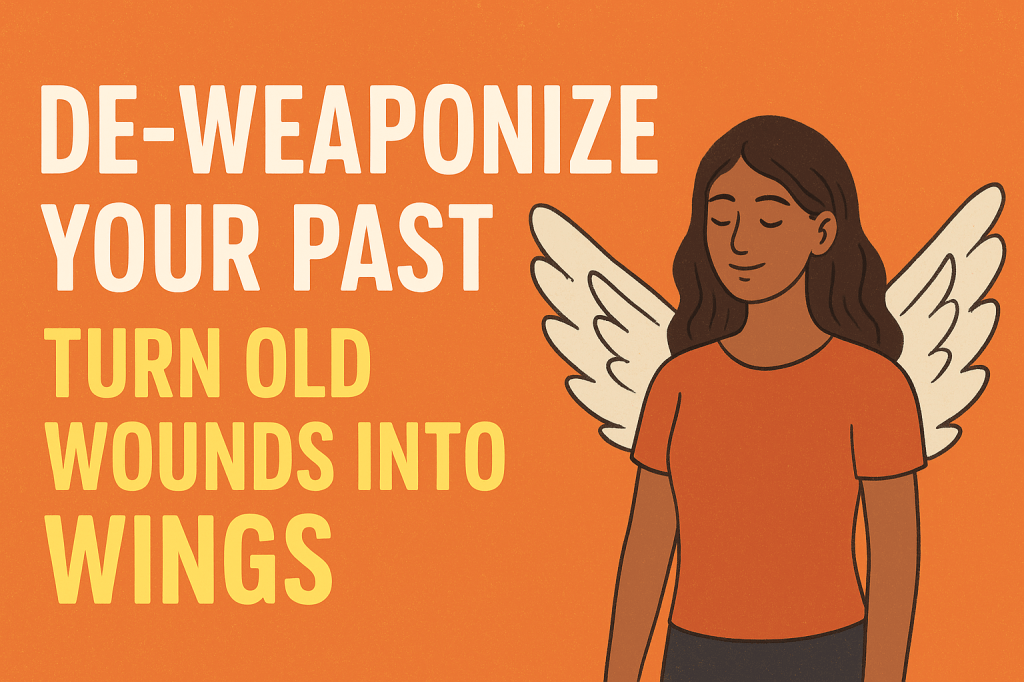
  • De-Weaponize Your Past—Turn Old Wounds into Wings of Empowerment

    De-Weaponize Your Past—Turn Old Wounds into Wings of Empowerment

    Your past is not a prison—it’s a teacher. When you learn to lay down your sword, you discover wings.

    Let’s be real for a moment.

    Your past isn’t a prison sentence.

    It’s a teacher — sometimes a tough one, sometimes a gentle one.

    And the moment you stop swinging old weapons at yourself, something incredible happens:

    your wounds grow wings.

    Picture this with me:

    A warrior comes home from battle. The war is over, but the sword is still in their hand — heavy, familiar, almost comforting. Every scar tells a story. But now, walking through everyday life, that same sword that once kept them safe starts cutting them instead.

    That’s what our past does when we don’t put the sword down.

    Pain that once protected us ends up slicing into our joy, relationships, and dreams.

    But here’s the truth:

    You can set the sword down. You can heal. You can rise.

    Why We Hold On to the Past

    Sometimes our past clings to us like ivy — beautiful in memory, but wrapped so tightly it slows our growth.

    Take Emma, for example.

    She grew up in a home where love had conditions and approval was currency. Now, as an adult, every bit of criticism feels like childhood all over again. Her past wasn’t just following her — it was speaking for her.

    Your past may have helped you survive.

    But if you’re not careful, it can start sabotaging your present.

    How Old Wounds Turn Into Weapons

    Old wounds often show up as automatic reactions that feel bigger than the moment.

    Common triggers:

    • Someone raises their voice → feels like childhood criticism
    • Rejection at work → feels like you’re failing again
    • Achieve something → still feel unworthy

    Quick science moment:

    Trauma gets stuck in the brain’s alarm system (the amygdala). When something reminds you of the past, your body reacts before your mind can even think.

    Try this:

    When you feel triggered, say internally:

    “This is an old weapon activating.”

    That tiny pause helps your nervous system calm down.

    Mapping Your Inner Weapons

    Healing starts with awareness.

    Step 1 — Make Your “Weapon Inventory”

    Grab your journal and write down patterns you notice.

    Examples:

    • Betrayal → you shut down
    • Abandonment → you over-give
    • Perfectionism → you beat yourself up

    Step 2 — Name the Weapons

    This makes them less scary:

    • The Hypervigilance Sword — always on guard
    • The Shame Grenade — explodes after every mistake
    • The People-Pleasing Rifle — saying yes to stay safe

    When you understand your triggers, you stop getting blindsided by them.

    The Four Pillars of De-Weaponization

    1. Safety First

    Before anything else — feel safe in your body.

    Try grounding: feet on the floor, hand on your belly, slow breathing.

    This literally calms your nervous system.

    2. Witness Without War

    Look at your past, but don’t fight it.

    Write for 10 minutes about the wound, then 10 minutes about how you survived it.

    It’s like reading an old diary: no judgment, just awareness.

    3. Strength Forging

    Every old wound hides a superpower.

    Examples:

    • Fear of abandonment → deep empathy and loyalty
    • Perfectionism → incredible attention to detail

    4. Ritual Release

    Write down the “weapon” on a piece of paper.

    Burn it safely, breathe deeply, release it.

    “Every flame, every exhale, signifies liberation.”

    Turning Scars Into Superpowers

    Did you know? About 70% of trauma survivors develop deeper empathy, resilience, and purpose once they work through it.

    Your wounds aren’t proof of weakness.

    They’re proof you lived, learned, and kept going.

    Daily Rituals to Support Your Healing

    • Morning Reset: 5-minute body scan
    • Midday Mantra: “My past informs me, but it doesn’t imprison me.”
    • Evening Reflection: Celebrate one win
    • Weekly Audit: Look at your patterns + progress
    • Share Safely: Talk about your journey in a judgment-free space

    Give yourself 21 days.

    It’s wild how much can change.

    When You Slip Back — Be Gentle

    Healing isn’t linear.

    Some days you’ll feel strong. Some days you’ll feel triggered.

    But relapses aren’t failures — they’re feedback.

    Say this to yourself:

    “I am human. I am healing. This moment is refinement.”

    Real People. Real Healing. Real Transformation.

    There’s Maya, who spent years doubting herself.

    Once she mapped her inner weapons and practiced daily grounding, she found her voice again.

    Jordan, who thought failure defined him.

    His perfectionism turned into a thriving project.

    Lisa, who was raised to stay silent.

    Now she teaches young women how to speak their truth.

    Your story can shift just like theirs.

    Your Past Isn’t Your Enemy — It’s Your Training Ground

    Your past doesn’t define you.

    It equips you.

    It sharpens your intuition.

    Deepens your compassion.

    Strengthens your boundaries.

    And guides you toward purpose.

    Your scars are not the end of your story —

    they’re the beginning of your becoming.

    If you’re ready to truly de-weaponize your past and step into your power, I’d love to walk that journey with you.

    Book a 1:1 Coaching Session at HerRadiantMind — let’s map your patterns, unlock your strengths, and build your wings.

    Thank you for spending this time with me.

    Healing doesn’t have to be loud to be powerful.

    Choose yourself gently, daily, and bravely.

    Until next time, stay radiant and take tender care of your beautiful mind and body.

    — Christabel, HerRadiantMind

  • How to Let Go of Guilt and Choose Yourself

    How to Let Go of Guilt and Choose Yourself

    Have you ever said “no” to something and immediately felt a pang of guilt?

    Or taken a break—only to find your brain whispering, “You should be doing more”?

    You’re not alone.

    So many of us have been conditioned to believe that choosing ourselves is selfish. But here’s the truth that can change everything:

    Self-love is not a betrayal of others. It’s a reunion with yourself.

    There’s a version of you underneath all the guilt—the one who knows her worth, who honours her boundaries, who doesn’t apologize for taking up space.

    You don’t have to keep breaking yourself into pieces to make other people comfortable.

    You are allowed to choose yourself without the guilt, the shame, or the apology.

    And if no one has told you this today—you’re not selfish. You’re healing.

    And that’s the most courageous thing you can do.

    Why We Feel Guilty for Choosing Ourselves

    From a young age, we’re taught to put others first. We’re praised for being agreeable, helpful, selfless.

    But what happens when being selfless leads to self-abandonment?

    Over time, the message becomes internalized:

    • “Good people give everything.”
    • “Love means sacrifice.”
    • “Your needs come last.”

    And when we finally start reclaiming our time, our boundaries, or our energy—the guilt kicks in.

    But that guilt isn’t truth. It’s conditioning.

    Here’s what guilt says:

    • “If I say no, they’ll be mad at me.”
    • “If I take time for myself, I’m letting people down.”
    • “If I put myself first, that makes me selfish.”

    Here’s what self-love says:

    • “I can love people and still choose myself.”
    • “My needs matter too.”
    • “Boundaries aren’t walls. They’re doors to healthier relationships.”

    My Breaking Point

    I hit a wall years ago—emotionally, physically, and spiritually drained. I was giving to everyone but myself.

    And then one night, I sat in my car, completely numb. I had nothing left. That’s when I realized:

    No one was going to give me permission to rest—I had to give it to myself.

    That was the first step of my self-love journey. It was messy. It was emotional. But it was necessary.

    3 Areas Where Guilt Shows Up—and How to Shift It

    1. Saying No: Your peace matters. Saying no doesn’t make you selfish—it makes you self-aware. You’re not responsible for managing other people’s emotions.
    2. Taking Rest: We glorify hustle, but healing comes through rest. Rest isn’t laziness—it’s medicine.
    3. Putting Yourself First: You’re allowed to be the main character in your life. You don’t owe anyone your constant availability.

    How to Start Releasing Guilt

    • Question the guilt: Ask yourself, “Is this guilt coming from love—or from old programming?”
    • Practice mirror affirmations: Try, “I’m allowed to choose myself without guilt.”
    • Surround yourself with safe people: Healthy people respect your boundaries.
    • Do something every day that centers you—without apologizing.

    Final Thoughts

    Releasing guilt isn’t easy. But choosing yourself is the beginning of healing—not just for you, but for every woman watching you rewrite the rules.

    Releasing guilt isn’t easy. But choosing yourself is the beginning of healing—not just for you, but for every woman watching you rewrite the rules.

    You are not selfish.

    You are worthy.

    And you deserve to take up space—guilt-free.


    Stay Radiant—Join the List 

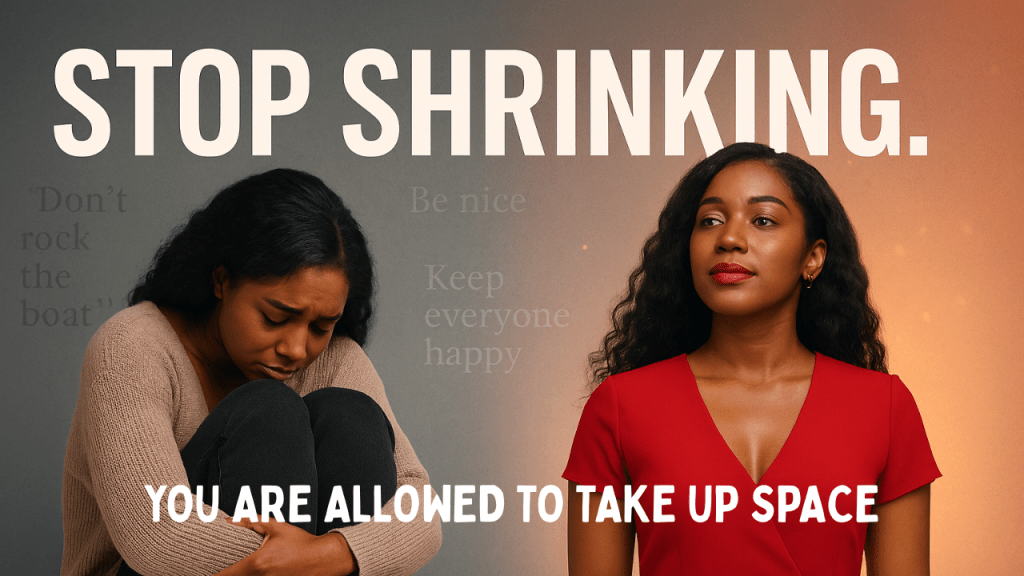
  • How to Stop People Pleasing and Step into Your Power

    How to Stop People Pleasing and Step into Your Power

    Have you ever caught yourself holding back in a conversation, shrinking just a little so someone else could feel comfortable? Maybe you said yes when you really meant no—or stayed silent just to keep the peace?

    If so, you’re not alone.

    So many women have been taught that being “nice” means being small. That being agreeable is safer than being honest.

    But what happens when you wake up one day and realize you don’t recognize the version of you who’s always shrinking just to fit in?

    Let’s talk about that.

    The Hidden Cost of People-Pleasing

    People-pleasing sounds innocent enough. After all, who doesn’t want to be kind and helpful?

    But when your need to be liked outweighs your need to be real… that’s when the harm begins.

    You:

    • Say yes to things that drain you
    • Struggle to set boundaries
    • Put everyone else’s needs ahead of your own
    • Constantly worry about what others think
    • Feel emotionally exhausted, resentful, or invisible

    It’s not just a bad habit. It’s a survival strategy.

    One you probably learned early in life to avoid conflict, earn love, or feel safe.

    But here’s the truth:

    You weren’t born to be liked by everyone. You were born to be yourself.

    Why We Start Shrinking

    Let’s pause and go deeper for a second.

    If you grew up in an environment where love was conditional—on being “good,” quiet, obedient, helpful—then it makes perfect sense that you learned to shape-shift.

    To avoid rocking the boat.

    To not take up too much space.

    To silence your needs so you wouldn’t be “too much.”

    This becomes your unconscious belief system:

    “If I stay small, I stay safe.”

    But staying small eventually becomes a cage.

    You lose touch with your own voice. You question your worth. And worst of all—you start to believe that your power is a threat instead of a gift.

    The Turning Point: Recognizing the Pattern

    Maybe that’s where you are now.

    Maybe you’re tired of saying “I’m fine” when you’re actually falling apart.

    Maybe you’re done twisting yourself into a version that’s easier for others to accept.

    Maybe you’re finally ready to stop shrinking and start rising.

    Here’s how to start.

    5 Ways to Step Out of People-Pleasing and Into Your Power

    1. Get Honest with Yourself

    Ask yourself:

    • Where am I holding back to be accepted?
    • What do I truly want—but rarely express?

    Awareness is the first key to freedom. You can’t change what you don’t acknowledge.

    2. Validate Your Own Feelings

    You don’t need someone else’s permission to feel what you feel.

    You don’t have to justify your no.

    You don’t need to explain your boundaries to be respected.

    Give yourself the emotional validation you’ve been seeking from others.

    3. Start Setting Small Boundaries

    Boundaries don’t have to be loud. Sometimes they sound like:

    • “Let me get back to you on that.”
    • “I’m not available today.”
    • “That doesn’t feel right for me.”

    You don’t need a perfect script. You just need practice. And every time you honor your truth, you build inner trust.

    4. Get Comfortable Being Uncomfortable

    Saying no might feel scary. People might be surprised. They might not like it.

    But your peace matters more than their comfort.

    Stepping into your power will feel unfamiliar at first—that’s okay. You’re not doing it wrong. You’re just doing it differently.

    5. Reconnect with Your Authentic Self

    Remember her? The version of you who used to dream big, speak freely, and take up space?

    She’s still there—beneath the layers of conditioning, expectations, and guilt.

    It’s time to come home to her.

    Start by doing one small thing each day that feels true to you. Dance to your favorite song. Wear what makes you feel powerful. Speak up when your heart nudges you to.

    You’re Allowed to Take Up Space

    You don’t need to be agreeable to be lovable.

    You don’t need to shrink to be safe.

    You don’t need to be perfect to be worthy.

    You are already enough. You are already powerful. You just need to remember.

    From Shrinking to Shining

    It’s not easy undoing years of people-pleasing. It takes courage. It takes compassion. And most of all—it takes choosing yourself, even when it feels unfamiliar.

    But let me tell you this:

    Every time you use your voice, set a boundary, or honor your truth…

    You are not just healing yourself.

    You are lighting the way for someone else to do the same.

    So here’s your reminder:

    You don’t need to fit in when you were born to stand out.

    Let’s Connect

    Have you ever struggled with people-pleasing? What’s one boundary you’re learning to set?

    Drop a comment below or share your story—it might be the reminder someone else needs today.

    Let’s Connect

    Have you ever struggled with people-pleasing? What’s one boundary you’re learning to set?

    Drop a comment below or share your story—it might be the reminder someone else needs today.

    If this resonated, bookmark this post and send it to a friend who’s learning to take up space too.

    Next Step: Watch This

    👉 Watch the video version of this blog: From People-Pleasing to Power: How to Stop Shrinking to Fit In

    Ready to keep reclaiming your power?

    Connect with me on instagram https://www.instagram.com/herradiantmind?igsh=MXQwa25vODd2Nnp0NA%3D%3D&utm_source=qr

    Until next time, breathe deep.

    Honor your truth.

    And remember—you are not too much. You are just enough.

    With love & light

    Christabel E.

    Founder, HerRadiantMind

    Stay Radiant—Join the List