Tag: trauma-recovery

  • 5 Things to Remember When the Holidays Bring Up Old Wounds

    5 Things to Remember When the Holidays Bring Up Old Wounds

    The smell of cinnamon candles. The sound of a familiar song echoing through a store. The sight of twinkling lights that make the world shimmer for a moment.

    And suddenly… it hits you.

    That old ache in your chest. The one you thought time had softened.

    The holidays have a way of stirring up memories you didn’t ask to remember — the ones tied to loss, loneliness, or the version of you who never felt safe to relax.

    If this season feels heavy instead of merry, you’re not broken. You’re human.

    The truth no one says out loud? Even joy-filled months carry shadows. The trick is learning to care for your heart while the world celebrates around you.

    Before you build emotional armor or hide under a blanket of “I’m fine,” here are five things to remember when the holidays bring up old wounds — because healing doesn’t pause for tinsel and lights.

    1. When Old Feelings Resurface at Unexpected Moments

    You’re chopping vegetables, scrolling gift ideas, or wrapping a present — and then something small cracks you open. A memory. A scent. A song.

    Suddenly, you’re 12 again at the kitchen table, hearing a raised voice, or noticing that empty chair across from you that used to be filled.

    Pain has a funny calendar; it doesn’t check what month it is before saying, “Hey, remember me?”

    Here’s the key: it’s not a setback. It’s communication. Your nervous system is reminding you that you’ve lived through things that mattered — deeply.

    When old emotions rise during the holidays, see them as signals, not setbacks. They’re showing up now because you finally have the safety, space, or softness to feel what couldn’t be felt before.

    You’re not back at square one. You’re revisiting an old chapter with new wisdom in your hands.

    Mini practice:

    When a wave of sadness or frustration comes up:

    1. Pause.
    2. Place your hand over your heart.
    3. Quietly say, “I see you. You’re allowed to be here.”

    That one sentence can transform the moment from self-judgment to self-connection.

    2. You Don’t Have to Fake the Festive

    Somewhere along the way, the holidays turned into a performance — the smiling family photos, the “grateful” posts, the cheerful small talk.

    But pretending everything’s fine when it isn’t? That only deepens the loneliness.

    It’s okay if you can’t summon joy on command. You’re not required to decorate your pain with glitter.

    You can love the season and still want to skip the party. You can laugh over cocoa one day and cry the next. Healing doesn’t mean feeling good all the time. It means being honest.

    Set boundaries that protect your energy:

    • Politely decline events that drain you.
    • Create your own version of celebrating — a quiet dinner, a nature walk, or a cozy night in.
    • Respond with honesty: “Thank you for inviting me. I might need to see how I’m feeling that day.”

    When you stop pretending, you make room for connection that doesn’t require a mask.

    3. The “Perfect” Holiday Is a Myth (and It Always Was)

    The perfect holiday we see in movies or ads? It never really existed. No one’s family is that serene. No one’s table is free of tension.

    Even the person posting matching pajamas on Instagram probably cried in the bathroom ten minutes earlier.

    We chase an image from our childhood — the holiday we wish we had. But comparison is poison. Unrealistic expectations feed disappointment, which feeds shame.

    Instead, ask: What actually feels nurturing to me right now?

    • Bake cookies for yourself, not for show.
    • Play your favorite music while cleaning.
    • Tell your inner child, “This year, I’ll give you the safety you never had.”

    Try this: Each morning, ask, “What would make today feel 1% more peaceful?” Then do that one small thing. Healing is in the quiet gestures.

    4. Your Triggers Aren’t Enemies — They’re Invitations

    The holidays press buttons we didn’t even know were still there:

    • A critical parent comment.
    • A sibling rivalry that never faded.
    • That dinner conversation that makes you want to crawl out of your skin.

    These triggers aren’t proof you’ve failed to heal. They’re reminders that healing is ongoing — a spiral, not a straight line.

    Instead of seeing discomfort as the enemy, get curious:

    • What is this feeling trying to tell me?
    • Whose voice am I hearing — theirs or my own?
    • What would support feel like in this moment?

    Even a small pause — the breath between past and present — is evidence of growth.

    Triggers are teachers. They show which parts of you still crave safety or validation and invite you to bring light into old corners of the heart.

    5. You’re Allowed to Create New Traditions

    Just because something’s “always been done” doesn’t mean it belongs in your life now.

    Maybe old traditions feel like walking through a haunted house — familiar but unsettling. You can let them go and build something new that fits the life you’re growing into.

    Ideas to try:

    • Write a letter to your younger self and burn it safely as a ritual of release.
    • Spend a day volunteering or helping someone in need.
    • Host a “chosen family” dinner with people who make you feel safe.
    • Go somewhere quiet in nature and reflect on what you’re ready to leave behind.

    Traditions aren’t sacred because they’re old — they’re sacred because they hold love. Make new ones that nurture you, not drain you.

    Healing Doesn’t Skip the Holidays

    Many assume personal growth follows a calendar — progress in August, peace by December. But the truth? Healing is messy, nonlinear, and beautifully human.

    You can be grateful and grieving.

    You can forgive and feel anger.

    You can love your family and still need space.

    Both can be true.

    When Grief Joins the Celebration

    The holidays can feel especially heavy if you’re carrying loss — the absence of a loved one, a relationship that ended, or even the life you thought you’d have. Grief doesn’t take a vacation for December. In fact, it often shows up louder, reminding you of what’s missing amid the lights and laughter.

    It’s important to give grief space without guilt. Feeling sad doesn’t mean you’re failing at the season — it means you’re human, and your heart remembers love.

    Gentle ways to honor grief during the holidays:

    • Light a candle or create a small ritual to remember those you’ve lost.
    • Share a memory with someone you trust, or write it in a journal.
    • Allow yourself tears without judgment — they are part of healing, not weakness.
    • Blend joy and sorrow — it’s okay to laugh at a funny story, then feel a pang of longing afterward. Both emotions can coexist.

    Grief and celebration can exist side by side. When you acknowledge your grief instead of pushing it away, you make room for gentle presence, authentic joy, and meaningful connection — the kind of holiday your heart truly needs.

    The holidays don’t have to test your healing; they can deepen it. One quiet boundary, one grounded breath, one honest no at a time — that’s evolution.

    Every emotion that resurfaces — sadness, longing, or even anger — isn’t here to ruin your holiday; it’s asking to be witnessed, finally, with tenderness instead of judgment.

    Gentle Grounding Ritual for When the Season Feels Heavy

    1. Pause and breathe — Inhale for 4 counts, hold 2, exhale 6. Feel your feet on the floor.
    2. Name what’s real — Whisper, “This is just a moment. It will pass.”
    3. Soften your heart — Hand on chest: “I’m doing the best I can.”
    4. Reconnect — Step outside, look at the sky, light a candle, touch your pet. Remind your body life exists beyond the memory.

    Your nervous system doesn’t need perfection; it needs reassurance. Every small act tells your body, “You’re safe now.”

    Quick Reminders

    • Grief can share space with gratitude. Both belong at the table.
    • You’ve already survived the hardest parts. Memories can’t hurt you like they used to.

      It’s okay to unplug. Social media doesn’t define how your holiday should feel.
    • Rest is productive. You’re allowed to pause.
    • You are allowed to choose peace over tradition.

    Say it again: You are allowed to choose peace.

    The Quiet Power of Self-Compassion

    Self-compassion is courage. It’s what allows you to show up honestly, without the tight smile or “I’m fine” script.

    When you talk gently to yourself, you rewrite the tone of painful memories. You give past versions of yourself the love they deserved.

    Imagine sitting by candlelight, whispering, “I forgive you for how hard you tried.”

    That’s healing: soft, real, and enough.

    A Season to Come Home to Yourself

    The most sacred connection is the one you build within.

    You don’t need perfect family moments or a flawless dinner. You just need presence — the kind that says, “I’m here, I’m breathing, I’m learning to love myself through this.”

    When old wounds whisper, remember:

    They’re not reopening to punish you. They’re unfolding to be healed.

    And healing, even in December, is a sacred kind of magic.

    A Gentle Invitation from HerRadiantMind

    If this season feels heavier than your heart can hold alone, you don’t have to carry it without support.

    At HerRadiantMind, our mission is simple — to help women turn pain into presence, and wounds into wisdom.

    Through one-on-one coaching, you’ll learn to:

    • Release emotional patterns that resurface during the holidays.
    • Practice grounded self-care that feels natural, not forced.
    • Rewrite your inner story with compassion and clarity.

    Healing isn’t meant to be done in isolation — it’s meant to be witnessed, gently, by someone who sees you.

    Take this as your sign: it’s time to give yourself the same grace you’ve offered everyone else.

    Thank you for spending this time with me.

    Remember—healing isn’t linear, and growth doesn’t have to be loud to be powerful.

    Keep choosing yourself, one gentle moment at a time.💖

    Until next time, stay radiant and take tender care of your beautiful mind and body.

    With love,

    — Christabel, HerRadiantMind

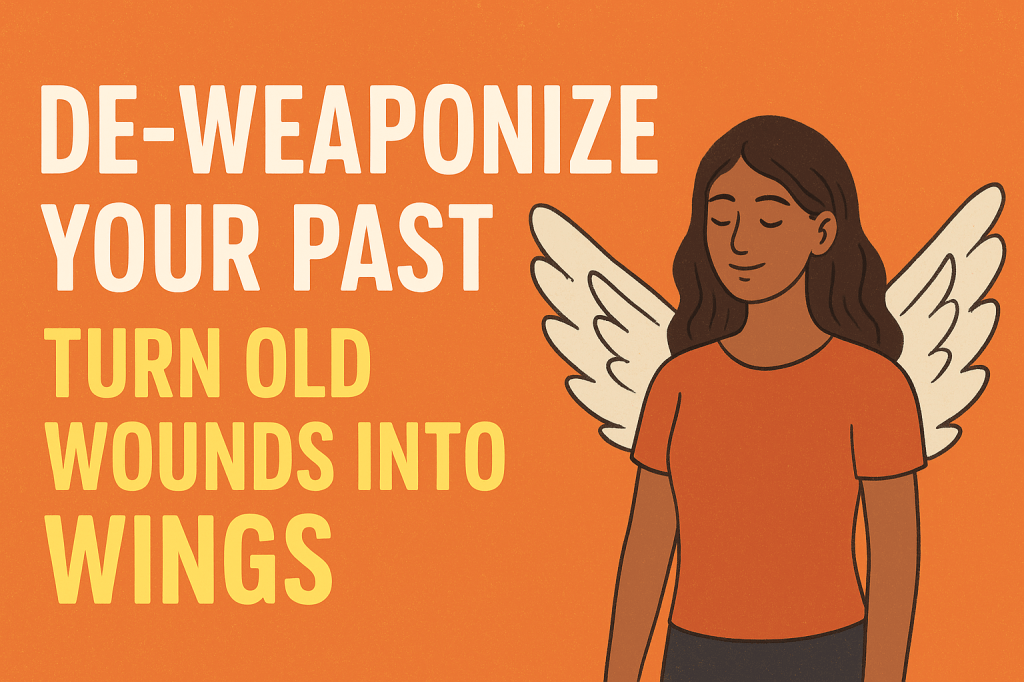
  • De-Weaponize Your Past—Turn Old Wounds into Wings of Empowerment

    De-Weaponize Your Past—Turn Old Wounds into Wings of Empowerment

    Your past is not a prison—it’s a teacher. When you learn to lay down your sword, you discover wings.

    Let’s be real for a moment.

    Your past isn’t a prison sentence.

    It’s a teacher — sometimes a tough one, sometimes a gentle one.

    And the moment you stop swinging old weapons at yourself, something incredible happens:

    your wounds grow wings.

    Picture this with me:

    A warrior comes home from battle. The war is over, but the sword is still in their hand — heavy, familiar, almost comforting. Every scar tells a story. But now, walking through everyday life, that same sword that once kept them safe starts cutting them instead.

    That’s what our past does when we don’t put the sword down.

    Pain that once protected us ends up slicing into our joy, relationships, and dreams.

    But here’s the truth:

    You can set the sword down. You can heal. You can rise.

    Why We Hold On to the Past

    Sometimes our past clings to us like ivy — beautiful in memory, but wrapped so tightly it slows our growth.

    Take Emma, for example.

    She grew up in a home where love had conditions and approval was currency. Now, as an adult, every bit of criticism feels like childhood all over again. Her past wasn’t just following her — it was speaking for her.

    Your past may have helped you survive.

    But if you’re not careful, it can start sabotaging your present.

    How Old Wounds Turn Into Weapons

    Old wounds often show up as automatic reactions that feel bigger than the moment.

    Common triggers:

    • Someone raises their voice → feels like childhood criticism
    • Rejection at work → feels like you’re failing again
    • Achieve something → still feel unworthy

    Quick science moment:

    Trauma gets stuck in the brain’s alarm system (the amygdala). When something reminds you of the past, your body reacts before your mind can even think.

    Try this:

    When you feel triggered, say internally:

    “This is an old weapon activating.”

    That tiny pause helps your nervous system calm down.

    Mapping Your Inner Weapons

    Healing starts with awareness.

    Step 1 — Make Your “Weapon Inventory”

    Grab your journal and write down patterns you notice.

    Examples:

    • Betrayal → you shut down
    • Abandonment → you over-give
    • Perfectionism → you beat yourself up

    Step 2 — Name the Weapons

    This makes them less scary:

    • The Hypervigilance Sword — always on guard
    • The Shame Grenade — explodes after every mistake
    • The People-Pleasing Rifle — saying yes to stay safe

    When you understand your triggers, you stop getting blindsided by them.

    The Four Pillars of De-Weaponization

    1. Safety First

    Before anything else — feel safe in your body.

    Try grounding: feet on the floor, hand on your belly, slow breathing.

    This literally calms your nervous system.

    2. Witness Without War

    Look at your past, but don’t fight it.

    Write for 10 minutes about the wound, then 10 minutes about how you survived it.

    It’s like reading an old diary: no judgment, just awareness.

    3. Strength Forging

    Every old wound hides a superpower.

    Examples:

    • Fear of abandonment → deep empathy and loyalty
    • Perfectionism → incredible attention to detail

    4. Ritual Release

    Write down the “weapon” on a piece of paper.

    Burn it safely, breathe deeply, release it.

    “Every flame, every exhale, signifies liberation.”

    Turning Scars Into Superpowers

    Did you know? About 70% of trauma survivors develop deeper empathy, resilience, and purpose once they work through it.

    Your wounds aren’t proof of weakness.

    They’re proof you lived, learned, and kept going.

    Daily Rituals to Support Your Healing

    • Morning Reset: 5-minute body scan
    • Midday Mantra: “My past informs me, but it doesn’t imprison me.”
    • Evening Reflection: Celebrate one win
    • Weekly Audit: Look at your patterns + progress
    • Share Safely: Talk about your journey in a judgment-free space

    Give yourself 21 days.

    It’s wild how much can change.

    When You Slip Back — Be Gentle

    Healing isn’t linear.

    Some days you’ll feel strong. Some days you’ll feel triggered.

    But relapses aren’t failures — they’re feedback.

    Say this to yourself:

    “I am human. I am healing. This moment is refinement.”

    Real People. Real Healing. Real Transformation.

    There’s Maya, who spent years doubting herself.

    Once she mapped her inner weapons and practiced daily grounding, she found her voice again.

    Jordan, who thought failure defined him.

    His perfectionism turned into a thriving project.

    Lisa, who was raised to stay silent.

    Now she teaches young women how to speak their truth.

    Your story can shift just like theirs.

    Your Past Isn’t Your Enemy — It’s Your Training Ground

    Your past doesn’t define you.

    It equips you.

    It sharpens your intuition.

    Deepens your compassion.

    Strengthens your boundaries.

    And guides you toward purpose.

    Your scars are not the end of your story —

    they’re the beginning of your becoming.

    If you’re ready to truly de-weaponize your past and step into your power, I’d love to walk that journey with you.

    Book a 1:1 Coaching Session at HerRadiantMind — let’s map your patterns, unlock your strengths, and build your wings.

    Thank you for spending this time with me.

    Healing doesn’t have to be loud to be powerful.

    Choose yourself gently, daily, and bravely.

    Until next time, stay radiant and take tender care of your beautiful mind and body.

    — Christabel, HerRadiantMind

  • The Inner Child Speaks: Connecting with the Wounded Younger You

    The Inner Child Speaks: Connecting with the Wounded Younger You

    Opening the Door to Your Inner Child’s Voice

    Imagine that inside you—quietly tucked beneath the layers of adult life—lives a younger version of yourself.

    This little one carries the echoes of joy and wonder, but also the pain and unmet needs of childhood.

    For many of us, those early wounds silently shape our relationships, self-worth, and emotional well-being in adulthood.

    But what if you could finally hear that inner child’s voice—the one that’s been waiting patiently to be seen, heard, and held?

    This post invites you on a heartfelt journey to meet your wounded younger self, listen deeply, and begin the transformative work of inner child healing—a path toward wholeness, peace, and radiant self-compassion.

    The Silent Cry: A Story of Lost Innocence

    Once upon a winter night, a little girl sat curled beside a frosted window, watching the snowflakes swirl.

    She wished for warmth, for safety, for someone to notice the silent tears that slipped down her cheeks.

    That little girl grew up, carrying that quiet ache into adulthood.

    Maybe that same little girl—or boy—still lives quietly inside you, waiting to be noticed, to be held, to be loved.

    Understanding Your Inner Child: The Keeper of Childhood Memories

    Your inner child is a deeply authentic part of you that holds memories, emotions, and experiences from your earliest years.

    Like a worn diary, it carries both joy and sorrow—moments that continue to shape how you see yourself and the world.

    If your childhood included neglect, trauma, or emotional pain, your inner child may still feel unsafe or unheard—carrying those unmet needs into your adult life.

    But this part of you isn’t just wounded—it’s also wonder-filled: creative, spontaneous, and full of light.

    Reconnecting with your inner child means learning to meet that vulnerability with patience, kindness, and warmth.

    Why Connecting Matters: How a Wounded Inner Child Shapes Adult Life

    Unhealed childhood pain can quietly influence your behaviors and emotions in surprising ways:

    • Fear of abandonment
    • Chronic people-pleasing
    • Difficulty trusting others
    • Deep shame or guilt
    • Overreactions to small disappointments

    These patterns aren’t flaws—they’re echoes of early wounds asking to be healed.

    When you listen to your inner child, you begin to recognize emotional triggers as messages from your past, not failures in your present. This awareness is where healing begins.

    How to Hear Your Inner Child’s Voice

    1. Acknowledge Their Presence

    Simply start by recognizing that your inner child exists.

    It may feel unfamiliar, but imagine greeting a shy part of yourself that has been waiting for your attention all along.

    2. Listen with Open Ears and Heart

    When emotions feel intense—anger, sadness, anxiety—pause and ask:

    “Is this my inner child trying to speak?”

    Reflect on what your younger self might be feeling beneath those reactions. Offer validation instead of judgment.

    3. Engage in Loving Dialogue Through Writing

    Write a heartfelt letter to your inner child.

    Offer reassurance, explain what happened from your adult perspective, and give the comfort you once needed.

    Ask gentle questions like:

    “How do you feel?”

    “What do you need from me right now?”

    Writing creates a bridge between your present self and your younger self—one built on empathy and love.

    4. Heal Through Meditation and Visualization

    Visualize a safe, nurturing space and imagine your younger self there.

    Speak softly, offer warmth, and let them know they are loved and protected.

    This meditative practice helps regulate emotions and fosters a sense of inner safety over time.

    5. Express Through Play and Creativity

    Revisit childhood joys—painting, dancing, singing, or playing in nature.

    These acts awaken your inner child’s creativity and remind them that it’s safe to feel joy again.

    You might also journal as your inner child, letting their voice speak freely.

    6. Practice Compassionate Reparenting

    Healing often means learning to “reparent” yourself—offering the love, structure, and safety you may have missed.

    Set healthy boundaries, honor your needs, and remind yourself daily:

    “I deserve care, rest, and understanding.”

    Inner Child Healing as a Path to Growth and Recovery

    For many, inner child work is life-changing.

    It can ease anxiety, improve relationships, and restore emotional stability.

    When you begin nurturing this inner connection, you break generational patterns and reclaim your authentic, radiant self.

    A Personal Story: From Darkness to Light

    Consider Maya’s story.

    She grew up feeling invisible, often blamed for conflicts she didn’t cause. As an adult, she battled anxiety and self-doubt—until she realized her wounded inner child was still calling for safety and love.

    Through writing, meditation, and creative expression, Maya learned to comfort that little girl within.

    Over time, the fog lifted. Confidence and peace replaced fear.

    Her story reminds us: when you heal the child within, you awaken the woman you were always meant to become.

    Embracing Healing as a Lifelong Journey

    Healing your inner child isn’t a one-time task—it’s a relationship you nurture over time.

    As deeper layers surface, meet them with gentleness and patience.

    If the process feels heavy, therapy or compassionate coaching can help you navigate it with expert care and emotional safety.

    Invitation to Your Radiant Healing Journey

    Your wounded younger self is waiting—with open arms and endless hope.

    When you choose to connect, you open the door to profound transformation and radiant self-compassion.

    At HerRadiantMind, compassionate coaching offers personalized guidance to help you heal, rebuild trust with yourself, and live with more authenticity and peace.

    ✨ Take the first step today.

    Embrace your inner child’s voice.

    Begin your radiant journey toward wholeness and self-love—because your story deserves to be heard, and your radiant mind is ready to shine. 🌷

    Thank you for spending this time with me.

    Remember—healing isn’t linear, and growth doesn’t have to be loud to be powerful.

    Keep choosing yourself, one gentle moment at a time.💖

    Until next time, stay radiant and take tender care of your beautiful mind and body.

    With love,

    — Christabel, HerRadiantMind
  • From Surviving to Thriving: Rewriting Your Story After Trauma

    From Surviving to Thriving: Rewriting Your Story After Trauma

    Trauma doesn’t have to be the end of your story. It can be the very place your healing begins.

    Rewriting your narrative after trauma isn’t about forgetting—it’s about reclaiming your voice and choosing to live empowered, not imprisoned.

    The Science Behind Trauma’s Impact

    Trauma alters the brain, especially in areas like the amygdala, hippocampus, and prefrontal cortex. According to research published in The Journal of Neuroscience, trauma can over-activate the amygdala (the brain’s fear center) and reduce activity in the prefrontal cortex (responsible for decision-making and reasoning).

    This biological shift explains why trauma survivors may feel “stuck” in survival mode—reactive, anxious, and emotionally exhausted—even when the threat has passed.

    But here’s the hopeful part:

    Thanks to neuroplasticity, the brain can rewire itself. With intentional self-care, therapy, and mindfulness, healing isn’t just possible—it’s physiological.

    Affirmation:

    “My brain and body are capable of healing. I am not broken—I am becoming whole.”

    Why Rewriting Your Story Matters

    Your subconscious mind stores trauma as a pattern, which means your brain may still interpret present-day situations through a past lens. But when you intentionally reframe your narrative, you begin to create new neural pathways and emotional responses.

    You are not erasing your pain—you are giving it new meaning.

    Affirmation:

    “I am the author of my life. Every chapter, even the hard ones, have led me to this strength.”

    Steps to Rewrite Your Story and Thrive

    1. Acknowledge, Don’t Avoid

    Denial deepens the wound. Healing begins when we shine light on our pain.

    “What you resist, persists. What you feel, you can heal.” — Carl Jung

    2. Name Your Emotions

    According to Dr. Dan Siegel, “naming it to tame it” helps regulate the nervous system. Journaling or talking to a therapist helps shift emotional overwhelm into clarity.

    Affirmation:

    “I give myself permission to feel and to heal.”

    3. Reconnect with Your Body

    Trauma disconnects us from our bodies. Practices like breathwork, yoga, or grounding techniques help bring us back to the present and restore safety.

    Try This:

    • Inhale for 4 counts

    • Hold for 4 counts

    • Exhale for 6 counts

    • Repeat 3 times

    Affirmation:

    “In this moment, I am safe. My body is my ally.”

    4. Cultivate Self-Compassion

    Dr. Kristin Neff’s research shows that self-compassion is linked to reduced PTSD symptoms and improved emotional resilience. Be kind to yourself in the same way you would be to a friend.

    Affirmation:

    “I am worthy of love, healing, and peace—just as I am.”

    5. Visualize a New Identity

    Visualization activates the same neural networks as real experience. By imagining a thriving version of yourself, you condition your mind to step into that reality.

    Affirmation:

    “I choose to see myself not through the lens of trauma, but through the light of transformation.”

    Raising the Stakes: Why It Matters Now

    Unresolved trauma doesn’t just affect your mental health—it impacts your relationships, work, physical well-being, and overall sense of joy. The longer we carry unprocessed pain, the more it seeps into every decision and connection.

    But thriving is possible. You’ve already survived. Now it’s time to live fully.

    Affirmation:

    “I am more than what happened to me. I am creating a new path forward.”

    Closing Thought: You Are the Rewrite

    Healing doesn’t happen overnight—but with every small act of courage, you’re turning survival into strength. You’re rewriting your story—not to forget, but to reclaim your power.

    Affirmation:

    “My healing is not linear, but it is unfolding. I am becoming my most radiant self—one moment, one breath, one breakthrough at a time.”

    Healing isn’t linear—it’s layered, sacred, and deeply personal. If you’ve spent years simply surviving, know this: thriving isn’t just possible—it’s your birthright. Your trauma doesn’t define you, but your courage to face it and rewrite your story does.

    As you continue walking this path, may you give yourself permission to grow beyond survival. To love yourself through the process. To feel worthy of peace, joy, and wholeness—not after you’ve healed, but as you heal.

    You are not alone in this journey. I’m walking it with you, one breath, one breakthrough at a time.

    With so much light and love,

    Christabel

    Your Radiant Mind-Body Coach