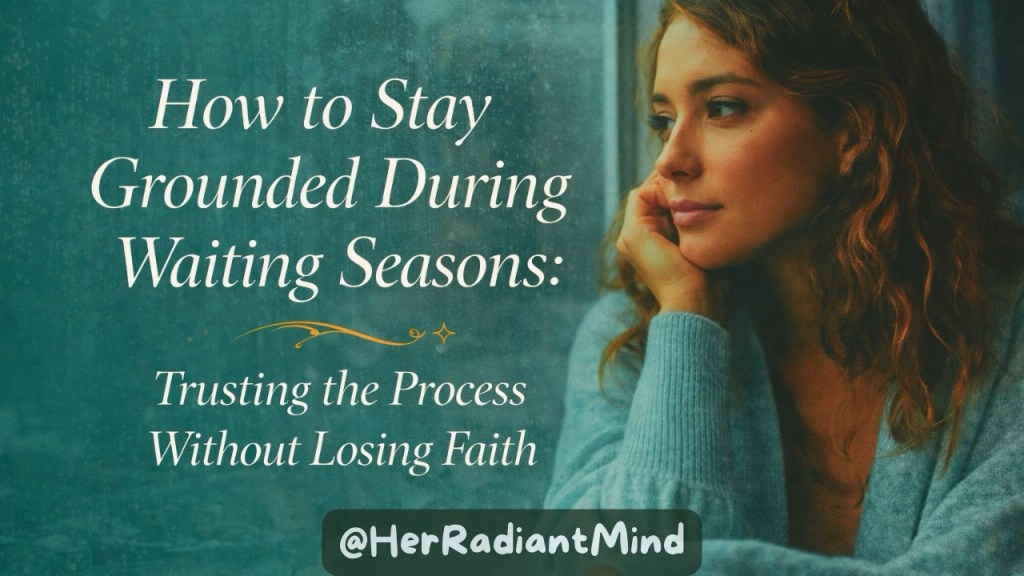
You know that space between “almost” and “not yet”?
That quiet, maddening gap where you’ve done everything you can — and now life says wait.
It’s one of the hardest emotional spaces to hold.
Because waiting doesn’t just test your patience.
It tests your identity. Your faith. Your self-worth.
When outcomes are delayed, doubt gets louder.
Maybe I’m behind.
Maybe I missed my chance.
Maybe I’m not enough.
If you’ve ever felt the emotional heaviness of waiting — this is for you.
Today we’re unpacking:
- Why waiting feels so emotionally intense
- What’s happening in your brain during uncertainty
- How to stay grounded in the in-between
- And how to trust the process without losing yourself
Because waiting isn’t wasted time.
It’s a becoming season.
When Waiting Feels Like Emotional Quicksand
Waiting can feel like quicksand.
You’ve done the work.
Sent the application.
Had the difficult conversation.
Started the healing.
Launched the offer.
And then… silence.
Uncertainty triggers a very real stress response in the body.
When we care deeply about an outcome, the amygdala — your brain’s emotional alarm center — activates. It reads uncertainty as potential danger. That’s why waiting doesn’t just feel uncomfortable mentally — it feels uncomfortable physically.
Tight chest.
Racing thoughts.
Restlessness.
Overthinking.
Your nervous system is bracing.
But here’s the truth: uncertainty is not the same as danger.
And when we understand that, we begin to reclaim power.
Why Your Brain Hates Waiting
We’re wired for immediate feedback.
Action gives us dopamine — the “progress chemical.” Checking something off a list, getting a reply, seeing visible movement — it feels rewarding.
But waiting removes visible proof of progress.
And the brain interprets that as loss of control.
However, neuroscience shows that during slower seasons, your brain’s default mode network activates — the system responsible for reflection, integration, emotional processing, and long-term learning.
Translation?
While it looks like nothing is happening, deep internal work is unfolding.
Waiting isn’t empty.
It’s integration.
A Client Story: When “Not Yet” Felt Like Rejection
One of my clients — let’s call her Sarah — came to me feeling completely defeated.
She had applied for a leadership role she deeply wanted. She had the experience. The qualifications. The vision.
And then she received the email:
“We’ve decided to move forward with another candidate.”
She didn’t just feel disappointed. She felt rejected.
Her inner narrative shifted quickly:
Maybe I’m not as capable as I thought.
Maybe I’m not leadership material.
Maybe I’ve plateaued.
What made it harder? She saw colleagues advancing. Moving. Growing. Meanwhile, she felt stuck.
In our sessions, we didn’t immediately jump to strategy. We focused on regulation.
We worked on:
- Naming the grief instead of suppressing it
- Challenging the narrative that delay equals inadequacy
- Rebuilding identity separate from outcomes
Here’s what shifted everything:
Instead of asking, “Why didn’t I get it?”
She began asking, “Who am I becoming in this season?”
Over the next few months, something subtle happened.
She strengthened her communication.
She clarified her leadership philosophy.
She stopped seeking validation externally.
And six months later — a different opportunity opened. A role that aligned more deeply with her long-term goals, offering more flexibility and influence than the first one ever would have.
The first “no” wasn’t failure.
It was redirection — and preparation.
But she couldn’t see that while she was in it.
That’s the emotional weight of waiting. It clouds perspective.
The Psychology of “Not Yet”
Humans struggle with something called temporal discounting — we value immediate rewards more than delayed ones.
So when life says “not yet,” it can feel like rejection.
But psychologically speaking, delayed outcomes often increase long-term satisfaction and stability because they require internal expansion first.
Growth expands capacity.
And capacity determines sustainability.
Sometimes the delay isn’t punishment.
It’s preparation.
How to Stay Grounded While You Wait
Grounding is not about pretending everything is fine.
It’s about creating internal stability when external outcomes are uncertain.
Here are grounded, research-backed tools you can use:
1. Regulate Before You Reframe
Before positive thinking, regulate your nervous system.
Try this breathing pattern:
Inhale for 4
Hold for 4
Exhale for 6
Longer exhales activate the vagus nerve and signal safety.
Calm body → clearer thoughts.
2. Separate Identity from Outcome
You are not your timeline.
Delays do not define your worth.
Ask yourself:
If this outcome never happened, who would I still be?
Detach identity from achievement.
That’s emotional resilience.
3. Shift from “When?” to “Who?”
Instead of obsessing over when it will happen, ask:
Who am I becoming in this season?
Am I:
- More patient?
- More self-aware?
- More grounded?
- Less reactive?
Invisible growth still counts.
4. Limit Comparison
Comparison intensifies waiting.
Someone else’s acceleration doesn’t mean you’re behind.
Different timing. Different path. Different preparation.
The Power of Surrender (Without Giving Up)
Surrender isn’t quitting.
It’s releasing the illusion of total control.
It sounds like:
“I will keep showing up, but I will not force what isn’t aligned.”
When Sarah stopped trying to control the timeline and focused on strengthening herself internally, opportunities flowed differently.
Because grounded energy attracts aligned opportunities.
Desperate energy repels them.
Rest Is Still Progress
We measure progress by movement.
But emotional growth often happens in stillness.
During waiting seasons, you might:
- Heal faster
- React less
- Recover quicker from disappointment
- Speak up more clearly
That is progress.
Repeat this:
Rest is also forward.
When Waiting Feels Unfair
Let’s be honest.
Sometimes trusting the process feels naive.
You’ve done the affirmations. The mindset work. The therapy. The journaling.
And you’re tired.
If that’s you, let me say this gently:
You are allowed to feel exhausted and still trust.
Trust doesn’t require constant positivity.
It requires quiet consistency.
Reclaiming Power in Uncertain Seasons
If you feel stuck right now, try these perspective shifts:
From:
“Why is this happening to me?”
To:
“What is this strengthening within me?”
From:
“I have nothing to show for it.”
To:
“I am building what cannot yet be seen.”
From:
“Everyone is ahead of me.”
To:
“My timing is building sustainability.”
The Emotional Science of Hope
Hope activates the prefrontal cortex — the brain region responsible for planning and future vision.
Hope fuels forward movement.
That’s why losing hope feels heavy — your brain interprets it as depletion.
Hope isn’t naive.
It’s neurological fuel.
Cultivate it intentionally:
- Through gratitude
- Through reflection
- Through evidence of past resilience
- Through supportive community
Transformation Has Its Own Timeline
Waiting is rarely about stagnation.
It’s about internal alignment.
You are not late.
You are expanding.
And when the opportunity meets the version of you that’s grounded enough to hold it — it will feel steady, not chaotic.
That’s the difference between rushed success and aligned growth.
Your Invitation
If you’re in a waiting season right now — whether it’s career, healing, relationships, or clarity — you don’t have to navigate it alone.
At HerRadiantMind, I help women build emotional resilience so that uncertainty doesn’t shake their foundation.
Through mindset coaching, nervous system regulation tools, and grounded self-trust practices, we turn waiting seasons into strengthening seasons.
Ready to feel steady even when life feels uncertain?
Visit HerRadiantMind.com to book a clarity call.
Because your journey isn’t on hold.
It’s unfolding.
And you are becoming stronger than you realize.
Thank you for spending this time with me.
Remember—healing is not linear, and growth doesn’t have to be loud to be powerful.
Keep choosing yourself, one gentle moment at a time.💖
Until next time, stay radiant and take tender care of your beautiful mind and body.
With love,
— Christabel, HerRadiantMind


 herradiantmind