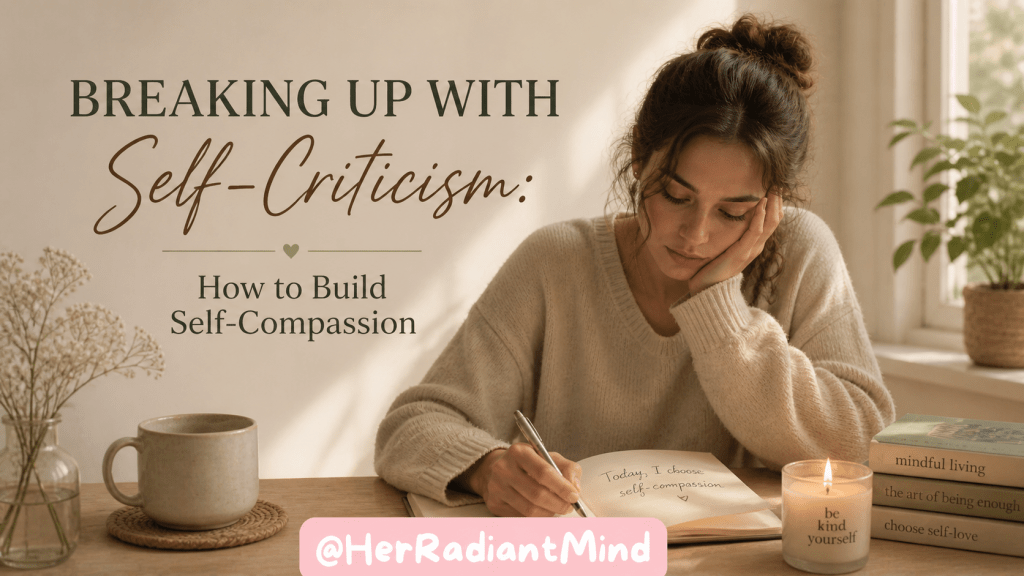
There’s a voice in your head.
You know the one.
It shows up when you make a mistake…
When you say the wrong thing…
When you look in the mirror a little too long…
And it whispers things like:
“Why are you like this?”
“You should be better by now.”
“That wasn’t good enough.”
Now imagine this…
What if that voice isn’t telling the truth?
What if it’s just a habit?
And what if—you could break up with it?
Not by forcing positivity.
Not by pretending everything is perfect.
But by learning to treat yourself like someone you genuinely care about.
Let’s talk about that.
The Voice That Feels Like You (But Isn’t)
Here’s what makes self-criticism so convincing…
It sounds like you.
So you believe it.
But in most cases, that voice was learned.
Maybe it came from a parent who focused on what you did wrong.
Maybe from school, where mistakes felt embarrassing.
Or from social media, where perfection is the illusion—and you feel like you’re falling behind.
So your brain adapted.
It created a voice designed to keep you in line:
“Don’t mess up.”
“Try harder.”
“Be better.”
And your brain thinks this is helpful.
Because your brain’s primary job isn’t happiness—it’s protection.
There’s something called the negativity bias—your brain’s tendency to focus more on what’s wrong than what’s right.
One awkward moment? Replays all day.
Ten compliments? Gone in minutes.
This once helped humans survive.
But today?
It often just keeps you stuck in a loop of self-doubt and criticism.
Why Self-Criticism Is Holding You Back
A lot of people believe:
“If I stop being hard on myself, I’ll become lazy.”
It sounds logical—but it’s not true.
Research by Dr. Kristin Neff, a leading expert on self-compassion, shows the opposite.
People who practice self-compassion are more likely to:
- Stay motivated
- Try again after failure
- Feel less anxious and overwhelmed
- Build emotional resilience
Meanwhile, harsh self-criticism often leads to:
- Procrastination
- Fear of failure
- Giving up too soon
That inner voice you think is pushing you forward?
It’s quietly holding you back.
It’s like trying to grow a plant by yelling at it.
It doesn’t work.
You’re Fighting the Wrong Battle
Most people respond to self-criticism in one of two ways:
- Ignoring it
- Fighting it
But neither works.
Ignoring it doesn’t make it disappear.
Fighting it often makes it louder.
So instead of trying to silence your inner critic…
You learn to change your relationship with it.
Think of Your Inner Critic Like a Bad Coach
Imagine learning something new and hearing:
“That was terrible.”
“What’s wrong with you?”
“You’ll never get this.”
You wouldn’t improve—you’d shut down.
Now imagine a different voice:
“That didn’t work—try again.”
“You’re learning.”
“I see your effort.”
Same goal.
Different energy.
Self-compassion isn’t about lying to yourself.
It’s about coaching yourself better.
Gentle Mindset Shifts That Change Everything
Let’s make this practical.
Not perfectly—just gently.
1. Notice the Voice (Instead of Becoming It)
Instead of:
“I’m such a failure.”
Try:
“Oh… that’s my inner critic speaking.”
That small shift creates space.
You are not the voice.
You are the one noticing it.
2. Give It a Name
It might sound silly—but it works.
“Negative Nancy.”
“Old Teacher Voice.”
“Drama Queen.”
Now when it shows up:
“Ah… there you are again.”
It becomes less powerful—and easier to challenge.
3. Speak to Yourself Like a Friend
If a friend said:
“I messed up. I’m so stupid.”
You wouldn’t agree.
You’d say:
“It’s okay. Everyone makes mistakes.”
“You’re learning.”
“I’ve got you.”
Offer yourself the same energy.
Start simple:
“I’m allowed to be human.”
4. Focus on Effort, Not Just Outcomes
Self-criticism fixates on results:
“You failed.”
“That wasn’t enough.”
But growth lives in effort:
“I showed up.”
“I tried.”
“I’m learning.”
Every time you focus on effort, you begin to rewire your thinking.
5. Catch the “Should” Trap
“I should be better.”
“I shouldn’t feel this way.”
“Should” creates instant pressure—and often shame.
Try replacing it with:
“I’m learning to…”
“I wish I had…”
It softens the experience without avoiding responsibility.
6. Use the 10-Year Perspective
Ask yourself:
“Will this matter in 10 years?”
Most of the time, the answer is no.
What feels overwhelming now…
is often small in the bigger picture.
And that perspective helps your nervous system settle.
A Story You Might Recognize
A woman once shared that every small mistake at work would replay in her mind all night.
“I’m not good enough.”
“They’ll find out.”
“I’m going to fail.”
One day, she tried something different.
She wrote down what she would say to her best friend.
It sounded like:
“You’re doing your best.”
“You’re learning.”
“One mistake doesn’t define you.”
At first, it felt unnatural.
But over time…
That became her new inner voice.
Not perfect.
But kinder.
And that changed everything.
The Truth Most People Avoid
Your inner critic may never fully disappear.
And that’s okay.
The goal isn’t silence.
It’s less control.
You can hear it… without believing it.
Notice it… without obeying it.
That’s where freedom begins.
What Self-Compassion Really Is
Let’s clear this up.
Self-compassion is not:
- Avoiding responsibility
- Making excuses
- Settling for less
It is:
- Being honest without being harsh
- Taking responsibility without shame
- Growing without tearing yourself down
It sounds like:
“That didn’t go how I hoped… but I’m still worthy.”
“I can do better next time… and I’m still okay right now.”
That’s not weakness.
That’s strength.
Start Small (This Matters More Than You Think)
You don’t need to wake up tomorrow and love everything about yourself.
Start here:
Catch one negative thought.
Pause.
Respond with one kind sentence.
That’s it.
Small shifts—repeated consistently—create real change.
Before You Go…
You are not a project that needs fixing.
You are a human being—learning, growing, and figuring things out in real time.
You don’t need to earn your worth through perfection.
You don’t need to punish yourself to improve.
You’re allowed to grow…
and be kind to yourself at the same time.
So maybe today isn’t about becoming someone new.
Maybe it’s simply about…
Speaking to yourself a little more gently than you did yesterday.
And that?
That’s a powerful place to begin.
If you’ve been nodding along, it’s time to take the next step. The Radiant Reset is my 12-week coaching program designed to help women just like you reclaim energy, confidence, and resilience.
Thank you for spending this time with me.
Remember—healing is not linear, and growth doesn’t have to be loud to be powerful.
Keep choosing yourself, one gentle moment at a time.💖
Until next time, stay radiant and take tender care of your beautiful mind and body.
With love,
— Christabel, HerRadiantMind