You told yourself you’d rest after this week.
But then the week filled up. Again.
There’s always one more thing to finish. One more message to answer. One more way to “get ahead” so you can finally relax later. And somehow, later never really comes.
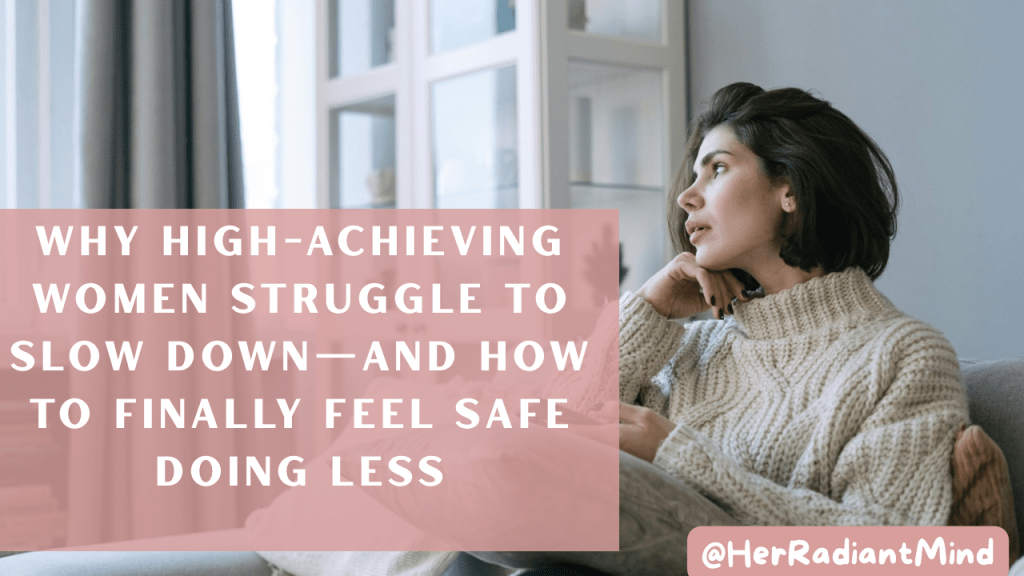
Even when you try to slow down, something inside you won’t let you. You feel restless. A little guilty. Maybe even anxious.
So you go back to doing.
Not because you want to—but because stopping doesn’t feel safe.
If that sounds familiar, you’re not alone. And more importantly, there’s nothing wrong with you.
The Quiet Grip of Productivity Addiction
On the surface, it looks like discipline. Drive. Ambition.
But underneath, something else is often at play: productivity addiction.
It’s the feeling that your worth is tied to how much you do. That rest has to be earned. That slowing down means falling behind.
And for high-achieving women, this pattern can run deep.
You’ve likely been praised for being responsible. Reliable. The one who handles it all. Over time, doing more became part of your identity—not just your schedule.
So when you try to do less, it doesn’t just feel uncomfortable.
It feels like losing a part of who you are.
Why Slowing Down Feels So Uncomfortable
Your brain is wired to keep you safe. And if you’ve spent years equating productivity with safety, approval, or success, slowing down can feel like a threat.
Not logically—but emotionally.
Here’s what might be happening beneath the surface:
- Your nervous system is used to being “on,” so stillness feels unfamiliar
- You associate rest with laziness or falling behind
- You’ve learned that being needed equals being valued
- You fear what might come up if you finally stop and sit with yourself
This isn’t about time management. It’s about emotional conditioning.
And that’s why typical advice like “just take a break” rarely works.
Because for you, it’s not just a break.
It’s a shift in identity.
Hustle Culture Taught You the Wrong Things
You didn’t wake up one day and decide to overwork yourself into exhaustion.
You were taught—subtly and repeatedly—that your value comes from output.
Finish more. Achieve more. Be more.
Hustle culture rewards burnout in a polished way. It calls it dedication. It normalizes constant motion. It rarely talks about the cost.
But here’s the part we don’t say enough:
Being constantly productive doesn’t make you more worthy. It just makes you more tired.
And over time, that exhaustion disconnects you from yourself.
A Client Story: “I Didn’t Know Who I Was Without Being Productive”
One of my clients came to me after years of burnout.
On paper, she was thriving—high-level role, always available, always delivering. The kind of person everyone relied on.
But privately, she said something that stayed with me:
“I don’t know who I am if I’m not being useful.”
Even in moments meant for rest, she felt anxious. If she wasn’t doing something productive, she felt behind. If she slowed down, she felt guilty.
So we started small.
Not with productivity hacks—but with permission to pause.
At first, she couldn’t sit still for more than a few minutes without reaching for her phone. Her mind would spiral into everything she “should” be doing.
But over time, something shifted.
She started noticing the discomfort instead of reacting to it. She began taking short, intentional pauses without filling every gap. She even described one moment months later where she sat outside with coffee—no phone, no task—and realized she didn’t feel anxious.
Just… present.
Her words to me were simple:
“It feels like I’m learning how to exist without performing.”
That’s what slowing down actually is for so many high-achieving women—not laziness, but re-education.
A Story You Might See Yourself In
Imagine this.
You finally have a free evening. No deadlines. No obligations.
You’ve been craving this all week.
You sit down, maybe with a cup of tea, ready to relax.
But within minutes, your mind starts racing.
“You should answer those emails.”
“You’re wasting time.”
“You could be doing something more productive.”
You try to ignore it, but the discomfort grows.
So you reach for your phone. Or your laptop.
And just like that, your “rest” turns into another work session.
Not because you had to.
But because doing felt easier than being.
The Nervous System Factor (And Why This Matters)
This isn’t just mindset—it’s also your nervous system.
When you’re constantly in go-mode, your body adapts to that pace. It starts to expect stimulation, pressure, and urgency.
Slowing down can actually trigger discomfort because your system isn’t used to calm.
It’s like stepping off a moving treadmill. Even when you stop, your body still feels like it’s going.
This is why learning to rest isn’t just a decision.
It’s a practice.
And it takes patience.
Redefining What “Doing Less” Actually Means
Doing less doesn’t mean becoming unmotivated, lazy, or disconnected from your goals.
It means choosing intention over compulsion.
It means you’re no longer driven by pressure, fear, or the need to prove yourself.
Instead, you’re guided by clarity.
You can still be ambitious and protect your peace.
You can still create, lead, and grow—without constantly running on empty.
How to Start Feeling Safe Doing Less
This isn’t about overhauling your entire life overnight.
It’s about small, steady shifts that help your mind and body learn that slowing down is safe.
1. Notice the Urge Without Immediately Acting on It
Pause when the impulse to “stay busy” shows up.
Ask: What am I feeling right now that I’m trying to avoid?
2. Create Gentle Transitions Instead of Full Stops
- Sit outside for five minutes without your phone
- Make tea slowly and intentionally
- Listen to music without multitasking
3. Redefine Rest as a Need, Not a Reward
Rest isn’t something you earn—it’s something your body requires.
4. Question the Voice That Tells You to Keep Going
Not every “you should” is truth. Some of it is conditioning.
5. Let Your Identity Expand Beyond Productivity
You are more than what you produce.
And the more you remember that, the safer stillness becomes.
You Don’t Have to Earn Your Right to Slow Down
You don’t need permission to rest.
You don’t need to reach a certain level of success first.
You don’t need to prove exhaustion.
The pressure to earn rest is what keeps burnout alive.
And stepping out of that doesn’t mean losing your edge.
It means finally having the energy to use it in a way that feels sustainable.
A Softer Way Forward
There’s nothing wrong with being driven.
Your ambition isn’t the problem.
The problem is when your worth gets tied to your output… and your nervous system never gets a break.
Learning to slow down isn’t about becoming a different person.
It’s about returning to yourself.
So if doing less feels hard right now, that makes sense.
You’re not failing at rest.
You’re learning it.
And that counts.
Thank you for spending this time with me.
Remember—healing is not linear, and growth doesn’t have to be loud to be powerful.
Keep choosing yourself, one gentle moment at a time.💖
Until next time, stay radiant and take tender care of your beautiful mind and body.
With love,
— Christabel, HerRadiantMind