Tag: emotionalresilience

  • From Comparison to Compassion: Letting Go of the Timeline Trap

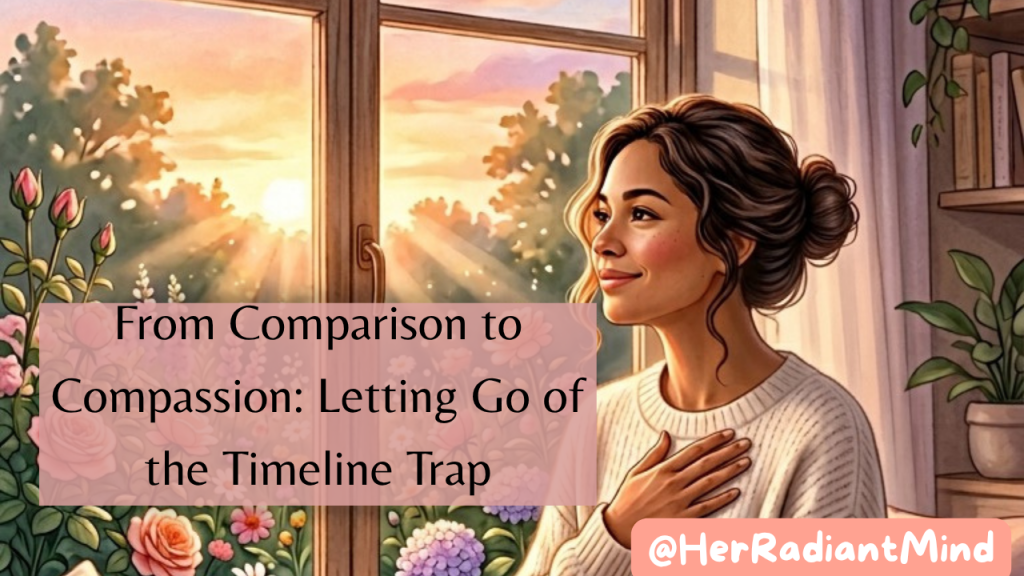
    From Comparison to Compassion: Letting Go of the Timeline Trap

    The Moment Everything Feels “Too Late”

    Ever had that gut-punch moment when you scroll through social media, and it feels like everyone else is sprinting ahead while you’re… stuck at a red light?

    Someone’s getting married. Someone’s buying a house. Someone’s launching their third business. And there you are — scrolling, half-proud of them, half-panicking because suddenly, all you can think is: Shouldn’t I be further by now?

    It’s that unsettling whisper that starts quietly but gets louder the longer you stare.

    It’s comparison — dressed up as motivation but secretly stealing your peace.

    If you’ve ever felt behind in your own life story, this isn’t a coincidence.

    It’s a trap — what I like to call the Timeline Trap.

    And the wild part? The Timeline Trap convinces us that real life has a finish line. That we’re supposed to “arrive” somewhere. That time is running out.

    But what if it’s not about catching up…

    What if it’s about catching yourself — with compassion?

    The Lie We All Learned Too Young

    Since we were kids, we’ve been fed invisible timelines. Go to school, pick a career, find the one, get married, buy a home, have kids — and do it all by your late 20s because, apparently, that’s when life is “supposed” to make sense.

    But where did that rule come from? Who decided your happiness should have deadlines?

    Psychologists call this social comparison theory — our brain’s habit of measuring ourselves against others to understand our own progress. It’s a natural human instinct. In primitive times, it helped us survive (you’d watch what others did to know where the food was or how to stay safe). But in the modern world, especially with social media, this instinct spirals.

    Now, instead of comparing hunting skills, we’re comparing highlight reels.

    A study from the American Psychological Association found that people who spend more time comparing their lives online report higher stress levels, lower life satisfaction, and increased anxiety. And it’s not because their lives are worse — it’s because their perception of enough keeps shifting every time they scroll.

    You could be content one minute and five minutes later, feel like you’re lightyears behind.

    Your Timeline Isn’t Late — It’s Custom-Built

    Let me tell you a story.

    A few years ago, one of my clients, let’s call her Amelia, came to me in tears because she felt like her life was a mess.

    Her friends were settling down; she was single. Her younger cousin just got promoted; she was still figuring out what she truly wanted.

    She sighed and said, “It’s like everyone’s running a race, and I’m still tying my shoes.”

    I told her something that made her pause:

    “Maybe you’re not behind. Maybe they’re just running their race.”

    Think about a garden.

    One flower doesn’t rush the other to bloom. The rose doesn’t panic because the sunflower sprouted first.

    They all unfold on their own time — and that timing is perfect because it fits them.

    The truth is, life isn’t linear. It’s layered, messy, and deeply human.

    Some people peak early. Some bloom later. Some reinvent themselves at 50 and feel more alive than ever before.

    Can you imagine telling a butterfly it’s “behind” because it was still in its cocoon? Silly, right?

    That’s exactly what we do to ourselves.

    The Science of Feeling “Behind”

    Here’s something fascinating: your brain is hardwired to notice gaps. When it sees someone achieving something you haven’t, it lights up the same area that reacts to physical pain.

    Functional MRI scans have shown that social rejection, criticism, or comparison light up the brain’s anterior cingulate cortex — the same spot triggered when you stub your toe. In short, comparison doesn’t just hurt emotionally. It actually hurts.

    Your brain says, “Danger! You’re being left out of the tribe!” — even though, logically, you know life isn’t a competition.

    That’s why telling yourself “I shouldn’t compare” doesn’t work. You can’t shut off biology with logic.

    But here’s the empowering part: you can redirect that instinct.

    Instead of turning comparison inward (“Why not me?”), what if you used it as a mirror to notice what you desire instead of what you lack?

    The key isn’t stopping comparison — it’s changing what you do after you notice it.

    The Compassion Shift

    The antidote to comparison isn’t confidence. It’s compassion.

    Compassion says: I see where I am, and I’m still enough.

    It’s the voice that whispers, “You’re doing your best — and that matters.”

    You can’t shame yourself into progress. Real growth comes from gentleness mixed with honest reflection.

    And ironically, the more compassion you give yourself, the faster you move forward — because you’re no longer stuck fighting yourself along the way.

    Think of your inner critic like a scared kid. Yelling at it won’t calm it down. But listening to it — understanding why it feels left behind — that heals something deeper.

    Self-compassion researcher Dr. Kristin Neff explains it beautifully: people who practice self-kindness are more motivated, not less. Because when failure or comparison show up, they don’t crumble — they recover quicker.

    In other words, compassion isn’t weakness — it’s your reset button.

    Signs You’re Caught in the Timeline Trap

    Awareness is step one. Here’s how to know if comparison’s been running the show lately:

    • You feel anxious when seeing someone’s “success update” online.
    • You measure your worth by milestones — age, career, relationships.
    • You keep saying, “I should be further by now.”
    • You find it hard to celebrate others without wondering what’s wrong with you.
    • You rush through your life, chasing invisible deadlines.

    If any of these hit home, first — deep breath.

    Nothing’s wrong with you. You’re human. But maybe it’s time to rewrite the timeline narrative.

    How to Step Out of the Timeline Trap

    1. Name the Story You’re Living

    Ask yourself, “What story am I telling myself about where I should be?”

    Write it down.

    Then ask, “Who gave me that timeline — me, or someone else?”

    Most of the time, it’s not even your story. It’s society’s default script. Real freedom starts when you realize you can lay that script down and write your own.

    2. Limit Comparison Triggers

    Notice who or what triggers your “I’m behind” spiral. Is it a specific influencer, group chat, or friend?

    It doesn’t mean you’re jealous. It means that interaction activates a wound.

    Take space. Curate your environment the same way you’d declutter your home — with love, not guilt.

    3. Redefine Success by Feeling, Not Milestones

    Instead of asking, “What should I have achieved by now?” ask, “How do I want to feel in my daily life?”

    Fulfillment, peace, excitement — those aren’t age-restricted.

    Measure success by alignment, not a checklist.

    4. Practice Small Acts of Self-Compassion

    It could be as simple as saying to yourself, “It’s okay to be where I am.”

    Or writing a letter to your younger self — thanking her for getting you this far.

    Try this compassion check-in:

    Every time you catch yourself feeling behind, place your hand on your chest and say, “Even if this isn’t where I pictured myself, I’m proud of how far I’ve come.”

    Science backs this up — physical touch paired with positive self-talk actually regulates your nervous system and lowers cortisol.

    5. Surround Yourself With Real Conversations

    Find spaces where people talk honestly about the in-betweens of life — not just the wins.

    That’s why I created the HerRadiantMind community: a place where “progress” isn’t about performing, but about being real.

    Because when we normalize growth that doesn’t look perfect, comparison loses its grip.

    The Butterfly Moment

    Let me circle back to Amelia.

    A few months after our session, she texted me a photo — her smiling on a solo trip to Thailand.

    The caption read: “Finally stopped waiting for the right time — I realized I’m the one who decides it.”

    She didn’t suddenly figure out her entire life. She simply stepped out of the Timeline Trap and into compassion.

    Now, when she scrolls and sees others doing things differently, she smiles — because she knows her timing isn’t wrong. It’s hers.

    That smile? That’s what real freedom looks like.

    The Truth About “Late Bloomers”

    History is full of people who bloomed “late.”

    • Vera Wang didn’t design her first dress until she was 40.
    • Oprah got fired from her first TV job at 23.
    • Colonel Sanders started KFC at 65.

    Imagine if they’d quit because society said they were “behind.”

    You’re not behind; you’re becoming.

    Your timing is not a mistake — it’s medicine.

    Your Timeline, Rewritten

    What if, just for today, you stopped racing and started trusting?

    What if you believed that every delay, detour, and dead end was quietly shaping the deeper strength you’re going to need for what’s coming next?

    You don’t have to rush the blooming.

    You just have to keep growing.

    Comparison says, “Hurry up.”

    Compassion says, “You’re exactly where you need to be.”

    One keeps you trapped.

    The other sets you free.

    Let’s Bring It Home

    If you’ve been stuck in comparison lately — questioning your worth, your timing, or your direction — I want you to pause and breathe this in: you are not behind.

    Your journey isn’t supposed to look like anyone else’s.

    You are the author, not the audience. Rewrite the plot whenever you need.

    And if you want deeper support shifting from self-doubt to self-worth, that’s what I help you do inside HerRadiantMind Coaching. Together, we’ll clear the noise, ground you in your inner peace, and help you create a life that feels in tune — not “on time.”

    Because your timeline isn’t late. It’s sacred.

    And it’s waiting for you to own it.

    If you’ve been nodding along, it’s time to take the next step. The Radiant Reset is my 12-week coaching program designed to help women just like you reclaim energy, confidence, and resilience. 

    Thank you for spending this time with me.

    Remember—healing is not linear, and growth doesn’t have to be loud to be powerful.

    Keep choosing yourself, one gentle moment at a time.💖

    Until next time, stay radiant and take tender care of your beautiful mind and body.

    With love,

    — Christabel, HerRadiantMind
  • How to Protect Your Peace Without Cutting Everyone Off

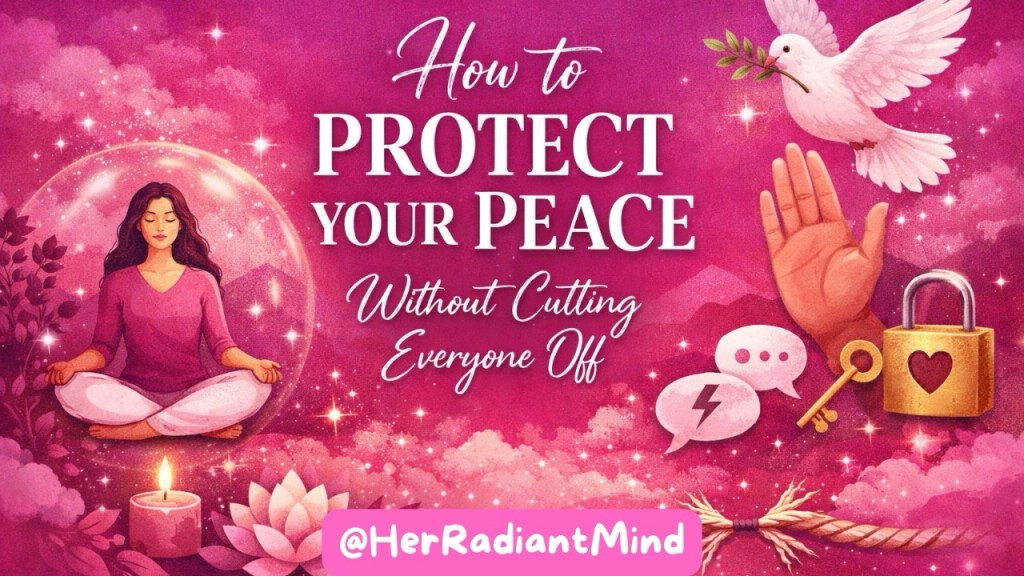
    How to Protect Your Peace Without Cutting Everyone Off

    You ever notice how “protecting your peace” has started sounding like a solo survival mission?

    Like the only way to stay sane is to delete half your contacts, ignore every text, and disappear into the woods with your tea and affirmations?

    Here’s the truth:

    You don’t have to ghost everyone to stay grounded.

    Real peace isn’t found in isolation — it’s built through boundaries.

    And while “cut them off” makes a snappy quote, it’s not always growth. Sometimes it’s just avoidance dressed up as empowerment.

    If you’ve ever whispered, “I just can’t deal anymore,” this is for you.

    Let’s talk about how to protect your peace — without turning your heart into a gated community.

    Why “Protecting Your Peace” Gets Misunderstood

    The phrase went viral because we’re overstimulated, overextended, and emotionally exhausted.

    But peace isn’t built by blocking everyone who irritates you.

    It’s built through emotional regulation — your ability to stay steady even when someone tests your limits.

    Psychology calls this emotional resilience — the skill of staying calm and intentional instead of reactive.

    Your nervous system is wired like an alarm. When someone crosses a boundary, your brain shouts:

    Danger. Protect yourself.

    If you never learned how to reset that alarm, you go into:

    • Fight (argue, snap)
    • Flight (avoid, ghost)
    • Freeze (shut down)

    The goal isn’t eliminating every trigger.

    The goal is strengthening your response.

    Peace is a muscle. And it gets stronger with practice.

    Why Cutting Everyone Off Doesn’t Create Lasting Peace

    Maybe you’ve tried it.

    You decide, “That’s it. I’m done with anyone who drains me.”

    At first? It feels quiet. Empowering.

    But eventually, something else creeps in — loneliness.

    Humans are wired for connection. Social neuroscience shows that the brain processes rejection similarly to physical pain. We aren’t designed for isolation — we’re designed for regulated connection.

    True peace isn’t the absence of people.

    It’s the presence of balance.

    Solitude heals in doses.

    Isolation protects temporarily.

    Boundaries sustain long-term peace.

    The Real Peace Leaks: Overgiving and Weak Boundaries

    Most peace doesn’t disappear because people are terrible.

    It disappears because we say yes when our nervous system is screaming no.

    Being kind does not mean being endlessly available.

    Try this simple Energy Audit:

    At the end of the day, ask:

    • What energized me?
    • What drained me?
    • Where did I override myself?

    Patterns don’t lie.

    Boundaries aren’t walls.

    They’re fences.

    You can still see people.

    You just decide who gets access.

    What Healthy Boundaries Actually Look Like

    A boundary is not a punishment.

    It’s a promise to yourself.

    Here’s a simple framework:

    1. Notice the Body Signal

    Tight chest.

    Clenched jaw.

    Exhaustion after certain conversations.

    That’s your nervous system talking.

    2. Communicate Simply

    No over-explaining. No essays.

    Example:

    “I’m not available for that conversation right now.”

    “I need to recharge before we go deeper.”

    Clear. Calm. Direct.

    3. Hold the Line

    The first time feels uncomfortable.

    The second time feels intentional.

    By the third time, it feels like self-respect.

    Peace grows when consistency replaces guilt.

    When People Don’t Like Your Boundaries

    Here’s the uncomfortable truth:

    People who benefited from your lack of boundaries may resist your growth.

    That doesn’t mean you’re wrong.

    When you change, the dynamic changes.

    And change feels threatening to people who prefer predictability.

    Stay kind.

    Stay steady.

    Stay firm.

    The right relationships adjust.

    The 4 Levels of Protecting Your Peace

    Think of peace as layered protection — not isolation.

    Level 1: Self-Awareness

    Know your triggers.

    Know your limits.

    Know your capacity.

    Awareness removes 50% of emotional chaos.

    Level 2: Daily Regulation

    Small nervous system resets:

    • Slow breathing
    • Morning silence
    • 5-minute outdoor walks
    • Body scans

    Regulation builds resilience.

    Level 3: Clear Communication

    “I can’t take that on.”

    “That doesn’t work for me.”

    “I need space.”

    Simple sentences protect complex emotions.

    Level 4: Discernment

    Sometimes loving someone means loving them from a healthy distance.

    Not out of anger.

    Out of clarity.

    Emotional Protection vs Emotional Avoidance

    This part matters.

    Sometimes “protecting your peace” is actually avoiding discomfort.

    Real peace isn’t fragile.

    It can handle disagreement.

    It can handle tension.

    It can handle growth conversations.

    Ask yourself:

    Am I protecting my peace?

    Or am I protecting my fear?

    One expands you.

    The other shrinks you.

    Micro-Habits That Strengthen Inner Peace

    Peace is built in small moments.

    • Drink your coffee without your phone.
    • Pause before responding to triggering texts.
    • Relax your shoulders and jaw during stress.
    • Take one intentional deep breath before saying yes.

    These are micro-rebellions against chaos.

    They train your nervous system to return to calm faster.

    Digital Boundaries = Emotional Boundaries

    You cannot protect your peace without addressing tech.

    Every notification activates your stress response.

    Try:

    • Muting instead of blocking (when appropriate)
    • No scrolling 1 hour before bed
    • Unfollowing accounts that trigger comparison

    Your nervous system doesn’t know the difference between digital stress and real-life stress.

    Protect it.

    Protecting Peace in Relationships

    You can love deeply and still say:

    “I can’t hold that for you right now.”

    “I need space before we continue.”

    “I care about you, but I can’t carry this.”

    Peace and love are not opposites.

    In fact, boundaries often make love healthier.

    Because resentment grows where boundaries don’t exist.

    Final Thoughts: Peace Is Power, Not Distance

    Protecting your peace doesn’t mean becoming distant.

    It means becoming regulated.

    It means choosing calm without disconnecting from humanity.

    It means standing steady in the middle of noise and saying:

    “I will not abandon myself to keep others comfortable.”

    You can stay connected and stay grounded.

    You can love others and still love yourself.

    You can participate in life without absorbing all of it.

    That’s not isolation.

    That’s emotional maturity.

    Gentle Reflection for You

    Before you close this page, ask yourself:

    Where in my life am I leaking peace?

    What boundary have I been afraid to set?

    What would protecting my peace look like this week — not in extremes, but in small courage?

    Protecting your peace isn’t about shrinking your world.

    It’s about strengthening your center.

    And when your center is strong, you don’t have to cut everyone off.

    You simply stop cutting yourself off.

    If you’ve been nodding along, it’s

    time to take the next step. The

    Radiant Reset is my 12-week

    coaching program designed to help

    women just like you reclaim energy,

    confidence, and resilience.

    Thank you for spending this time with me.

    Remember—healing is not linear, and growth doesn’t have to be loud to be powerful.

    Keep choosing yourself, one gentle moment at a time.💖

    Until next time, stay radiant and take tender care of your beautiful mind and body.

    With love,

    — Christabel, HerRadiantMind

  • Own Your Enough-ness: A Guide to Reclaiming Your Worth and Living Radiantly

    Own Your Enough-ness: A Guide to Reclaiming Your Worth and Living Radiantly

    Have you ever felt that quiet but persistent whisper in the back of your mind? The one that says:

    “You’re not smart enough.”

    “You’re not thin enough.”

    “You’re not accomplished enough.”

    For years, I carried that whisper like an invisible backpack full of bricks. Every decision, every opportunity, every relationship was weighed down by the belief that I needed to earn my worth.

    But here’s what I’ve learned and what I want you to take to heart today: you are already enough, exactly as you are.

    This blog post is an invitation. A conversation. A journey back to yourself. By the end, my hope is that you not only understand what it means to own your enough-ness, but that you feel it in your bones, your breath, your heartbeat. Because once you do, life opens up in ways you never thought possible.

    Why “Enough” Feels So Hard to Believe

    Let’s be honest: society profits off our insecurities. Every advertisement, influencer highlight reel, or glossy magazine cover is designed to whisper that we’re missing something — and that buying, doing, or achieving more will fill that void.

    But here’s the kicker: the goalpost always moves.

    • You lose the weight, and suddenly it’s about sculpting abs.
    • You land the job, and now it’s about climbing higher.
    • You post the photo, and the likes don’t quite hit the number you hoped for.

    The cycle never ends — until you step out of it. And that begins with learning how to own your enough-ness.

    My Story: The Moment I Realized I Was Chasing Shadows

    There was a season in my life where I looked like I had it all together on the outside. I was checking every box — career, family, responsibilities. Yet inside, I felt like I was failing at an invisible test no one else could see.

    One day, while standing in front of the mirror, I caught myself whispering: “When will you finally be enough?”

    And the silence that followed was deafening.

    That was my turning point. Not a dramatic epiphany with fireworks — but a quiet, steady awakening. A decision that I was done living as if my worth was something I had to chase.

    Maybe you’ve had a similar moment. Or maybe today will be the day you choose to start writing a new story.

    What It Really Means to “Own Your Enough-ness”

    Owning your enough-ness isn’t about perfection. It’s not about convincing yourself you’ll never struggle with self-doubt again. Instead, it’s about shifting the foundation you stand on.

    Owning your enough-ness means:

    • You stop seeking validation as your main source of worth.
    • You allow yourself to rest without guilt.
    • You celebrate progress instead of punishing imperfection.
    • You choose to show up authentically, even when it feels risky.
    • You believe that your value doesn’t decrease when life gets messy.

    It’s not about becoming someone new. It’s about remembering who you’ve always been beneath the layers of expectation, comparison, and fear.

    The 5 Barriers That Keep Women From Feeling “Enough”

    Let’s name them — because awareness is the first step to dismantling them.

    1. Comparison Culture: Scrolling Instagram, seeing curated lives, and measuring your behind-the-scenes against someone else’s highlight reel.
    2. Perfectionism:Believing you must do everything flawlessly or not at all.
    3. Old Wounds & Conditioning: Childhood experiences, cultural narratives, or past relationships that planted seeds of unworthiness.
    4. Overachievement Addiction: The belief that your value is tied only to productivity and accomplishments.
    5. Silenced Self-Talk: Ignoring your own needs, dreams, or voice in order to keep the peace or fit in.

    Sound familiar? You’re not alone. These barriers are universal, but the good news is they are also reversible.

    7 Practical Ways to Start Owning Your Enough-ness

    1. Rewrite the Script

    Instead of asking, “Am I enough?” ask, “Who benefits when I believe I’m not?”

    Spoiler: it’s never you.

    2. Create a “Worthiness Ritual”

    This could be a daily affirmation, journaling prompt, or a grounding practice like placing your hand on your heart and whispering, “I am enough, always.”

    3. Set Radiant Boundaries

    Saying no isn’t rejection — it’s protection. Every boundary honors the fact that your energy and time are valuable.

    4. Surround Yourself with Mirrors, Not Critics

    Build a circle of women who reflect your brilliance back to you, not ones who thrive on competition or negativity.

    5. Redefine Success

    Instead of chasing external milestones, ask: “What does success feel like in my body?” Maybe it’s peace. Maybe it’s freedom. Maybe it’s joy.

    6. Let Go of “Someday”

    Stop waiting for the perfect conditions to live fully. Your life is happening now.

    7. Practice Radical Compassion

    When the old whispers creep in, meet them with kindness. “I hear you. But today, I choose to believe I’m enough.”

    There’s a story I love about bamboo. For years after it’s planted, bamboo shows no visible growth. It can sit underground for up to five years, appearing stagnant. But beneath the soil, it’s developing a powerful root system.

    Then suddenly — almost overnight — it can grow over 80 feet tall.

    Maybe your enough-ness is like that bamboo. You don’t always see the progress. But every quiet act of self-love, every boundary, every moment of courage is building your roots. And one day, you’ll rise in ways that surprise even you.

    Why Owning Your Enough-ness Matters (For You and the World)

    When women stop living in the shadow of “not enough,” entire generations are changed.

    • Children grow up seeing self-worth modelled instead of self-criticism.
    • Relationships become healthier because they’re built on authenticity, not performance.
    • Careers flourish when women stop hiding and start owning their voice.

    Your enough-ness isn’t just about you. It’s about the ripple effect of your healing.

    How I Help Women Reclaim Their Enough-ness

    Through HerRadiantMind, I work with women who are tired of burnout, self-doubt, and living small. Together, we rebuild the foundation:

    • Mindset coaching to shift limiting beliefs.
    • Resilience practices to manage stress and emotional overwhelm.
    • Personalized tools to help you feel radiant in your own skin.

    If you’ve been waiting for permission to finally believe you are enough — let this be it.

    So here’s my question for you:

    👉 What would your life look like if you truly believed you were enough?

    Pause. Breathe. Imagine it.

    Now, I’d love to hear from you: share in the comments below, or if you’re ready to take this journey deeper, explore my coaching program The Radiant Reset designed to help women reclaim their energy, confidence, and enough-ness.

    You are not behind. You are not lacking. You are already whole. 🌸

    Thank you for spending this time with me.

    Remember—healing isn’t linear, and growth doesn’t have to be loud to be powerful.

    Keep choosing yourself, one gentle moment at a time.💖

    Until next time, stay radiant and take tender care of your beautiful mind and body.

    With love,

    — Christabel, HerRadiantMind
    Stay Radiant! Join the list.

  • How to Build Emotional Resilience  When You Feel Weak or Overwhelmed

    How to Build Emotional Resilience When You Feel Weak or Overwhelmed

    We often think of resilience as something reserved for the strong. The superheroes. The people who rise from ashes with flawless grace. But here’s the truth no one really talks about:

    Resilience isn’t about strength. It’s about willingness.

    Willingness to keep showing up — even when you’re tired.

    Willingness to try again — even after falling apart.

    Willingness to believe that something better is still possible — even when everything feels like it’s falling apart.

    The Quiet Kind of Resilience

    Let me tell you a quick story.

    A few years ago, I was sitting alone in my car after a long, emotionally draining day. My hands were on the steering wheel, frozen. I had nothing left in the tank. I didn’t want to go home and pretend everything was fine. I didn’t want to make dinner, fold the laundry, or do the routine things that suddenly felt like mountains.

    But even in that numb, exhausted state… I got out of the car.

    Not because I was strong. But because I was willing.

    Willing to take one more step.

    Willing to just get through that evening.

    Willing to believe that maybe — just maybe — tomorrow could feel a little lighter.

    That’s resilience. Not the flashy kind. Not the Instagrammable kind. But the real kind.

    We’ve Been Misled About What Resilience Looks Like

    We live in a world that praises strength — the kind that looks bold, busy, and loud. But real resilience doesn’t always look like power poses and motivational quotes. Sometimes, it looks like brushing your teeth after three days of depression. Sometimes, it looks like sending that scary “Can we talk?” text. Sometimes, it’s just making it out of bed.

    The American Psychological Association defines resilience as “the process of adapting well in the face of adversity, trauma, tragedy, threats, or significant sources of stress.”

    It doesn’t say “never breaks down” or “never cries in the car.”

    In other words: you don’t need to be unshakable to be resilient. You just need to be willing to come back after being shaken.

    Why Willingness is More Powerful Than Strength

    Let’s shift the lens.

    Strength is something you build.

    Willingness is something you choose.

    Willingness says:

    • “I don’t have all the answers, but I’ll take the next step.”
    • “I’m scared, but I’ll try anyway.”
    • “This hurts, but I’ll stay present with it instead of running away.”

    There’s a story about bamboo that perfectly captures this idea. When bamboo is planted, you don’t see anything for years. Nothing seems to grow. But underground, it’s developing a deep and wide root system. And then, in its fifth year, it shoots up almost 90 feet in just a few weeks.

    That’s what resilience looks like: invisible, slow, deeply rooted, and fueled by quiet, daily willingness.

    What Willingness Looks Like in Real Life

    Here are a few examples of how willingness shows up in small but mighty ways:

    1. Willingness to Feel Discomfort

    Resilient people aren’t numb to pain — they just don’t avoid it. They’re willing to feel sadness, grief, anger, and fear, knowing these feelings don’t make them weak. They make them real.

    2. Willingness to Ask for Help

    Resilience isn’t about going it alone. It’s about knowing when to reach out, when to lean in, and when to say, “I can’t do this by myself.” That takes courage — and trust.

    3. Willingness to Start Again

    Every time you get back up, even if it’s slowly… even if you need help… that’s resilience in motion. Falling is human. Getting up is willingness.

    The Problem With Waiting to Feel “Strong”

    So many of us fall into the trap of thinking, “I’ll start once I feel strong.”

    But here’s the twist: strength doesn’t come first — action does.

    You build resilience by doing, not waiting. It’s like trying to get better at swimming by standing on the shore and reading books about it. At some point, you have to get in the water.

    You’ll mess up. You’ll feel awkward. You might even panic.

    But over time? You’ll float. You’ll swim.

    You’ll stop drowning and start moving — even if it’s slow.

    Real-Life Resilience Isn’t Always Loud

    I once worked with a woman who was battling depression, burnout, and physical illness. She couldn’t hold down a job. She felt like a burden to her family. She told me she hated how “weak” she had become.

    But she kept showing up. Week after week.

    Some days she journaled. Some days she just sat in silence.

    But every single time, she was willing. Willing to try. Willing to heal. Willing to believe.

    That’s what changed everything for her.

    Not an overnight transformation — but a daily practice of staying in the game.

    The Bottom Line

    Resilience isn’t a superhero trait.

    It doesn’t require you to be fearless, unbreakable, or perfect.

    It just asks you to be willing.

    Willing to:

    • Stay with your pain instead of burying it.
    • Ask for help instead of suffering in silence.
    • Start over, again and again and again.

    If no one else has told you today — you’re already doing it. Every breath, every step, every time you say “not today, but maybe tomorrow” — you are building resilience.

    And it’s not because you’re strong.

    It’s because you’re willing.

    Looking for More?

    If this resonated with you, don’t stop here.

    Check out my other blog posts!

    And remember: even the smallest seed can grow into something extraordinary — if it’s just willing to keep reaching for the light.

    Until next time, Stay Radiant and take care of your beautiful mind & body⭐️

    Christabel E. (HerRadiantMind)

    Stay Radiant- Join the list