Category: General

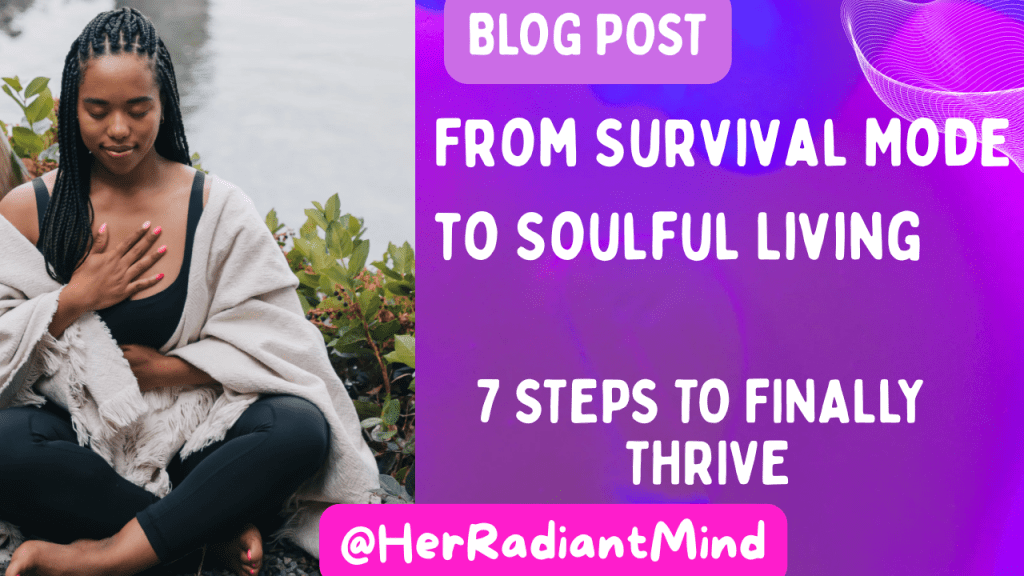
  • From Survival Mode to Soulful Living: 7 Steps to Finally Thrive

    From Survival Mode to Soulful Living: 7 Steps to Finally Thrive

    Have you ever felt like life has become one endless to-do list?

    Wake up. Work. Take care of everyone else. Crash into bed. Repeat.

    You tell yourself, “I’m fine… this is just what life is right now.”

    But deep down, you know you’re not really living — you’re surviving.

    If this feels familiar, you’re not alone. So many women are carrying invisible weights: the pressure to show up for others, to keep it all together, to never drop the ball. Survival mode becomes our default setting — and over time, it drains our energy, joy, and sense of self.

    But here’s the truth: you were never meant to just survive. You were meant to thrive — to feel alive, radiant, and connected to your soul.

    In this post, I’ll walk you through 7 steps to shift from survival mode into soulful living, so you can finally reclaim your energy, confidence, and joy.

    Let’s dive in.

    What Does Survival Mode Really Look Like?

    Survival mode isn’t always obvious. It doesn’t always mean lying in bed all day or crying every night (though it can). Sometimes, it’s far more subtle:

    • Saying “yes” when your whole body is screaming “no.”
    • Feeling guilty for resting.
    • Living on autopilot — doing the motions without feeling present.
    • Being constantly tired, even after a full night’s sleep.
    • Feeling like life is happening to you, not with you.

    👉 If any of these ring true, you’re not broken. You’re human. Your body and mind are trying to protect you by conserving energy.

    But the cost? You lose touch with your own aliveness. That’s where the shift to soulful living begins.

    What Is Soulful Living?

    Soulful living is more than just “self-care” or taking a bubble bath (though those have their place!).

    It’s about living with intention. Choosing to listen to your body, your intuition, and your desires. It’s about creating space for what lights you up instead of being consumed by what drains you.

    When you’re thriving in soulful living, you:

    • Wake up with purpose.
    • Feel grounded instead of rushed.
    • Set boundaries with love (without guilt).
    • Make decisions that align with your values.
    • Feel nourished — mind, body, and spirit.

    Sound impossible? I promise it’s not. With small but intentional steps, you can begin to shift out of survival and into soulful thriving.

    The 7 Steps to Finally Thrive

    Step 1: Pause and Acknowledge Where You Are

    The first step in any transformation is awareness.

    Take a deep breath. Ask yourself: Am I surviving or am I thriving?

    Don’t judge your answer. This is about honesty, not shame. Survival mode doesn’t mean you’ve failed — it means you’ve been strong enough to keep going, even under pressure. That’s something to honor.

    Journal prompt: What does survival mode look like in my life right now?

    Step 2: Release the Guilt Around Rest

    One of the biggest survival-mode traps? Believing rest is “lazy.”

    But rest is not a luxury — it’s repair. Your nervous system needs moments of calm to reset. Without them, you’ll always be running on empty.

    Try this: give yourself permission to schedule guilt-free downtime. Even 15 minutes of quiet can shift your energy from “frazzled” to “centered.”

    Remember: you cannot pour from an empty cup.

    Step 3: Redefine Success on Your Terms

    Many women stay stuck in survival mode because they’re chasing someone else’s version of success.

    Society tells us success looks like endless productivity, a spotless house, and constant achievement. But soulful living asks: What does success mean to YOU?

    Maybe it’s waking up without an alarm clock.

    Maybe it’s finally writing that book.

    Maybe it’s having slow breakfasts with your kids.

    Action step: Write down 3 ways your version of success looks different from what you’ve been told.

    Step 4: Tune Into Your Body’s Wisdom

    When you’re in survival mode, you disconnect from your body — ignoring signals like exhaustion, tension, or anxiety.

    But your body is always whispering clues. Pay attention:

    • Where do you feel tension most often?
    • What activities make you feel heavy vs. energized?
    • What foods, people, or routines leave you drained?

    Soulful living starts by listening inward. Your body is not your enemy; it’s your compass.

    Step 5: Set Boundaries That Protect Your Energy

    Here’s a hard truth: if you’re constantly drained, it’s often because you’re giving away energy to things (or people) that don’t deserve it.

    Boundaries aren’t walls — they’re bridges to the life you want.

    Practice saying:

    • “I can’t commit to that right now.”
    • “That doesn’t work for me.”
    • “I need some time for myself today.”

    At first, it feels uncomfortable. But over time, boundaries create freedom. They give you space to thrive.

    Step 6: Reconnect With What Brings You Joy

    In survival mode, joy becomes an afterthought. You’re so busy “getting through the day” that you forget what lights you up.

    Think back: what did you love as a child? Painting? Dancing? Exploring outside?

    Joy isn’t frivolous — it’s fuel. When you prioritize joy, you send yourself a powerful message: I deserve to feel alive.

    Try this: Write a “Joy List” of 10 small things that make you feel good. Commit to doing at least one this week.

    Step 7: Create a Vision for Thriving

    Thriving doesn’t happen by accident — it happens by intention.

    Close your eyes. Imagine your most radiant self six months from now.

    • What does she do each morning?
    • How does she move through her day?
    • What energy does she carry?

    Now write it down. This is your vision — your roadmap for soulful living.

    Even if you don’t believe it fully yet, hold onto it. Every small choice you make in alignment with that vision will pull you closer.

    The Gentle Truth About Thriving

    Here’s what I need you to know: thriving isn’t about constant joy, perfect routines, or never feeling stressed again.

    It’s about building a life that feels yours. A life where you are present, aligned, and alive.

    Some days will still feel heavy — but when you’re thriving, you’ll know how to return to yourself instead of losing yourself.

    Final Thoughts: Your Next Step

    If you’re reading this, it means part of you is ready. Ready to stop surviving. Ready to step into something more radiant, aligned, and soulful.

    You don’t have to do it alone.

    This is why I created HerRadiantMind coaching — to help women just like you move beyond burnout, rewrite their inner stories, and finally thrive.

    ✨ You deserve a life that feels good on the inside, not just one that looks good on the outside.

    Call to Action (CTA)

    Ready to shift from survival to soulful living?

    Let’s create your personalized roadmap to thriving.

    👉 Book your free clarity call with HerRadiantMind today

    Because surviving isn’t enough anymore. It’s your time to thrive.

    Thank you for spending this time with me.

    Remember—healing isn’t linear, and growth doesn’t have to be loud to be powerful.

    Keep choosing yourself, one gentle moment at a time.💖

    Until next time, stay radiant and take tender care of your beautiful mind and body.

    With love and light,

    — Christabel, HerRadiantMind

    Stay Radiant! Join our list

  • Own Your Enough-ness: A Guide to Reclaiming Your Worth and Living Radiantly

    Own Your Enough-ness: A Guide to Reclaiming Your Worth and Living Radiantly

    Have you ever felt that quiet but persistent whisper in the back of your mind? The one that says:

    “You’re not smart enough.”

    “You’re not thin enough.”

    “You’re not accomplished enough.”

    For years, I carried that whisper like an invisible backpack full of bricks. Every decision, every opportunity, every relationship was weighed down by the belief that I needed to earn my worth.

    But here’s what I’ve learned and what I want you to take to heart today: you are already enough, exactly as you are.

    This blog post is an invitation. A conversation. A journey back to yourself. By the end, my hope is that you not only understand what it means to own your enough-ness, but that you feel it in your bones, your breath, your heartbeat. Because once you do, life opens up in ways you never thought possible.

    Why “Enough” Feels So Hard to Believe

    Let’s be honest: society profits off our insecurities. Every advertisement, influencer highlight reel, or glossy magazine cover is designed to whisper that we’re missing something — and that buying, doing, or achieving more will fill that void.

    But here’s the kicker: the goalpost always moves.

    • You lose the weight, and suddenly it’s about sculpting abs.
    • You land the job, and now it’s about climbing higher.
    • You post the photo, and the likes don’t quite hit the number you hoped for.

    The cycle never ends — until you step out of it. And that begins with learning how to own your enough-ness.

    My Story: The Moment I Realized I Was Chasing Shadows

    There was a season in my life where I looked like I had it all together on the outside. I was checking every box — career, family, responsibilities. Yet inside, I felt like I was failing at an invisible test no one else could see.

    One day, while standing in front of the mirror, I caught myself whispering: “When will you finally be enough?”

    And the silence that followed was deafening.

    That was my turning point. Not a dramatic epiphany with fireworks — but a quiet, steady awakening. A decision that I was done living as if my worth was something I had to chase.

    Maybe you’ve had a similar moment. Or maybe today will be the day you choose to start writing a new story.

    What It Really Means to “Own Your Enough-ness”

    Owning your enough-ness isn’t about perfection. It’s not about convincing yourself you’ll never struggle with self-doubt again. Instead, it’s about shifting the foundation you stand on.

    Owning your enough-ness means:

    • You stop seeking validation as your main source of worth.
    • You allow yourself to rest without guilt.
    • You celebrate progress instead of punishing imperfection.
    • You choose to show up authentically, even when it feels risky.
    • You believe that your value doesn’t decrease when life gets messy.

    It’s not about becoming someone new. It’s about remembering who you’ve always been beneath the layers of expectation, comparison, and fear.

    The 5 Barriers That Keep Women From Feeling “Enough”

    Let’s name them — because awareness is the first step to dismantling them.

    1. Comparison Culture: Scrolling Instagram, seeing curated lives, and measuring your behind-the-scenes against someone else’s highlight reel.
    2. Perfectionism:Believing you must do everything flawlessly or not at all.
    3. Old Wounds & Conditioning: Childhood experiences, cultural narratives, or past relationships that planted seeds of unworthiness.
    4. Overachievement Addiction: The belief that your value is tied only to productivity and accomplishments.
    5. Silenced Self-Talk: Ignoring your own needs, dreams, or voice in order to keep the peace or fit in.

    Sound familiar? You’re not alone. These barriers are universal, but the good news is they are also reversible.

    7 Practical Ways to Start Owning Your Enough-ness

    1. Rewrite the Script

    Instead of asking, “Am I enough?” ask, “Who benefits when I believe I’m not?”

    Spoiler: it’s never you.

    2. Create a “Worthiness Ritual”

    This could be a daily affirmation, journaling prompt, or a grounding practice like placing your hand on your heart and whispering, “I am enough, always.”

    3. Set Radiant Boundaries

    Saying no isn’t rejection — it’s protection. Every boundary honors the fact that your energy and time are valuable.

    4. Surround Yourself with Mirrors, Not Critics

    Build a circle of women who reflect your brilliance back to you, not ones who thrive on competition or negativity.

    5. Redefine Success

    Instead of chasing external milestones, ask: “What does success feel like in my body?” Maybe it’s peace. Maybe it’s freedom. Maybe it’s joy.

    6. Let Go of “Someday”

    Stop waiting for the perfect conditions to live fully. Your life is happening now.

    7. Practice Radical Compassion

    When the old whispers creep in, meet them with kindness. “I hear you. But today, I choose to believe I’m enough.”

    There’s a story I love about bamboo. For years after it’s planted, bamboo shows no visible growth. It can sit underground for up to five years, appearing stagnant. But beneath the soil, it’s developing a powerful root system.

    Then suddenly — almost overnight — it can grow over 80 feet tall.

    Maybe your enough-ness is like that bamboo. You don’t always see the progress. But every quiet act of self-love, every boundary, every moment of courage is building your roots. And one day, you’ll rise in ways that surprise even you.

    Why Owning Your Enough-ness Matters (For You and the World)

    When women stop living in the shadow of “not enough,” entire generations are changed.

    • Children grow up seeing self-worth modelled instead of self-criticism.
    • Relationships become healthier because they’re built on authenticity, not performance.
    • Careers flourish when women stop hiding and start owning their voice.

    Your enough-ness isn’t just about you. It’s about the ripple effect of your healing.

    How I Help Women Reclaim Their Enough-ness

    Through HerRadiantMind, I work with women who are tired of burnout, self-doubt, and living small. Together, we rebuild the foundation:

    • Mindset coaching to shift limiting beliefs.
    • Resilience practices to manage stress and emotional overwhelm.
    • Personalized tools to help you feel radiant in your own skin.

    If you’ve been waiting for permission to finally believe you are enough — let this be it.

    So here’s my question for you:

    👉 What would your life look like if you truly believed you were enough?

    Pause. Breathe. Imagine it.

    Now, I’d love to hear from you: share in the comments below, or if you’re ready to take this journey deeper, explore my coaching program The Radiant Reset designed to help women reclaim their energy, confidence, and enough-ness.

    You are not behind. You are not lacking. You are already whole. 🌸

    Thank you for spending this time with me.

    Remember—healing isn’t linear, and growth doesn’t have to be loud to be powerful.

    Keep choosing yourself, one gentle moment at a time.💖

    Until next time, stay radiant and take tender care of your beautiful mind and body.

    With love,

    — Christabel, HerRadiantMind

    Stay Radiant! Join the list.

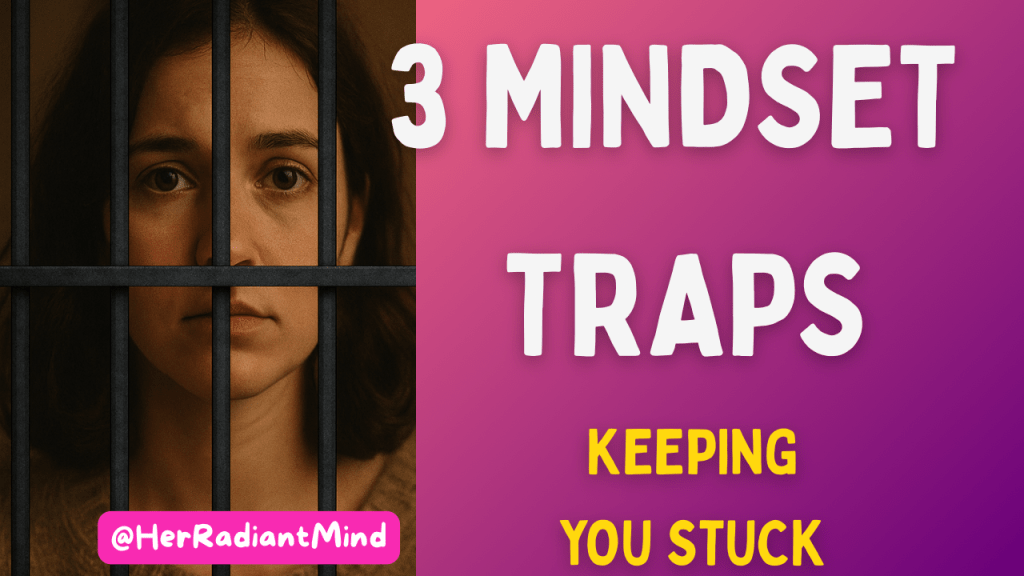
  • 3 Hidden Mindset Traps Keeping You Stuck (and How to overcome limiting beliefs)

    3 Hidden Mindset Traps Keeping You Stuck (and How to overcome limiting beliefs)

    Stop scrolling for a second.

    You’re not lazy. You’re not broken.

    But… what if I told you there’s a mental trap — one you don’t even realize you’re in — quietly sabotaging your progress every single day?

    And here’s the kicker… you probably think it’s just “how you are.”

    If you’ve ever felt like you’re pushing and pushing — but something invisible keeps dragging you back — this article is your wake-up call.

    Today, I’m breaking down 3 of the most common mindset traps I see in smart, capable, hard-working women that keep them stuck in self-doubt, burnout, and people-pleasing mode.

    And as you read, I want you to catch yourself in real time thinking: “Oh… she’s talking about me.”

    Because once you spot these traps, you can finally break them.

    Ready? Let’s dive in.

    🧠 Trap #1 — “I’ll Feel Ready When I’m Confident Enough”

    Let’s talk about confidence.

    Quick question — have you ever said something like:

    • “Once I feel confident, I’ll apply for that job.”
    • “When I finally believe in myself, I’ll start that side business.”
    • “I’ll have that hard conversation when I’m brave enough.”

    I get it. It feels safe to wait until the confidence magically shows up.

    But here’s the truth nobody told us growing up:

    Confidence doesn’t come before action — it comes from action.

    It’s like waiting to get warm before stepping into the sunlight. You have to step into the light first.

    📌 Why this keeps you stuck:

    Because it creates a loop.

    No confidence → no action → no proof → still no confidence.

    Sound familiar?

    👩‍🦰 Maria’s Story

    Maria, a 38-year-old teacher, told me she felt too insecure to start a side business she had been dreaming of for years.

    When we dug deeper, it turned out she wasn’t really lacking confidence at all — she was terrified of rejection.

    So we tried something radical: tiny daily bravery.

    • One DM.
    • One short video.
    • One email.

    That was it. No huge leaps, just tiny steps.

    Two weeks later? She was glowing. Not because she’d magically “become confident,” but because she had collected proof that she could do it scared.

    💡 Your takeaway:

    Stop waiting to feel ready. Start small. Let courage build the confidence.

    And here’s a cliffhanger for you: this particular trap is way more common in women than men — and the reason why might shock you. (We’ll circle back to this in a moment.)

    🧠 Trap #2 — “If I Slow Down, Everything Will Fall Apart”

    Now, this one is for my burnout warriors.

    Be honest with yourself: do you ever feel like the moment you even think about resting, your brain hisses things like—

    • “You’re being lazy.”
    • “You’ll fall behind.”
    • “Everyone’s counting on you.”

    If so, you’re not alone.

    📌 Why this keeps you stuck:

    Because somewhere along the way, your worth became tied to how much you do, not who you are.

    You’ve been praised your whole life for being the one who holds it all together. So now, slowing down feels unsafe — almost like failure.

    😴 Real-Life Example:

    One of my clients literally felt sick with guilt on her days off.

    She would “rest” by… organizing closets. Doing laundry. Planning next week’s meals.

    Until we tried reframing rest as resistance.

    Rest wasn’t laziness — it was a radical act of self-preservation.

    And when her nervous system learned that rest = fuel, not failure?

    The world didn’t fall apart.

    Her body finally had space to heal.

    💡 Your takeaway:

    If you’re always exhausted, maybe it’s not a time management problem.

    Maybe it’s a permission problem.

    🧠 Trap #3 — “Other People’s Needs Matter More Than Mine”

    Okay… deep breath for this one.

    If you grew up in a home where love felt conditional — where being helpful, kind, or quiet kept you safe — putting yourself last probably feels normal.

    Maybe you catch yourself saying things like:

    • “I don’t want to disappoint anyone.”
    • “It’s easier to just say yes.”
    • “I’ll deal with my stuff later.”

    📌 Why this keeps you stuck:

    Every time you silence your needs, you teach your brain that your needs don’t matter.

    👩‍🦱 Jamila’s Story:

    Jamila, a mom of three, couldn’t remember the last time she did something just for herself.

    When she realized this, she cried. Not because she was weak, but because she recognized she had been invisible to herself for years.

    We started small: 10 minutes of alone time per day. That’s it.

    Months later? She had boundaries. She was asking for help. And the kicker — she wasn’t drowning in guilt anymore.

    💡 Your takeaway:

    You’re not selfish for having needs.

    Every time you choose yourself, you’re teaching your brain that you matter.

    🧩 What These Traps Have in Common

    Now… what do these three traps have in common?

    They keep you performing, pleasing, and perfecting — instead of living, resting, and receiving.

    They convince you that your worth is conditional.

    And here’s the sneaky part: even when you know they’re traps, your brain will pull you back to what’s familiar — even if it’s painful.

    Why?

    Because the brain is wired for familiarity, not freedom.

    Unless you choose differently — consciously — every single day.

    🔍 Why Women Fall Into These Traps More Than Men

    Let’s circle back to Trap #1 for a second, because this is where things get fascinating.

    From the time we’re little girls, many of us are praised for “getting it right” rather than just trying.

    • Boys are encouraged to take risks, mess up, and bounce back.
    • Girls are taught to avoid failure at all costs.

    By adulthood, that conditioning becomes a silent rule:

    “If I’m not 100% sure I’ll succeed, I shouldn’t even try.”

    Layer on top of that:

    • Workplace bias that makes women’s mistakes more visible and judged more harshly.
    • The “confidence gap” — where equally capable women rate themselves lower than men.
    • A cultural double standard where men taking risks are called “bold,” but women are labeled “reckless” or “too ambitious.”

    So it’s not that women lack confidence.

    It’s that we’ve been taught to believe we need confidence first — instead of seeing it as something we earn through action.

    And that’s why this trap grips us harder: the fear of being judged for failing is heavier. So we wait until we “feel ready”… and keep waiting.

    🔥 The Shift You’ve Been Waiting For

    Here’s the part I want you to tattoo on your brain:

    Your life won’t change because you read one more book or hustle harder.

    It changes when you pause long enough to hear your own truth again.

    The truth that says:

    • You’re allowed to take up space.
    • You don’t have to earn rest.
    • Your worth is non-negotiable.

    And yes, guilt will show up at first.

    That’s not a sign you’re wrong — it’s proof you’re breaking generational patterns.

    Do it anyway.

    🧾 Quick Recap — The 3 Traps + Your Next Step

    So here’s your cheat sheet:

    1️⃣ Waiting to feel confident before taking action → Act first. Courage grows confidence.

    2️⃣ Believing rest = laziness → Rest is fuel. Your worth isn’t tied to output.

    3️⃣ Putting yourself last → Choosing yourself isn’t selfish — it’s sacred.

    Mindset work isn’t about becoming someone new.

    It’s about remembering who you were before the world told you to be someone else.

    So, which of these 3 traps has been running your life lately?

    Drop it in the comments — and in my next post, I’ll show you how to rewire your brain so these traps lose their power for good.

    🌟 Final Word

    You’re not lazy.

    You’re not broken.

    You’ve just been living inside mental traps that were designed by old patterns, old fears, and old conditioning.

    But the moment you spot them? You hold the key to breaking free.

    It’s not about becoming fearless.

    It’s about learning to act, rest, and choose yourself even with the fear.

    Because freedom doesn’t come from waiting.

    It comes from choosing.

    So tell me… which trap are you ready to walk out of today? 👇

    Thank you for spending this time with me.

    Remember—healing isn’t linear, and growth doesn’t have to be loud to be powerful.

    Keep choosing yourself, one gentle moment at a time.💖

    Until next time, stay radiant and take tender care of your beautiful mind and body.

    With love,

    — Christabel, HerRadiantMind

    Stay Radiant! Join the list.

  • Authentic Living in a Filtered World: A Guide to Being True to Yourself

    Authentic Living in a Filtered World: A Guide to Being True to Yourself

    Feeling fake, exhausted, or like you’re living someone else’s life? This may be why.

    Maybe it’s subtle. You smile when you don’t mean it. You say “I’m fine” when your chest feels heavy. You post something online and immediately wonder if it was “too much.”

    Here’s the truth: Most of us are more filtered than we realize—and it’s slowly killing our joy.

    In a world of curated content, highlight reels, and expectations to always have it together, it’s easy to lose yourself. But behind the polished posts and polite conversations, there’s often a quiet ache.

    And that ache is telling you something:

    You weren’t made to perform.

    You were made to live—freely, fully, and truthfully.

    Are You Performing Your Life Instead of Living It?

    Let’s be honest. When was the last time you showed up online—or even in real life—without tweaking, editing, or second-guessing?

    No filter. No polish. Just real, raw you.

    If you can’t remember, you’re not alone.

    From childhood, we’re trained to “be nice,” “read the room,” and “not rock the boat.” We learn early on how to mask our quirks, tone down our truths, and fit in.

    Then social media shows up and amplifies the performance.

    What used to be a mask we wore at work or family gatherings became a full-time persona—curated, filtered, and socially approved. Even our emojis are calculated. And the cost?

    We start feeling like strangers in our own lives.

    The Hidden Mental Cost of Constant Filtering

    Living out of alignment—constantly editing yourself to be more palatable—creates deep emotional and psychological stress.

    You might not notice it at first, but it shows up like this:

    • That low-grade anxiety that never seems to go away
    • Overthinking your words in every conversation
    • Saying “yes” to things you want to scream “no” to
    • Feeling hollow, even when people are praising you
    • Wondering: “Is this what I really want… or just what’s expected of me?”

    Eventually, you forget what the real you even sounds like.

    A study from the University of Houston found that suppressing your authentic self leads to higher rates of anxiety, depression, and even relationship dissatisfaction. Another from the Journal of Social Psychology revealed that people who live more authentically experience greater self-worth, stronger connections, and overall life satisfaction.

    Translation? Faking it doesn’t make you happy—it makes you tired, lonely, and lost.

    What It Really Means to Live Authentically

    Now let’s be clear: Authenticity isn’t about baring your soul 24/7 or rejecting every societal norm.

    It’s about alignment.

    It means your outer life reflects your inner truth. It’s the courage to let who you really are inform how you show up—at home, at work, online, and in your relationships.

    Here’s what that journey looks like in real life.

    A True Story: From Pretending to Living

    One of my clients had everything that looked “right”: a stable job, a long-term partner, a gorgeous home, and a warm Instagram feed filled with smiling selfies.

    But inside? She felt invisible in her own life.

    She couldn’t remember the last time she did something just for her. She didn’t know what she liked, what she believed, or what lit her up. Every decision was filtered through the lens of approval: “Will they like this?” “Does this look okay?”

    Everything changed when she finally whispered the truth out loud:

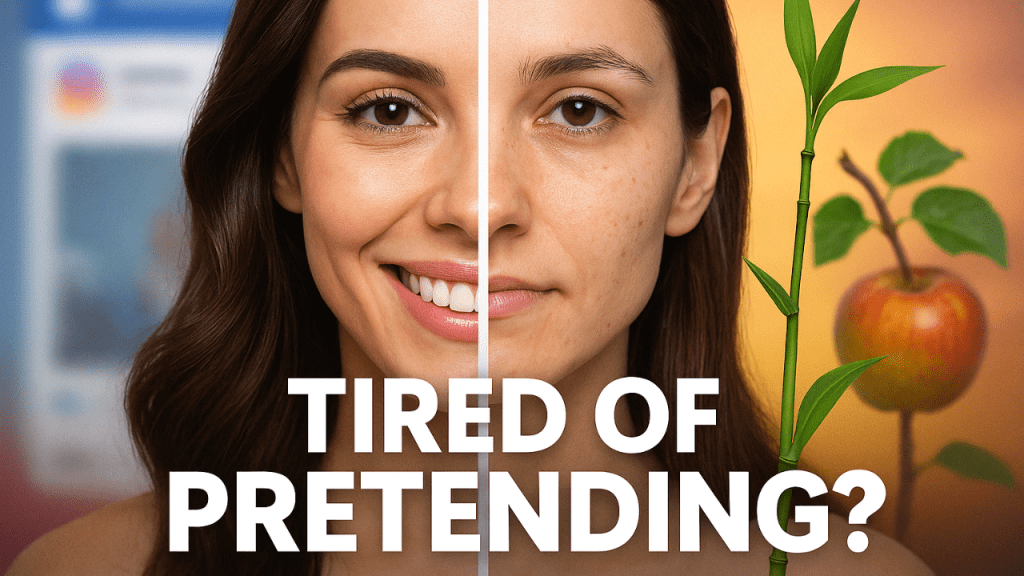
    “I’m tired of pretending.”

    Here’s how she began the journey back to herself:

    Step 1: She stopped filtering her truth.

    She didn’t rage-quit her job or call out everyone on social media.

    She just got honest—in small ways.

    When someone asked “How are you?” she paused and said, “Honestly? A little overwhelmed today.”

    Step 2: She asked herself what felt true.

    Instead of defaulting to what looked good or what was expected, she began checking in:

    “Does this feel aligned with who I really am?”

    That one question changed how she dressed, how she spoke, how she moved through her life.

    Step 3: She allowed the discomfort.

    Because yes—being real is risky.

    Not everyone will get it. Some people may fall away.

    But what she gained was worth everything: clarity, peace, and the freedom to be herself without apology.

    You Don’t Need to Be More. You Just Need to Be More You.

    Read that again.

    You’ve spent so long trying to improve yourself, earn approval, or fit in that you’ve forgotten your worth was never up for debate.

    Your weird laugh.

    Your strong opinions.

    Your quiet sadness.

    Your loud joy.

    It all belongs.

    Authenticity isn’t about being perfect.

    It’s about being real—and letting that be enough.

    So How Do You Start Living Unfiltered?

    You don’t need a 10-step transformation or a radical life overhaul.

    Start with one honest moment:

    • Say “no” to something that drains you.
    • Admit when you’re not okay.
    • Post something meaningful—even if it doesn’t get a lot of likes.
    • Show up as you are, not as who you think you “should” be.

    And when the voice of doubt creeps in (because it will), remind yourself:

    It’s better to be real and misunderstood than accepted for someone you’re not.

    Drop the Mask. Come Home to Yourself.

    Unmasking in a filtered world isn’t just brave—it’s healing.

    When you choose truth over performance, you give others permission to do the same. You create real connection, rooted in honesty—not perfection.

    So if you’re tired of pretending…

    If you’re done with the pressure to always smile, always please, always perform…

    Give yourself the gift of being seen.

    Not just the polished version.

    The whole, messy, beautiful truth of who you are.

    That’s where freedom begins.

    That’s where you begin.

    Thank you for taking the time to read this today. I know how exhausting it can be to keep showing up for the world while feeling disconnected from yourself. Just know—you are not alone, and you are not too far gone. Every moment you choose honesty over perfection is a step back home to yourself.

    I see you. I honor your journey. And I’m so proud of you for doing the brave work of unmasking.

    Until next time,

    Stay radiant and take gentle care of your beautiful mind and body.

    With love and light

    Christabel, HerRadiantMind

    Stay Radiant-Join the list

  • Letting Go of the Inner Critic: Reclaim Your Power and Peace

    Letting Go of the Inner Critic: Reclaim Your Power and Peace

    Subscribe to continue reading

    Subscribe to get access to the rest of this post and other subscriber-only content.

  • How to Rebuild Your Confidence After Years of Playing Small

    How to Rebuild Your Confidence After Years of Playing Small

    Introduction

    Let’s be real: playing small doesn’t protect you — it just makes you feel like a smaller version of yourself. If you’ve been living in the shadows, shrinking your voice, your power, or your presence just to feel safe or accepted… this is your reminder: you were never meant to play small. You were made to take up space — confidently, boldly, and unapologetically.

    In this blog post, we’re breaking down how to rebuild your confidence — even if it feels like you’ve lost it for good.

    Why You Started Playing Small (And Why It’s Not Your Fault)

    You didn’t wake up one day and decide to dim your light. Playing small often starts with little moments — being told you’re too loud, too ambitious, too much. It’s reinforced by criticism, rejection, and social conditioning, especially for women and marginalized voices.

    Over time, you internalize it. You start second-guessing yourself, holding back, people-pleasing — until your confidence feels like a distant memory.

    But confidence isn’t something you’re born with. It’s something you build — and you can rebuild it.

    Step 1: Reconnect With Yourself

    Before you can rebuild your confidence, you have to get reacquainted with the real you.

    Start by asking:

    • When did I feel most alive?

    • What parts of myself have I been hiding?

    • What lights me up — even if no one else is watching?

    Begin a daily habit of writing 3 things you admire about yourself. These can be traits, experiences, or small wins. Over time, you’ll start to rebuild the internal proof that you are enough — and always have been.

    Step 2: Take Micro-Risks Every Day

    Confidence doesn’t come from waiting. It comes from doing.

    Start taking small actions that stretch you:

    • Speak up when you’d normally stay quiet.

    • Share your ideas, even if they feel imperfect.

    • Say no to things that drain your energy.

    These “micro-risks” teach your nervous system that you can take up space and still be safe. The more you practice, the stronger your inner confidence becomes.

    Step 3: Rewrite the Old Narrative

    The voice in your head telling you you’re not good enough? That’s not your voice. It’s the echo of old experiences, conditioning, or fear-based thinking.

    Start by identifying your most common self-doubt stories. Then, actively rewrite them.

    For example:

    Old thought: “I’m not ready.”

    New belief: “I might be nervous, but I’m capable.”

    Confidence doesn’t require perfection — just the willingness to keep showing up, even when your inner critic gets loud.

    Step 4: Surround Yourself With People Who Reflect Your Light

    Confidence doesn’t grow in isolation — it grows in safe, supportive environments.

    Find your people:

    • Join communities that reflect your values.

    • Limit time with energy-drainers and confidence-shrinkers.

    • Follow creators and mentors who help you feel empowered, not insecure.

    Think of your confidence like a garden. The right people are the sunlight and water it needs to bloom.

    The Hard Truth: Stop Waiting for Permission

    Most people stay stuck because they’re waiting for a green light — someone to say, “Go ahead, it’s your turn.” But here’s the truth:

    No one is coming to give you permission.

    You have to give it to yourself.

    That doesn’t mean you’ll never be afraid. It means you’ll choose to act even with fear in the passenger seat.

    Final Thoughts

    Confidence is not about being the loudest person in the room.

    It’s about being so rooted in who you are that you no longer feel the need to perform, prove, or please.

    If you’ve been playing small, it’s not too late.

    You haven’t missed your chance.

    You just forgot how powerful you are.

    Now’s the time to remember — and rise.

    👉 Ready for the next step?

    Check out this post: [https://youtu.be/6gcrJLP16gQ?si=RV1lxbCfCzTnDszs”] — it’s the perfect next step if you’re reclaiming your confidence.

    Take a deep breath—you’re doing better than you think.
    With love and light,
    Christabel (HerRadiantMind)

    Stay Radiant—Join the List 

  • How to Stop Overthinking: 5 Mindset Shifts to Reclaim Your Peace and Confidence

    How to Stop Overthinking: 5 Mindset Shifts to Reclaim Your Peace and Confidence

    You don’t need more time to decide. You need to stop running mental marathons over simple stuff.

    If you’re constantly stuck in your head — replaying conversations, analyzing every outcome, and feeling paralyzed by even the smallest decision — this post is for you.

    Let’s break down what’s really keeping you stuck in the spiral of overthinking — and how to get out.

    Why You Can’t Stop Overthinking (Even When You Want To)

    If your brain feels like it has 47 tabs open — and none of them are loading — you’re not alone.

    Overthinking:

    • Steals your peace.
    • Wrecks your confidence.
    • Turns small decisions into massive stress triggers.

    But here’s the truth most people miss:

    Overthinking is not who you are. It’s a habit. A pattern.

    And habits can be changed.

    In this post, I’m sharing 5 powerful mindset shifts that will help you stop overthinking and start trusting yourself again.

    The third one? It’s the one no one talks about — and it’s probably what’s keeping you up at night.

    Mindset Shift #1: Your Brain is Wired for Survival — Not Clarity

    Your brain’s #1 job is to keep you alive, not to keep you calm.

    That’s why it constantly scans for potential threats — even in everyday situations like a meeting or text message.

    Ever find yourself replaying a weird interaction from three days ago at 2 a.m.?

    Yeah. That’s your survival brain doing its thing.

    🧠 Fun fact: A study in Science showed we make over 35,000 decisions per day.

    No wonder we’re mentally fried.

    ✨ The Shift:

    Ask yourself:

    “Is this a real problem… or am I just trying to avoid a bad feeling?”

    Fear doesn’t bring clarity. Calling out the fear does.

    Mindset Shift #2: Overthinking = Self-Doubt in Disguise

    Let’s talk about Leila.

    She’d spend 30 minutes editing a 2-sentence email. Rewrite a text 6 times. Obsess over whether her outfit was “too much.”

    What she was really saying was:

    “I don’t trust myself to get it right.”

    We often confuse overthinking with being “thorough” or “careful.”

    But underneath it? It’s self-doubt.

    ✨ The Shift:

    You don’t need to be 100% certain to move forward.

    You’re allowed to get it wrong and still be worthy.

    Confidence isn’t the absence of overthinking — it’s the courage to act despite it.

    Mindset Shift #3: You’re Not Looking for the Perfect Decision — You’re Looking for Control

    Let this one land for a moment.

    When we say, “I just need more time,” what we really mean is,

    “I’m afraid to mess this up.”

    We think if we analyze everything perfectly, we’ll avoid regret or pain.

    But perfection?

    It’s an illusion.

    ✨ The Shift:

    Ask:

    “What’s the best next step I can take with the info I have right now?”

    This shift moves you from paralysis to progress.

    From fear to curiosity.

    From control to courage.

    Mindset Shift #4: You Don’t Need More Thinking — You Need More Action

    This one might sting a little:

    You don’t need another journal entry, checklist, or heart-to-heart with your best friend.

    You need to take the next small, messy step.

    We get stuck thinking we need to figure it all out before we move.

    But clarity comes from doing, not thinking.

    💡 A study in the Journal of Behavioral Decision Making found that people who took action, even small imperfect ones, had more confidence and less regret than those who stayed in indecision.

    ✨ The Shift:

    Say this instead:

    “Let me take one small step and see how it feels.”

    Confidence isn’t born in your head — it’s built through lived experience.

    Mindset Shift #5: You Are Not Your Thoughts

    Here’s a truth bomb most people never learn:

    You are not your thoughts. You’re the one thinking them.

    Thoughts like:

    • “I’m not good enough.”
    • “They probably hate me.”
    • “I’ll never get this right.”

    …aren’t facts. They’re stories shaped by fear and conditioning.

    🧠 According to Cognitive Behavioral Therapy (CBT), one of the most powerful ways to stop overthinking is to challenge automatic thoughts, not believe them blindly.

    ✨ The Shift:

    Ask yourself:

    • Is this thought helpful?
    • Is it kind?
    • Is it even true?

    When you realize thoughts are suggestions — not instructions — you reclaim your power.

    What’s Actually Keeping You Stuck

    Most people think overthinking is about avoiding the wrong decision.

    But the real issue is this:

    Overthinking disconnects you from yourself.

    You start ignoring your gut.

    You stop trusting your own wisdom.

    You outsource your power to Google searches, Reddit threads, and opinions from people who don’t live your life.

    Why Do We Overthink in the First Place?

    Let’s break it down:

    • We were taught to fear failure.
    • We were shamed for making “wrong” choices.
    • We think being decisive means being reckless.
    • And sometimes? We just want to feel in control of a chaotic world.

    But guess what?

    ❌ Overthinking doesn’t protect you.

    ❌ It doesn’t help you grow.

    ❌ And it definitely doesn’t make life easier.

    People who build bold, fulfilling lives don’t have more certainty.

    They have more trust in themselves.

    Here’s your permission slip:

    There is no perfect decision.

    The “right” decision is not something you find.

    It’s something you create — through action, trust, and small course corrections.

    Imagine this:

    What if you dropped the need to be perfect, and started living like you could handle whatever came your way?

    Because you can.

    Final Thoughts: How to Stop Overthinking and Start Living

    Here’s a quick recap of the 5 mindset shifts to break free from overthinking:

    1. 🧠 Your brain is wired for protection, not peace.
    2. ❓ Overthinking is usually self-doubt wearing a logical mask.
    3. 🎯 You’re chasing control, not clarity.
    4. 🚶‍♀️ Action is the antidote to anxiety.
    5. 💭 You are not your thoughts — question them.

    You don’t need to overthink less.

    You just need to start trusting yourself more.

    Every decision doesn’t need to be perfect.

    It just needs to be yours.

    Remember you are not alone!

    Until next time, stay radiant!

    With love and light Christabel

    🔗 Stay connected:
    Instagram | @HerRadiantMind
    📌 Pinterest: Herradiantmind
    🌍 Website: http://www.herradiantmind.com

    Youtube: https://youtube.com/@herradiantmind?si=BkXhtAw1ABGA–k2
    Elevate your well-being with One of my coaching programs—personalized support , and exclusive resources.

    Stay Radiant—Join the List 

  • How to Let Go of Guilt and Choose Yourself

    How to Let Go of Guilt and Choose Yourself

    Have you ever said “no” to something and immediately felt a pang of guilt?

    Or taken a break—only to find your brain whispering, “You should be doing more”?

    You’re not alone.

    So many of us have been conditioned to believe that choosing ourselves is selfish. But here’s the truth that can change everything:

    Self-love is not a betrayal of others. It’s a reunion with yourself.

    There’s a version of you underneath all the guilt—the one who knows her worth, who honours her boundaries, who doesn’t apologize for taking up space.

    You don’t have to keep breaking yourself into pieces to make other people comfortable.

    You are allowed to choose yourself without the guilt, the shame, or the apology.

    And if no one has told you this today—you’re not selfish. You’re healing.

    And that’s the most courageous thing you can do.

    Why We Feel Guilty for Choosing Ourselves

    From a young age, we’re taught to put others first. We’re praised for being agreeable, helpful, selfless.

    But what happens when being selfless leads to self-abandonment?

    Over time, the message becomes internalized:

    • “Good people give everything.”
    • “Love means sacrifice.”
    • “Your needs come last.”

    And when we finally start reclaiming our time, our boundaries, or our energy—the guilt kicks in.

    But that guilt isn’t truth. It’s conditioning.

    Here’s what guilt says:

    • “If I say no, they’ll be mad at me.”
    • “If I take time for myself, I’m letting people down.”
    • “If I put myself first, that makes me selfish.”

    Here’s what self-love says:

    • “I can love people and still choose myself.”
    • “My needs matter too.”
    • “Boundaries aren’t walls. They’re doors to healthier relationships.”

    My Breaking Point

    I hit a wall years ago—emotionally, physically, and spiritually drained. I was giving to everyone but myself.

    And then one night, I sat in my car, completely numb. I had nothing left. That’s when I realized:

    No one was going to give me permission to rest—I had to give it to myself.

    That was the first step of my self-love journey. It was messy. It was emotional. But it was necessary.

    3 Areas Where Guilt Shows Up—and How to Shift It

    1. Saying No: Your peace matters. Saying no doesn’t make you selfish—it makes you self-aware. You’re not responsible for managing other people’s emotions.
    2. Taking Rest: We glorify hustle, but healing comes through rest. Rest isn’t laziness—it’s medicine.
    3. Putting Yourself First: You’re allowed to be the main character in your life. You don’t owe anyone your constant availability.

    How to Start Releasing Guilt

    • Question the guilt: Ask yourself, “Is this guilt coming from love—or from old programming?”
    • Practice mirror affirmations: Try, “I’m allowed to choose myself without guilt.”
    • Surround yourself with safe people: Healthy people respect your boundaries.
    • Do something every day that centers you—without apologizing.

    Final Thoughts

    Releasing guilt isn’t easy. But choosing yourself is the beginning of healing—not just for you, but for every woman watching you rewrite the rules.

    Releasing guilt isn’t easy. But choosing yourself is the beginning of healing—not just for you, but for every woman watching you rewrite the rules.

    You are not selfish.

    You are worthy.

    And you deserve to take up space—guilt-free.


    Stay Radiant—Join the List 

  • How to Stop People Pleasing and Step into Your Power

    How to Stop People Pleasing and Step into Your Power

    Have you ever caught yourself holding back in a conversation, shrinking just a little so someone else could feel comfortable? Maybe you said yes when you really meant no—or stayed silent just to keep the peace?

    If so, you’re not alone.

    So many women have been taught that being “nice” means being small. That being agreeable is safer than being honest.

    But what happens when you wake up one day and realize you don’t recognize the version of you who’s always shrinking just to fit in?

    Let’s talk about that.

    The Hidden Cost of People-Pleasing

    People-pleasing sounds innocent enough. After all, who doesn’t want to be kind and helpful?

    But when your need to be liked outweighs your need to be real… that’s when the harm begins.

    You:

    • Say yes to things that drain you
    • Struggle to set boundaries
    • Put everyone else’s needs ahead of your own
    • Constantly worry about what others think
    • Feel emotionally exhausted, resentful, or invisible

    It’s not just a bad habit. It’s a survival strategy.

    One you probably learned early in life to avoid conflict, earn love, or feel safe.

    But here’s the truth:

    You weren’t born to be liked by everyone. You were born to be yourself.

    Why We Start Shrinking

    Let’s pause and go deeper for a second.

    If you grew up in an environment where love was conditional—on being “good,” quiet, obedient, helpful—then it makes perfect sense that you learned to shape-shift.

    To avoid rocking the boat.

    To not take up too much space.

    To silence your needs so you wouldn’t be “too much.”

    This becomes your unconscious belief system:

    “If I stay small, I stay safe.”

    But staying small eventually becomes a cage.

    You lose touch with your own voice. You question your worth. And worst of all—you start to believe that your power is a threat instead of a gift.

    The Turning Point: Recognizing the Pattern

    Maybe that’s where you are now.

    Maybe you’re tired of saying “I’m fine” when you’re actually falling apart.

    Maybe you’re done twisting yourself into a version that’s easier for others to accept.

    Maybe you’re finally ready to stop shrinking and start rising.

    Here’s how to start.

    5 Ways to Step Out of People-Pleasing and Into Your Power

    1. Get Honest with Yourself

    Ask yourself:

    • Where am I holding back to be accepted?
    • What do I truly want—but rarely express?

    Awareness is the first key to freedom. You can’t change what you don’t acknowledge.

    2. Validate Your Own Feelings

    You don’t need someone else’s permission to feel what you feel.

    You don’t have to justify your no.

    You don’t need to explain your boundaries to be respected.

    Give yourself the emotional validation you’ve been seeking from others.

    3. Start Setting Small Boundaries

    Boundaries don’t have to be loud. Sometimes they sound like:

    • “Let me get back to you on that.”
    • “I’m not available today.”
    • “That doesn’t feel right for me.”

    You don’t need a perfect script. You just need practice. And every time you honor your truth, you build inner trust.

    4. Get Comfortable Being Uncomfortable

    Saying no might feel scary. People might be surprised. They might not like it.

    But your peace matters more than their comfort.

    Stepping into your power will feel unfamiliar at first—that’s okay. You’re not doing it wrong. You’re just doing it differently.

    5. Reconnect with Your Authentic Self

    Remember her? The version of you who used to dream big, speak freely, and take up space?

    She’s still there—beneath the layers of conditioning, expectations, and guilt.

    It’s time to come home to her.

    Start by doing one small thing each day that feels true to you. Dance to your favorite song. Wear what makes you feel powerful. Speak up when your heart nudges you to.

    You’re Allowed to Take Up Space

    You don’t need to be agreeable to be lovable.

    You don’t need to shrink to be safe.

    You don’t need to be perfect to be worthy.

    You are already enough. You are already powerful. You just need to remember.

    From Shrinking to Shining

    It’s not easy undoing years of people-pleasing. It takes courage. It takes compassion. And most of all—it takes choosing yourself, even when it feels unfamiliar.

    But let me tell you this:

    Every time you use your voice, set a boundary, or honor your truth…

    You are not just healing yourself.

    You are lighting the way for someone else to do the same.

    So here’s your reminder:

    You don’t need to fit in when you were born to stand out.

    Let’s Connect

    Have you ever struggled with people-pleasing? What’s one boundary you’re learning to set?

    Drop a comment below or share your story—it might be the reminder someone else needs today.

    Let’s Connect

    Have you ever struggled with people-pleasing? What’s one boundary you’re learning to set?

    Drop a comment below or share your story—it might be the reminder someone else needs today.

    If this resonated, bookmark this post and send it to a friend who’s learning to take up space too.

    Next Step: Watch This

    👉 Watch the video version of this blog: From People-Pleasing to Power: How to Stop Shrinking to Fit In

    Ready to keep reclaiming your power?

    Connect with me on instagram https://www.instagram.com/herradiantmind?igsh=MXQwa25vODd2Nnp0NA%3D%3D&utm_source=qr

    Until next time, breathe deep.

    Honor your truth.

    And remember—you are not too much. You are just enough.

    With love & light

    Christabel E.

    Founder, HerRadiantMind

    Stay Radiant—Join the List 

  •  7 Quotes That Built My Resilience (When Life Tried to Break Me)

     7 Quotes That Built My Resilience (When Life Tried to Break Me)

    Have you ever felt like you were barely holding it together — like life just kept hitting you, again and again, with no break?

    Yeah. Me too.

    There were seasons where I genuinely didn’t know how I’d get back up. Times when burnout, grief, heartbreak, or just plain exhaustion made me question everything. What saved me wasn’t some grand moment of transformation — it was a handful of words.

    These 7 quotes didn’t just inspire me — they held me together. They reminded me that resilience isn’t about being bulletproof. It’s about bending, falling, failing — and still choosing to rise.

    So whether you’re deep in the mud or just looking to build your inner strength, I hope one of these speaks to your heart the way it did to mine.

    1. “Fall seven times, stand up eight.” – Japanese Proverb

    Resilience isn’t about never falling. It’s about always getting back up.

    When I lost my father, this quote reminded me that getting out of bed, brushing my teeth, showing up — even in pain — was a victory.

    2. “You don’t drown by falling in the water. You drown by staying there.” – Edwin Louis Cole

    Pain isn’t the enemy. Staying stuck is.

    I learned that after a soul-crushing breakup that left me grieving who I thought I was. Healing began when I stopped marinating in misery and chose to move forward, one small action at a time.

    3. “No mud, no lotus.” – Thich Nhat Hanh

    Burnout brought me to my knees. But that season taught me boundaries, self-worth, and healing.

    Lotuses grow from mud. So does strength.

    4. “She stood in the storm, and when the wind did not blow her way, she adjusted her sails.” – Elizabeth Edwards

    There is power in the pivot.

    I thought strength meant pushing through everything. But sometimes, the strongest thing you can do is adjust.

    5. “I can be changed by what happens to me. But I refuse to be reduced by it.” – Maya Angelou

    Life has changed me — deeply.

    But I’m not broken. I’m refined. This quote reminded me that we can be shaped by pain… without letting it define us.

    6. “It’s not the load that breaks you down. It’s the way you carry it.” – Lena Horne

    Carrying the weight of the world alone? That’s what nearly broke me.

    Learning to rest, to delegate, to ask for help — that’s what made me unbreakable.

    7. “Sometimes when you’re in a dark place, you think you’ve been buried. But you’ve actually been planted.” – Christine Caine

    Dark seasons aren’t the end. Sometimes, they’re the beginning of something new growing inside you.

    So what’s the takeaway?

    Resilience isn’t about looking strong.

    It’s about choosing to keep going, even when you don’t feel strong at all.

    Let these words become your anchors.

    Write them down. Speak them. Keep them close.

    You don’t have to rise perfectly — you just have to rise.

    Your Turn:

    Which quote spoke to your soul the most?

    Leave a comment, or better yet — write it somewhere you’ll see it every day. Let it become your reminder that no matter what life throws at you…

    You are still standing. And you are not alone.

    📌 Ready to build deeper resilience?

    Check out my youtube channel for more tools and resouces. Until next time, stay radiant and take care of your beautiful mind and body.

    With love and light, Christabel (HerRadiantMind)

    Stay Radiant- Join the list